


There comes a moment, usually around fifteen or sixteen, when a young man looks in the mirror and decides the fuzz on his upper lip has to go. For many, it is also the moment he realises he has no idea where to start. This article is about that moment, and how much it changes when someone is standing beside him.
An ancient rite
For the Romans, the first shave marked a recognised step into adulthood, the depositio barbae: the first whiskers could be kept and offered to the gods. Suetonius tells us that Caligula, at nineteen, on Capri, assumed the toga of manhood and shaved his first beard on the same day. Nero sealed his first beard in a small golden box set with pearls and dedicated it on the Capitol. The historian Christopher Degelmann has shown that in the early Empire this beard festival was a rite distinct from the toga ceremony: a second, religious step towards maturity.
We don’t need ancient Rome to see the point. Whoever shaves for the first time is starting to look after his own face as an adult.
Learning alone
And yet, for many men, that step was taken alone. Anders Larsen opens his guide Sharp Practice (2006) with his own first time: sixteen, a school disco coming up, a disposable razor and a can of foam from the supermarket. Nobody offered advice, and he never asked. Half an hour later he was rinsing bloodstains out of the washbasin; then came the alcohol aftershave on raw skin. A start that chaotic, he adds, is the standard first shave for most men.
Michael Ham, who began shaving around 1955, calls those years “the dark ages of the isolated shaver”: each man relied on what he knew and what he could pick up from his family. In his case that meant a stepfather who knew no more than he did, and advertising whose message never changed: buy this product. Forums and videos have since filled part of that gap. A hand beside yours is something else.
Two first shaves, thirty years apart
In his memoir Shaving Lessons (2000), the Milwaukee journalist Kurt Chandler recounts a year with his fourteen-year-old son, Ben. The chapter that gives the book its title sets two first shaves side by side: his own in the 1960s, and his son’s some thirty years later.
The first lesson is a silent one. His father, a carpenter, shaves first in front of him: menthol lather, two passes with a double-edge safety razor, chin raised to stretch the neck, short strokes under the nose, and finally aftershave patted onto his cheeks. Then he opens the butterfly razor, drops in a fresh blade and hands it over, heavy and gleaming. Barely speaking, he lays his hand over his son’s and guides it along cheek and chin.
Thirty years on, the tools have changed: a plastic twin-blade razor that arrived free in the post, and a can of aloe foam that Ben presses far too hard. The gesture has not. The father stands behind his son, lays a hand over his, and together they find the angle of the blade. When the first cut whiskers appear in the sink, Ben looks at them like trophies.
Chandler closes by observing that many father-and-son experiences change with each generation and each new technology, while some stay the same: a game of catch, a first date, a shaving lesson.
Larsen’s advice
In the conclusion of his book, Larsen describes asking people how men learn to shave today. The men nearly all described the same first time: pain, blood, poor products, no technique. The women were surprised: why don’t your fathers teach you?
His advice is simple. Fathers: when you notice the fuzz appearing, offer to help, even if your son is barely speaking to you that month. Sons: ask, because shaving is one of the things your father really does know how to do better than you. And if the teacher-and-pupil arrangement is too much for both of you, there is always the barber: Larsen recalls that his grandfather took his sixteen-year-old son to the barbershop for his first lather, and that they spent the time talking and laughing.
What to show
You don’t need a technique course. A handful of gestures, shown more than explained, is enough.
- Prepare. Warm water and a few minutes’ patience: wet whiskers take far less force to cut (see “The Physics of Hydration“). Never shave dry.
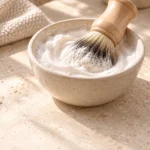
- Lather. Soap or cream with a brush, properly wet: the lather protects the skin and helps the blade glide.
- No pressure. Let the razor do the work. An extra pass is better than an extra push.
- The angle. The blade at roughly thirty degrees to the skin. This is where one hand over another teaches more than any explanation.
- With the grain. The first time, one pass in the direction of growth is enough; the rest will come.
- Afterwards. Rinse, pat dry with a towel and, if needed, an alcohol-free balm: no repeat of the sting Larsen still remembers.
If the razor is Grandad’s, check it first. A safety razor always gets a fresh blade. An old straight razor needs a close look, edge and rust included, and if necessary a proper honing by someone who knows how, before it goes anywhere near a face. For a beginner, a safety razor remains the calmer choice.
A small freedom
In his Autobiography, Benjamin Franklin remarks that happiness comes less from great strokes of fortune than from small advantages that occur every day: teach a young man to shave himself and keep his razor in order, he writes, and you may contribute more to his happiness than by giving him a thousand guineas. We explored this in “Learning to Shave Yourself: Benjamin Franklin“.
A razor handed down, like other things that last, carries something of whoever used it. But what is really passed on is time: ten minutes in which nobody hurries, a hand that guides and then lets go. From that day on, the young man will shave by himself. It will not be the solitude of someone who never had anyone beside him.
For general information, not medical advice: if acne or irritation makes shaving painful, or if a problem persists, see a dermatologist.
Sources and further reading
- Anders Larsen, Sharp Practice: The Real Man’s Guide to Shaving, 2006 (Corgi, 2007), introduction and conclusion (Library B002).
- Michael Ham, Leisureguy’s Guide to Gourmet Shaving, 4th ed., 2010, “Who I am and why this book” (Library B001).
- Kurt Chandler, Shaving Lessons: A Memoir of Father and Son, Chronicle Books, 2000, ch. 3 (Library B045).
- Suetonius, Lives of the Caesars, Caligula 10 and Nero 12: lexundria.com
- Christopher Degelmann, “Depositio barbae – Das kaiserzeitliche Bartfest als Initiationsritus”, Usuteaduslik Ajakiri 72 (1), 2018, pp. 93–122: ojs.utlib.ee
- Benjamin Franklin, Autobiography, part III (Project Gutenberg): gutenberg.org



 English
 Français
 Italiano