

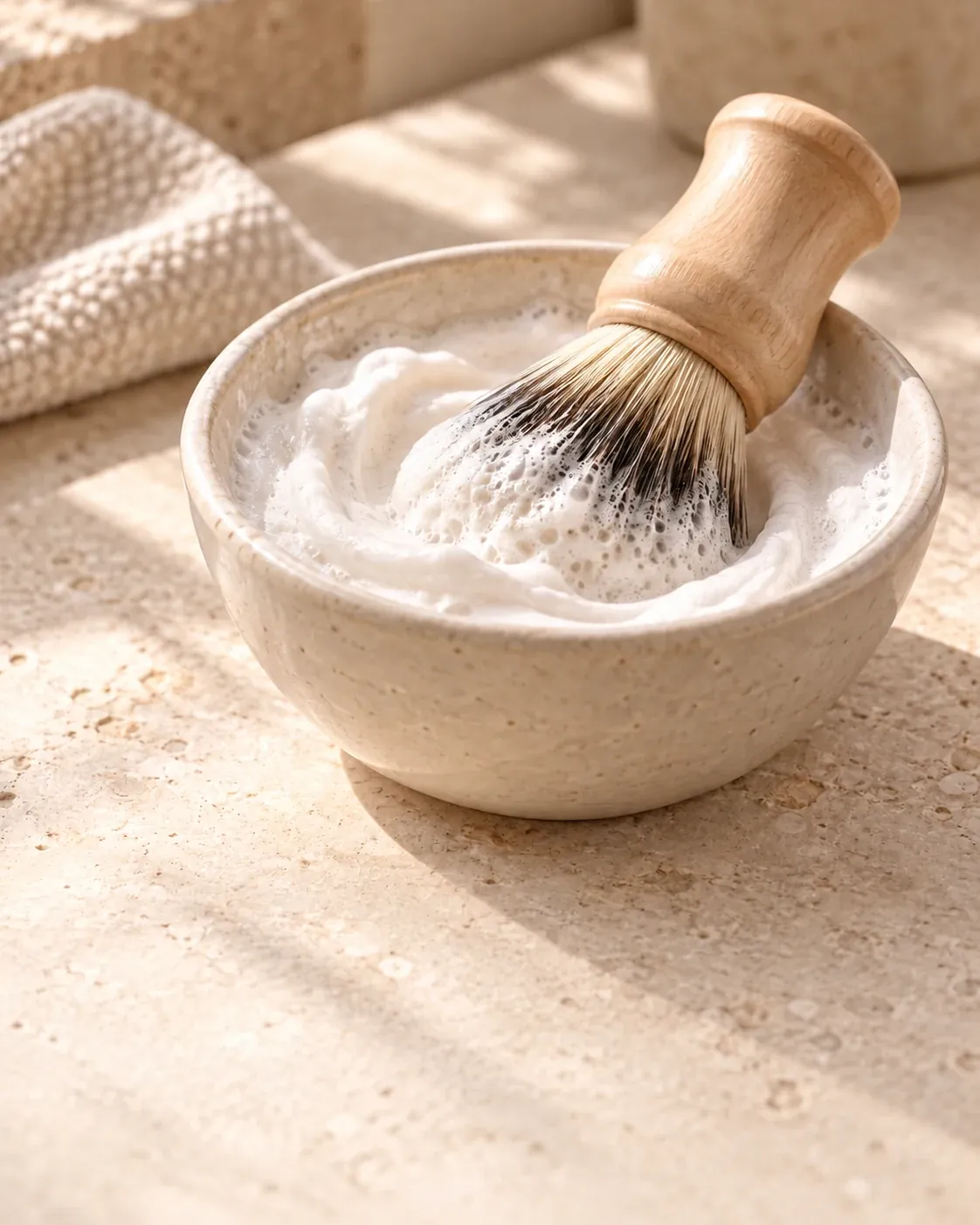
In traditional shaving, lather is neither a mere decorative element nor a soft cosmetic covering. From a hydrodynamic and dermatological perspective, the lather produced by an artisan shaving soap or a quality cream is a complex micro-emulsion of water, saponified lipids and air.
Its fundamental role is threefold:
- Keep the hair’s keratin hydrated throughout the shave, which greatly reduces the blade’s cutting effort compared with dry hair.
- Create a protective cushion that distributes razor pressure and prevents direct contact between the steel and the skin’s microscopic raised areas.
- Provide maximum slickness and residual slickness, allowing the edge to glide without snagging or pulling.
Understanding how to balance water and soap, avoiding the trap of “air bubbles”, and knowing how to choose between bowl lathering and face lathering is the real dividing line between a mediocre shave and complete comfort.
1. The Chemistry of Loading: Load the Brush Knot, Not the Tub
The most common mistake among beginners is trying to build lather directly inside the soap container by pouring in plenty of water. This approach unnecessarily dilutes the puck and produces a watery lather full of large air bubbles.
The correct procedure for loading the brush requires a separate action:
- Damp brush, not dripping: Gently squeeze or shake the knot, whether boar, badger or synthetic, so that it remains damp without being saturated with absorbed water.
- Avoid unnecessary “blooming”: Covering the surface of modern artisan soaps with hot water beforehand (blooming) is entirely unnecessary and counterproductive, because modern formulations are already sufficiently soft. Leaving standing water on the soap only risks wasting product and changing its pH over time.
- Mechanical loading action: Work the knot directly on the soap with firm pressure and circular movements for about 20–30 seconds.
- Aim for paste, not lather: At the end of loading, the brush tips should be coated with a thick, matte, concentrated paste, similar to a moisturising cream, with no visible bubbles.
2. Bowl Lathering: Geometric Control of Hydration
Bowl lathering involves transferring the brush loaded with paste into a bowl, made of ceramic, wood or steel, or featuring internal ridges, to develop the emulsion by gradually adding water.
| Bowl lathering | What to do |
|---|---|
| Water | Add it drop by drop |
| Brush | Circular movements and “pumping” on the paste |
| Goal | A Greek yoghurt consistency |
Advantages of Bowl Lathering:
- Precise water control: It allows you to add water drop by drop or in very small amounts, watching the emulsion change and avoiding going beyond its optimum balance (sweet spot).
- Visual and tactile assessment: It develops the shaver’s skill by allowing the sheen of the lather to be assessed before applying it to the face.
- Heat retention (Scuttle): When using a double-walled bowl filled with hot water (a scuttle), the soap in the bowl stays pleasantly warm throughout all passes of the shave.
Disadvantages:
It requires an additional accessory on the bathroom counter and does not provide direct mechanical massage of the skin during the initial lather-building stage.
3. Face Lathering: Follicular Massage and Exfoliation
Face lathering is the preferred traditional technique of many enthusiasts and barbers. The concentrated paste loaded onto the brush is transferred to, and worked into lather directly on, previously wetted facial skin.
Advantages of Face Lathering:
- Mechanical lifting of the hairs: The rotating action of the bristles, especially with boar brushes or brushes with considerable backbone, works the hair at its root, lifting flattened fibres and clearing shedding corneocytes from the follicular openings.
- Time savings and immediacy: It eliminates the need for a bowl, streamlining the routine and making it ideal for everyday use or travel.
- Direct tactile feedback: Facial skin immediately senses the transition from friction or sticking to perfect slickness as soon as the correct hydration is reached.
Disadvantages:
If a very stiff or coarse brush is used on highly reactive skin or skin affected by razor burn, prolonged rubbing can cause excessive exfoliation even before the razor touches the skin.
4. Scientific Water Management: the “Sweet Spot”
Lather quality is governed by a precise balance between water and soap. The more air is incorporated through frantic movements, the less protective the lather becomes:
- Dry / Under-hydrated Lather:
- Appearance: Matte, thick, forming stiff peaks like whipped cream.
- Consequences: It tends to dry on the face during the pass, clogs the razor’s channels, creates drag and causes painful pulling on the hair.
- Watery / Over-hydrated Lather:
- Appearance: Full of visible air bubbles, runny, dripping down the brush handle.
- Consequences: It provides no protective cushion, disappears within seconds and leaves the blade in direct, harsh contact with the skin.
- Perfect Lather (“Greek Yogurt Sheen”):
- Appearance: Extremely glossy, creamy, full of invisible micro-bubbles, with a consistency very similar to Greek yoghurt.
- Touch test: Take a thin layer of lather between your thumb and index finger. Your fingers should glide without any stickiness or roughness, leaving a velvety, slippery sensation.
| Under-hydrated | Sweet spot | Over-hydrated |
|---|---|---|
| Matte, dry | Glossy, Greek yoghurt consistency | Bubbly, dripping |
| Little glide | Maximum protection and slickness | No protective cushion |
Bowl or Face Lathering: Which Should You Choose?
| Comparison criterion | Bowl Lathering | Face Lathering |
|---|---|---|
| Water control | Precise, ideal for testing new soaps | Directly on the knot; requires a sensitive touch |
| Action on the skin | Gentle, applied with painting strokes | Exfoliating; lifts hairs and exfoliates |
| Heat retention | Excellent, especially with a scuttle | Moderate; lather cools on the face in a cold environment |
| Soap consumption | Standard / Slightly higher | Optimised and limited |
| Ideal user profile | Beginners, people with highly sensitive skin, lovers of bowl rituals | Barbers, those seeking deep massage and speed |
Sources
The article is based on the following works in the Shaveslow Library:
– Michael Ham, Leisureguy’s Guide to Gourmet Shaving, 4th ed., 2010 (Library B001)
– Christopher Moss, The Art of the Straight Razor Shave: A Basic Guide, 2005 (Library B022)
– Tyrone Humphries, Shaving – The Beginner’s Masterclass, 2014 (Library B003)
 English
 Français
 Italiano