

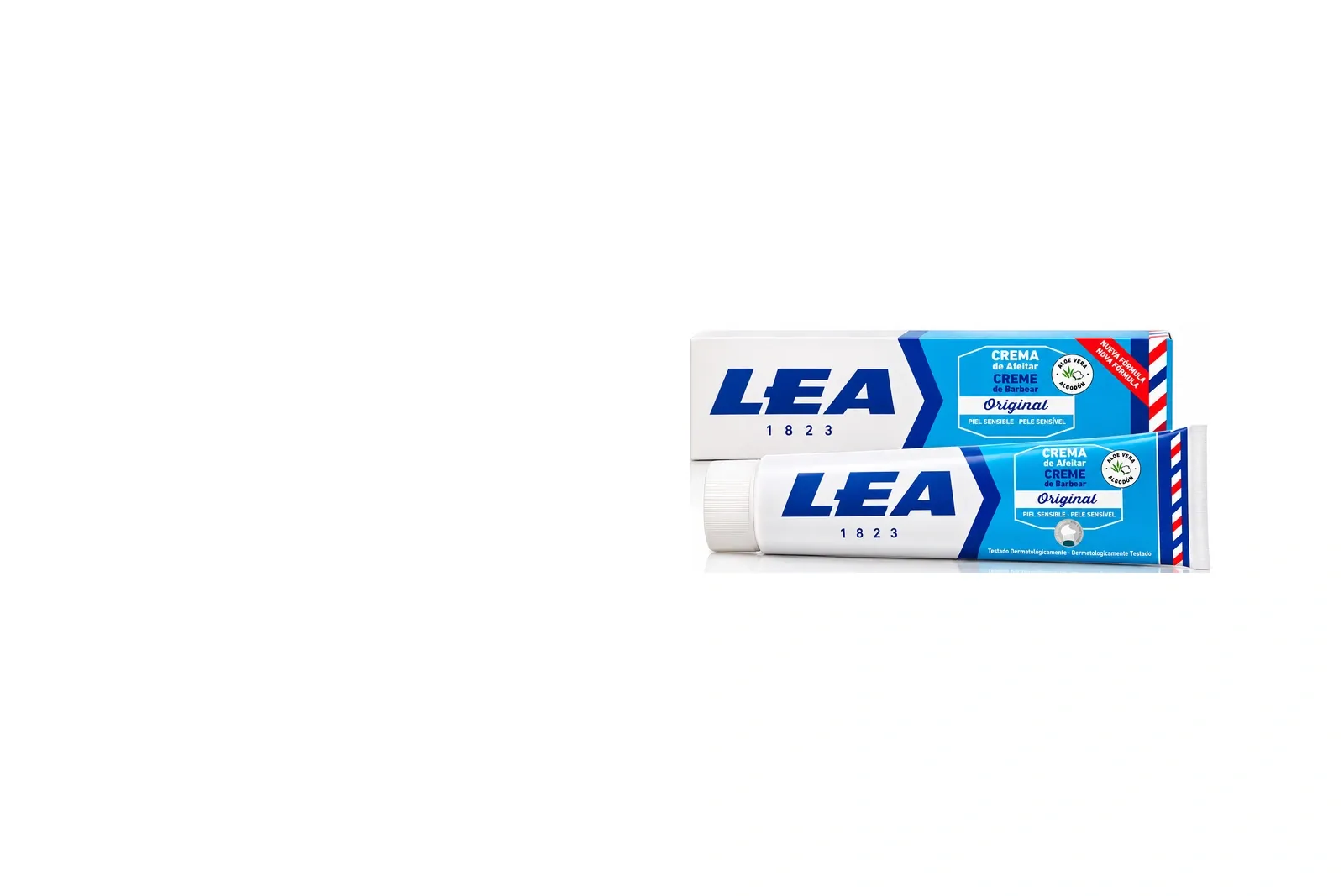
I bought it myself, online, together with the LEA aftershave balm and lotion. This review describes my first shave with the new formula of LEA Original shaving cream.
I had never used a LEA product before. I knew the brand, of course, but I had never had the chance to try its shaving creams. This time, what pushed me to buy was not the search for a particular fragrance, a sophisticated formula or a new object to add to my collection. It was a much simpler curiosity: how much can a shaving cream costing just one euro fifty actually offer?
The 100-gram tube of LEA Original is, without a doubt, the cheapest shaving cream I own. I bought it online from a Spanish retailer known for its affordable prices, together with a 30 ml aftershave balm, which cost me one euro, and a 200 ml aftershave lotion, which cost 2.25 euros.
In total, 4.75 euros for a complete routine. Even the lotion bottle is plastic. No concessions to luxury, no particularly refined packaging. Just three essential products, with an implicit promise: to do their job without asking much in return.
Of course, price alone is not enough to make a product interesting. A cheap cream that doesn’t give you a good shave is still a bad buy, however little it cost.
So I wanted to find out whether LEA Original was simply cheap, or actually good as well.
A new formula for a historic brand
LEA belongs to Lascaray, a Spanish company whose origins go back to 1823, in Vitoria. It is a brand deeply rooted in the tradition of personal care and shaving in Spain, where its products have been around for generations.
The cream I bought is LEA Original in the formula with aloe vera, allantoin and cotton extract, introduced in 2026. It should not be confused with earlier versions of the same cream, nor with LEA Classic or the menthol cream.
The manufacturer presents this formula as able to produce a richer, denser and creamier lather, helping the blade glide and keeping the skin comfortable.
Those are interesting promises, especially for such an inexpensive product. But reading what a manufacturer claims is one thing; seeing how the cream behaves in front of the mirror is another.
The preparation: when the lather takes patience
I began the shave with my usual skin preparation: a hot shower, followed by a hot towel on my face. No pre-shave product, so as not to add further variables to the experience.
To build the lather I used a bowl and my Omega 10048 boar brush, a brush I know well.
Right from the start, something did not go as I expected.
I loaded a more generous amount of cream than usual, but after the first few turns of the brush I realised it would not be enough. The lather was struggling to develop, and I had to add more product.
Then came the water. A little more, a few turns of the brush, another check of the consistency. More cream, more water. It felt like a dog chasing its own tail.
It was not simply a matter of waiting a few more seconds for the lather to build. The problem was twofold: on one hand, the initial difficulty in producing a satisfying amount of lather; on the other, the need to keep correcting the ratio of water to cream to reach the consistency I wanted.
In the end I got there, but the verdict on the preparation was already clear: more time, more water and more product than with the other creams I usually use.
It was the least convincing part of the experience.
Of course, this observation concerns my first use, with my brush and my bowl-lathering technique. I cannot rule out that a different starting amount of cream, more precise water management or another type of brush might change the result considerably.
The fact remains, however, that in my test LEA Original did not prove to be a particularly easy cream to lather.
And that is worth noting, especially when judging a product’s value for money: the price of the tube is one thing, the amount needed for each shave is another.
The shave: a good surprise at last
Once the lather was ready, my doubts began to fade.
For this test I chose a combination I know very well: my Edwin Jagger DE89, loaded with a Russian-made Astra Green blade that had already been used twice.
It is one of my most familiar combinations. A small safe territory, a kind of shaving comfort zone, where I can concentrate on the sensations without having to adapt to an unfamiliar razor or blade.
I did three passes.
The first surprise was the glide. The razor moved over the skin naturally, and I never felt the need to apply pressure. The lather, which had made me work so hard while building it, finally seemed to have found its balance.
Its staying power convinced me too. I never had the feeling it was drying quickly on my face. On the contrary, during the passes it stayed moist enough to support the blade without giving me any trouble.
It was a rather curious contrast: a cream that is laborious to prepare, but pleasant to use.
I don’t want to give LEA Original all the credit for the good glide. The DE89 is a razor I know inside out, and the Astra Green is a blade I get on particularly well with. The result inevitably comes from the interplay of lather, razor, blade, skin preparation and technique.
Still, precisely because I know this combination so well, I can say that during the shave the cream gave me no negative sensation at all.
And after such laborious lathering, that was not a given.
The scent: clean, discreet, almost invisible
If there is one aspect of LEA Original that surprised me as much as the lathering, it was the fragrance. Or rather, its almost total discretion.
During the preparation and the shave, the scent was barely noticeable. No particularly recognisable notes, no development that caught my attention.
After rinsing, I simply had the feeling of having washed my face with a good soap.
A clean, pleasant, reassuring feeling. But nothing more.
LEA officially describes the cream’s fragrance as citrus and woody. In my experience, however, these nuances did not come through clearly enough for me to pick them out. What I perceived was mostly a very light scent of fresh soap.
I don’t necessarily see this as a flaw. An unobtrusive fragrance can be an advantage for those who prefer discreet products, or who want to wear an aftershave or their own fragrance afterwards without the scents overlapping.
For me, though, the olfactory side is part of the pleasure of traditional shaving. I like a cream to contribute to the atmosphere of the ritual, to have a recognisable personality, to leave a sensory trace, at least for a few minutes.
From that point of view, LEA Original struck me as rather anonymous.
After the shave: no discomfort, but careful with the credit
After the third pass and a few touch-ups, I rinsed my face and finished with a small amount of LEA aftershave balm, followed by a generous application of the same brand’s lotion.
Both products gave me an immediate feeling of freshness, which I put down to their menthol component. A pleasant effect, but a fairly short-lived one.
The fragrance also echoed that of the cream, with slightly more intensity. The same fresh, soapy character, without any particular complexity. After a short while this scent faded too, leaving my face dry and lightly scented with clean.
The most important thing, though, was something else: no redness, no stinging, no particular discomfort.
A comfortable shave from start to finish.
It would not be rigorous, however, to credit this result to the cream alone. The DE89 and the Astra Green are a particularly reliable combination for my skin. And the balm and lotion applied afterwards bring in other elements that may have contributed to the final feeling.
So I can describe what happened, but I cannot claim to prove that LEA Original is responsible for the absence of irritation.
What I do know is that, in this first shave, it gave me no problems.
Inside the tube: what the formula tells us
The composition of the new LEA Original deserves a closer look, not least because its low price might lead you to think it was formulated without much care.
The ingredient list printed on the box of my tube is as follows:
- Aqua
- Palmitic Acid
- Stearic Acid
- Potassium Hydroxide
- Glycerin
- Lauric Acid
- Myristic Acid
- Sodium Hydroxide
- Parfum
- Allantoin
- Aloe Barbadensis Leaf Juice
- Gossypium Herbaceum Seed Extract
- Lactic Acid
- Oleic Acid
- Hydroxyacetophenone
- Linoleic Acid
- Potassium Sorbate
- Sodium Benzoate
- Citric Acid
- Tetramethyl Acetyloctahydronaphthalenes
- Hexamethylindanopyran
- Linalool
- Limonene
- Acetyl Cedrene
- Linalyl Acetate
In fact, its INCI list has a structure that is entirely familiar for a traditional shaving cream.
Among the first ingredients we find water, palmitic acid, stearic acid, potassium hydroxide, glycerin, lauric acid and myristic acid.
The fatty acids, combined with the alkaline agents in the formula, form the basis of the soap system responsible for producing the lather. Using several types of fatty acid allows the formulator to work on characteristics such as consistency, lathering ability and behaviour in use.
Glycerin acts as a humectant: it helps retain water in the formula and can contribute to a feeling of comfort during application.
We also find allantoin, aloe vera juice and cottonseed extract.
Allantoin is a cosmetic ingredient also used in products for sensitive skin. Aloe vera is often used in moisturising and soothing formulas, while cotton extract is used as a skin-conditioning ingredient.
Their presence is interesting, but one should not draw too many conclusions from it. The INCI list does not show the exact concentrations of the ingredients and does not, on its own, tell us how much each one contributes to the performance of the finished product.
Moreover, a cream containing ingredients commonly associated with skin comfort is not automatically suitable for every skin.
The formula also includes a fragrance component, with declared aromatic substances such as linalool, limonene, acetyl cedrene and other compounds. Some fragrance ingredients can cause reactions in sensitised people.
The marketing claim that the product is suitable for sensitive skin should therefore be read as a characteristic stated by the manufacturer, not as a universal guarantee of tolerance.
As for the behaviour of the lather, the composition helps us understand its general structure, but it is not enough to explain with certainty the lathering difficulties I encountered. That would require comparative tests, with controlled amounts of product and water.
What do other users think?
The new LEA Original formula was discussed in May 2026 on the specialist Spanish forum Sin Corte No Hay Gloria.
One user who tried it with a synthetic brush reported an improvement over the previous version, especially in glide, the feeling of hydration and the lather’s ability not to dry out quickly.
That last observation matches my experience: once the lather was ready, I too found it stable enough and pleasant during the shave.
The most obvious difference concerns lathering. In my test with the Omega 10048 boar brush, the preparation was decidedly less straightforward.
This is not necessarily a contradiction. Different brushes, amounts of cream, water hardness and lathering techniques can all affect the result. Besides, individual accounts are not standardised tests.
Older reviews of LEA Original show that the brand has enjoyed a good reputation among traditional shaving enthusiasts, especially given its price. It should be remembered, though, that those reviews concern earlier formulas and cannot automatically be applied to the current product.
That is precisely why I think it is important to judge the cream I actually used, without letting myself be swayed too much by the brand’s reputation.
One euro fifty: does the price change the verdict?
Which inevitably brings us to the question of money.
I paid 1.50 euros for a 100-gram tube. That is 15 euros per kilogram, excluding shipping.
At that price, LEA Original is undeniably affordable. But the real value of a shaving cream is not measured by its price per gram alone.
During my first test I used more product than usual. I did not weigh the amount I used, so I cannot work out the actual cost of each shave. It would be wrong to invent a number of possible uses on the basis of a single experience.
Even so, the purchase price remains particularly low.
The point, however, is a different one: I would not want the price to become an automatic excuse for any of the product’s limits.
LEA Original should not be judged leniently just because it costs little. It should be judged on what it offers.
And what it offers, at least in this first test, is a pleasant shave, good glide, a lather that does not tend to dry out quickly and a comfortable end result.
In return, it asks for some patience during preparation and gives up almost entirely on that olfactory dimension which, personally, I consider part of the pleasure of shaving.
That is not nothing, but it is not everything either.
Shaveslow Verdict
LEA Original did not give me an unforgettable shave.
I won’t remember its scent for long, because I barely noticed it. I won’t keep a particularly fond memory of the lathering, because I had to work harder than expected to get the lather I wanted.
And yet, when I put the razor to my skin, the cream did what it had to do.
It supported the blade well, never gave me the feeling it was drying out, and let me complete three passes without difficulty. The routine ended without redness or stinging, even though I cannot attribute that result to the cream alone.
It is a shave I would call dignified. The kind you can picture in your daily routine, when you are not necessarily looking for a special experience, but simply for the pleasure of a good shave.
Would I buy it again? After a single test, I don’t have a definitive answer yet. Above all, I would like to see whether, by learning to dose water and product better, I can make the lathering easier and less wasteful.
For now, LEA Original leaves me with a clear impression: it is not the cream I would choose to turn a shave into a small sensory event, but it is a cream that has shown it can do its job honestly.
And for one euro fifty, that is already a respectable result.
Perhaps this is its most interesting quality: it reminds us that a good shave does not necessarily need an expensive product.
But also that the lowest price does not always mean the best experience.
Sources
The following sources were consulted to check the information on the product, its formula and independent accounts. My impressions of the shave come solely from my own personal test.
- LEA / Lascaray — Crema de Afeitar con Brocha LEA Original. Official manufacturer product page. Description of the formula, highlighted ingredients, stated characteristics and fragrance. https://productoslea.com/productos/hombre/afeitado/jabones-y-cremas/crema-de-afeitar-con-brocha-lea-original/
- LEA / Lascaray — 2026 product catalogue. Official documentation on the company’s history, the range and the formats sold. https://productoslea.com/wp-content/uploads/2026/03/Catalogo_OK_2026_16_MAR_HR.pdf
- Sin Corte No Hay Gloria — «Lea ha cambiado composición de su Crema de afeitar Original». Thread started on 22 May 2026. It reports the INCI list of the formula with aloe vera and cotton extract and users’ accounts of the new version. https://sincortenohaygloria.com/t/lea-ha-cambiado-composicion-de-su-crema-de-afeitar-original/114967
- Sin Corte No Hay Gloria — «Revisión: Lea (Crema)». Review published on 19 January 2016. Historical reference concerning an earlier formula, used only to put the product’s evolution in context. https://sincortenohaygloria.com/t/revision-lea-crema/1072
Methodological note: the functional characteristics of the ingredients are interpreted according to their common cosmetic functions. No independent clinical studies demonstrating the specific performance of the 2026 LEA Original formula were found. The manufacturer’s marketing claims and users’ accounts should not be confused with the results of controlled experiments.

 English
 Français
 Italiano