
MyShaveTherapy
There are moments when slowing down is not a choice. It is the only way to begin again.
I have spent most of my working life in hands-on marketing and communications, and I have been fortunate enough to do a job I genuinely loved. A job made of ideas, people, images, words, projects and deadlines, where I learned very early just how much the smallest details can matter — especially the ones that seem insignificant. A typeface. A shade of colour. A word. The exact moment to communicate something. A gesture. A feeling. I have always believed that details are what make the difference, at work as much as in life.
I have also always worked a lot. Too much, probably. For years I lived at a speed that felt perfectly natural to me: thousands of kilometres every month, one client after another, one assignment after another, while my mind kept running, planning, anticipating and solving. Then I discovered that there is a speed at which the brain can continue to race while the body simply can no longer keep up.
And then came burnout.
When everything stopped
From that moment on, I had to begin redesigning my life. Not only the big things, but also — and perhaps above all — the smallest ones. I had gone from driving thousands of kilometres every month, moving constantly from one appointment to the next, to gradually finding myself unable even to make it to the barber around the corner.
Panic attacks would appear precisely when I tried to move beyond my comfort zone. In the meantime, burnout had given way to severe depression and a diagnosis of agoraphobia.The paradox was almost perfect. I had made communication my profession, and now I was doing everything I could to avoid contact with other human beings. Looking back, there is something vaguely reminiscent of Dante’s law of contrapasso in all this. Dante might at least have appreciated the irony. The rest, of course, was considerably less amusing.
One of the most insidious consequences of depression was apathy. It does not necessarily arrive with some dramatic gesture. It slips quietly into everyday life.
I’ll do it later.
I’ll do it tomorrow.
I’ll do it sometime.
Time passes, things remain undone, and even what once excited you gradually begins to lose its meaning. My days started to resemble one another. Sometimes I would catch myself counting the hours until the following day, knowing that I would probably spend yet another sleepless night.
Something had to be found.
Together with the psychiatrist who follows me, we began thinking about introducing a regular activity into my routine. She never prescribed shaving, of course, and there was no such thing as Shave Therapy yet. We were simply looking for something with certain characteristics: an activity capable of holding my attention for at least twenty or thirty minutes; something that would force me, for once, to put myself first; something that allowed room for creativity, choice, satisfaction and a tangible result.
Preferably, even pleasure.
But what?
Meeting the shavette
One day, while casually scrolling through Amazon, I came across a shavette.
In truth, the object had fascinated me for as long as I could remember. When I was a child, my father would take me with him to the barber, and I would watch, mesmerised, as the barber handled an instrument that seemed almost magical to me: elegant and threatening at the same time. In his hands it glided across the face with effortless precision. In the wrong hands, it looked perfectly capable of turning a simple shave into a minor crime scene.
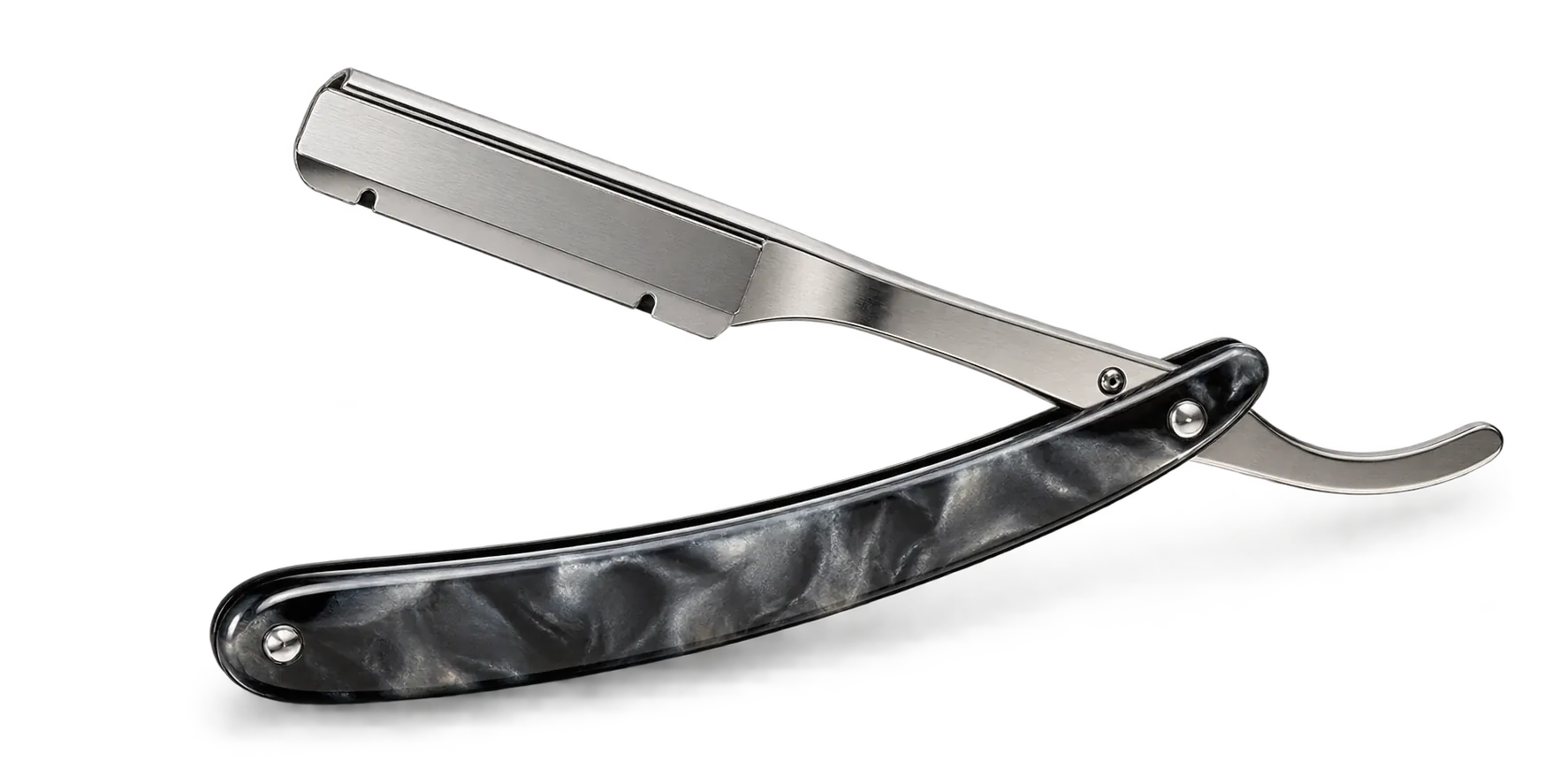
So I ordered one.
I was fully aware that, given the state I was in, even imagining that I might learn how to use it bordered on the absurd. But since finding the right activity already seemed difficult enough, I might as well begin at an advanced level.
Otherwise, what kind of challenge would it be?
When it arrived, I spent a few days simply looking at it, almost with reverence. Eventually, I decided to try.
My first shave was a bloodbath.
(For once, the expression is not metaphorical.)
Until then I had been using an electric razor.
For years I had almost permanently worn what people call “three-day stubble”, so my last real experience of traditional shaving dated back essentially to my teenage years: foam, disposable razor, done.
My first encounter with the shavette was therefore, technically speaking, fairly questionable.
And yet I was thrilled.
I had completed the task. I felt satisfied. But most importantly, something had happened that I had not expected.
About forty minutes had passed.
Forty minutes.
Forty minutes during which I had remained focused in a way I had not experienced for a very long time. I had been forced to observe, decide, correct, control the movement of my hand, the angle of the blade, the pressure, the exact place where it was touching my skin.
For forty minutes, there had been very little room for anything else.
The thoughts that had become my constant companions had stayed outside.
I was not cured. I had defeated nothing. But for forty minutes, time had worked differently.
And those forty minutes were mine.
From a gesture to a ritual
Gotthold Ephraim Lessing once expressed the idea that anticipating a pleasure is itself a pleasure. I find it difficult to imagine a thought that better describes what happened next.
Little by little, shaving stopped being merely the time I spent in front of the mirror. The ritual began to expand until, quite often, it started the day before.I begin mentally assembling the set I will use. A coordinated kit or a mix? Will this pre-shave fragrance work with that soap? Which aftershave? Which razor? Which blade?
Simply thinking about it already changes something. I begin to look forward to the moment.
There is something waiting for me tomorrow.
And for someone who has lived through periods when tomorrow seemed like nothing more than a repetition of today, that is not necessarily a small thing.
The Ritual
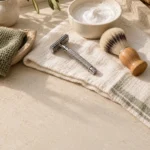
When the moment arrives, I warm pristine white towels.
The brush is already soaking while I apply the pre-shave, then I place the warm towel over my face and close my eyes.
For a few minutes, the world stays outside.
About ten minutes later, I open the soap, add a little water from the brush and begin to work it. I prefer bowl lathering because I enjoy watching the texture change, seeing the water gradually incorporate and the lather take shape.
And then, of course, there is the fragrance.
I like to give myself a few seconds simply to smell it properly before doing anything else.
The brush moves around the bowl. The consistency changes. The lather develops.
And time seems suspended.
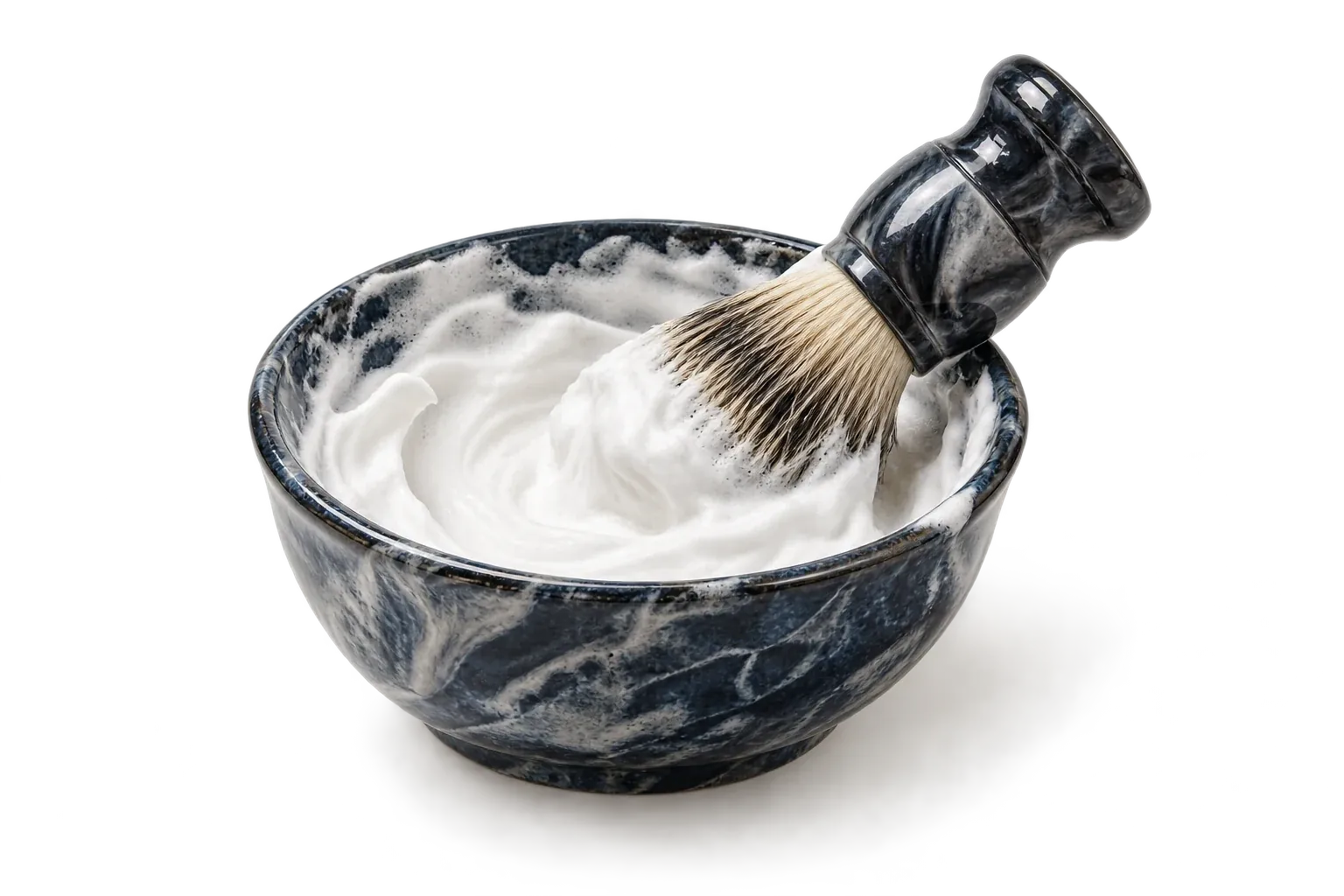
Then the foam reaches my face, applied with precise, repeated circular movements.
Bristles alternate with fingertips. Eventually comes the razor, and with it a different level of attention.
I am still learning the map of my face.
Perhaps I never really will finish learning it, and that too is part of the pleasure.
Every shave depends on the razor, the blade, the pressure, the angle, the direction of hair growth and the condition of my skin. But it also depends on my mood and on how I happen to feel that particular day.
Memory from previous shaves has begun to guide my movements, but I cannot surrender completely to automation. A shavette does not forgive distraction. Neither does a safety razor when handled badly.
Every misjudgement receives an immediate and rather severe verdict.
Searching for the right balance is part of the challenge.
With the grain and across the grain. On better days, with the grain and against the grain.
Then comes the rinse, a careful inspection, any small corrections that may be needed, and finally the aftershave, often coordinated with the soap. Over time, I have discovered that continuity and harmony reassure me.
And then comes the mirror.A clean face. Smooth. Neat.
A small result that can be seen, touched and felt.
Not every day, however, is the same.
For a while, the shavette represented the highest level of the challenge, the final boss waiting at the end of the video game. But my performance inevitably depends on the day.
Sometimes I can handle everything naturally. At other times, even changing a blade feels difficult.
I did not want to lose the ritual precisely on the days when I felt I needed it most, so I bought a safety razor, initially just to try it.
It worked.
I could keep shaving regularly even when I did not feel alert or confident enough to use the shavette. That was when I realised that the real challenge was not to use the most difficult tool every time. It was to avoid turning pleasure into obligation, and to keep going by adapting the ritual to the day.
Depression 0 – Armando 2.
It may not be the final score of the match, but two points are still two points.
Alchemy and writing
Then came the soaps, pre-shaves, aftershaves, blades, brushes and other razors.Almost without realising it, I had started doing something I knew extremely well: paying attention to details.
The details that had characterised my work and much of my life had not disappeared. They had simply changed scale. Now they could be contained in a bowl, in a blade, in a fragrance, or in the amount of water required to build the right lather.I could assemble my set almost like an alchemist: choosing, combining, measuring, correcting, working with shapes and geometries. Sight, smell, touch and sound could all participate in the same moment.
And when it was over, I could look at myself in the mirror and recognise a result I had created myself.
Each time, thirty or forty minutes reclaimed from the negative side of the day.
Sometimes the positive feeling lasted an hour. Sometimes it stayed with me for much of the day.
It hardly matters.
When too many days seem exactly the same, even a small interval that feels different can become a significant victory.
This, quite simply, became my Shave Therapy.
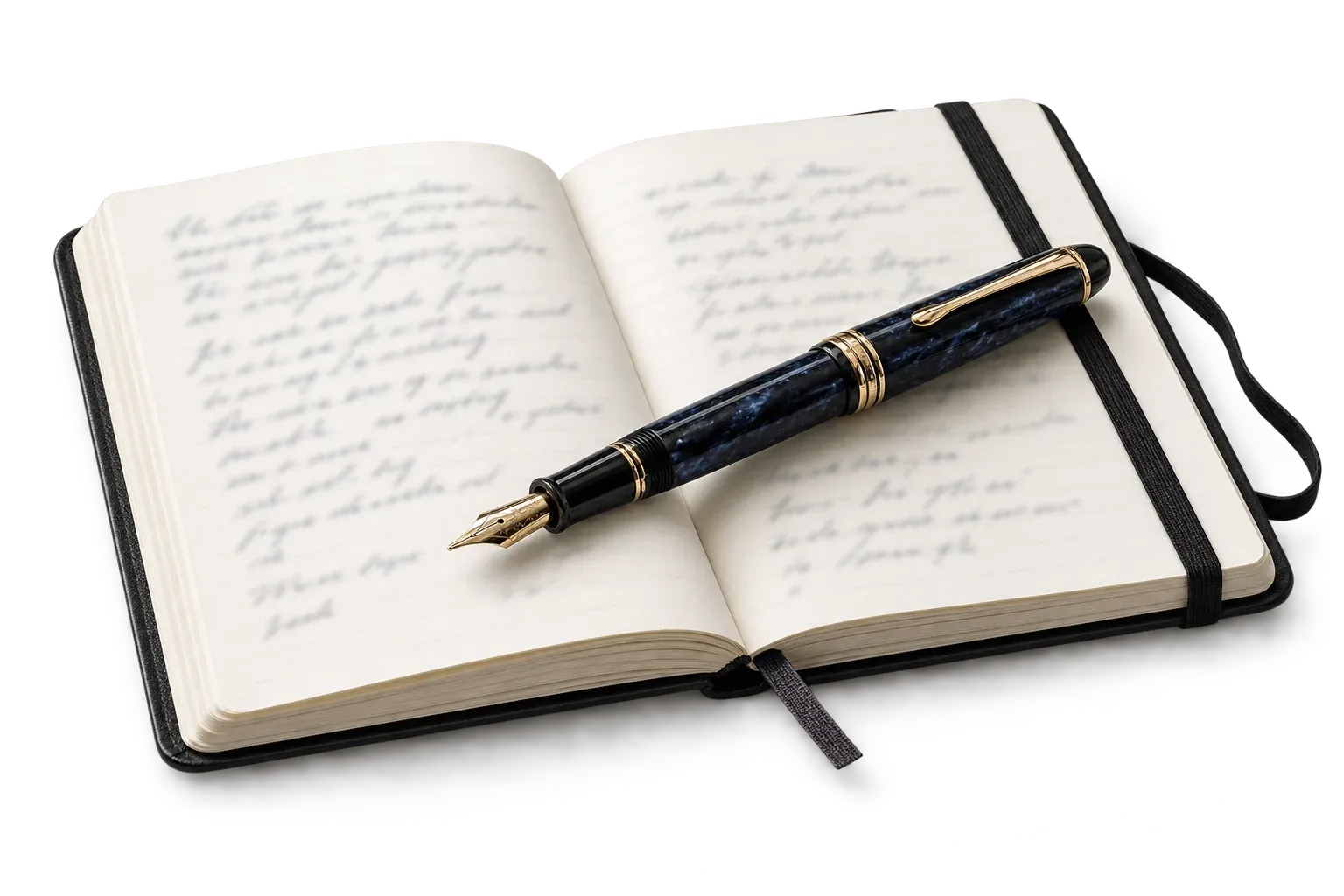
But the ritual does not end in front of the mirror, because at some point shaving met another old passion of mine: writing.
I have always loved handwriting, and I collect fountain pens.
My life is scattered with black Moleskine notebooks filled with the most unlikely things. They are not really diaries, but exercises, sentences, thoughts, handwriting practice and sometimes whole pages written for no reason other than the pleasure of feeling a new pen move across paper.
For years, I often wrote mainly for the mechanical pleasure of writing, beautiful packaging that sometimes lacked content.
Shaving changed that too.
After the Ritual
After the ritual, I began writing down what had happened, initially just for myself. Then, almost spontaneously, the accounts became more and more detailed: the razor, the blade, the soap, the sensations, the fragrances, the mistakes, the satisfaction, the day, my mood.
I realised that writing had become the final stage of the shave, the stage that allowed me to extend it.
The aftershave was still on my skin. Its fragrance still reminded me of what I had just experienced.
And I turned it into words.
To prolong the pleasure.
And perhaps to prolong my Shave Therapy a little too.
No scores.
That is also why I have no real interest in deciding whether a soap deserves a 6, a 7 or an 8.5.
I would not even know how to do it and, more importantly, it is simply not in my nature.
I can tell you whether I liked it. How it behaved. What I perceived. Which razor I used with it. What happened that particular time.
I can change my mind.
I can try it again.
I can discover that something that failed to convince me yesterday works beautifully tomorrow.
What I can offer is my experience.
Not an absolute judgement.
Price, brand reputation and other people’s opinions can all be useful information, but I do not want them deciding on behalf of my skin, my nose or my sensations.
From the notebook to Shaveslow
At some point, I began to think that those pages did not necessarily have to remain closed inside my Moleskines.
Perhaps they could be shared.
With someone simply looking for information about a product.
With someone discovering traditional shaving for the first time.
With someone who has been doing it for a lifetime and enjoys comparing experiences.
With anyone who simply loves soaps, razors, blades and brushes.
But also with someone fighting an entirely different kind of battle.
From one person living with illness to another.
No recipes. No promises. And certainly no “It worked for me, so it will work for you.”
I do not know.
What I do know is that, during that half hour, I feel better.
Sometimes that feeling lasts an hour. Sometimes it follows me through much of the day. And for anyone familiar with periods when days seem endlessly identical, perhaps there is some value simply in knowing that somebody else has found a small opening.
Mine happens to be this one: a blade, a brush, a soap, a little water, time and attention.
That is where Shaveslow begins.
A passenger
Today, for me, it represents much more than a website about shaving.
First of all, it is a commitment I genuinely enjoy: knowing that I may eventually write about a new experience gives me one more reason to live it.
It reminds me a little of riding a motorcycle.
When you are alone, you can decide how hard to accelerate and accept whatever consequences may come with that choice. When there is a passenger behind you, something changes. You become more cautious, more attentive.
There are two of you.
And respect for the other person almost inevitably creates a little more respect for yourself.
Ideally, every person who reads a Shave Note becomes that passenger.
Not an obligation.
A presence.
Can I still…?
Shaveslow is also a creative project and, in some ways, a long question I keep asking myself.
Can I still feel excited by a project?
Can writing still move me?
Can I still imagine an image and then create it?
Can I still design, photograph and tell stories?
Am I still capable of using the tools that accompanied me throughout so much of my professional life — WordPress, Photoshop, communication, design?
But above all: can I still reach people?
Agoraphobia has progressively narrowed the world in which I am able to move.
Shaveslow does not pretend that it can expand that world with the wave of a magic wand.
But perhaps it can open a window. Remotely, at first. Through a photograph, a page, a comment, an email, or a person who reads something I have written and chooses to reply.
It is still contact.
There is still somebody on the other side.
And perhaps it is a way for me to begin communicating again.
Me, of all people.
The man who made communication his profession.
Perhaps contrapasso can be negotiated after all.
What “Therapy” means
The word Therapy is not a diagnosis, a protocol, a prescription or, above all, a promise.
Traditional shaving is not a cure for depression or agoraphobia, and Shaveslow does not suggest that it can replace medical or psychological care, psychiatric treatment, psychotherapy or prescribed medication.
I continue my own course of treatment.
Shave Therapy is simply the name I have given to something that, in my personal experience, helps me carve out a different kind of space inside days that are not always easy.
Inside that space there is anticipation and preparation, concentration and choice, fragrance and touch, precision and error, satisfaction, writing and finally sharing.
I do not know where all of this will lead.
I do not know whether I will manage to win every challenge I have set myself.
Perhaps I do not even need to.
For a long time, I postponed far too many things until tomorrow.
Today, at least every other day, there is something I look forward to tomorrow: a soap to open, a blade to try, a razor to understand, a page to write.
And for now, that already feels like a victory.
This is My Shave Therapy.
Shaveslow is where I have chosen to tell its story.


 English
 Français
 Italiano