

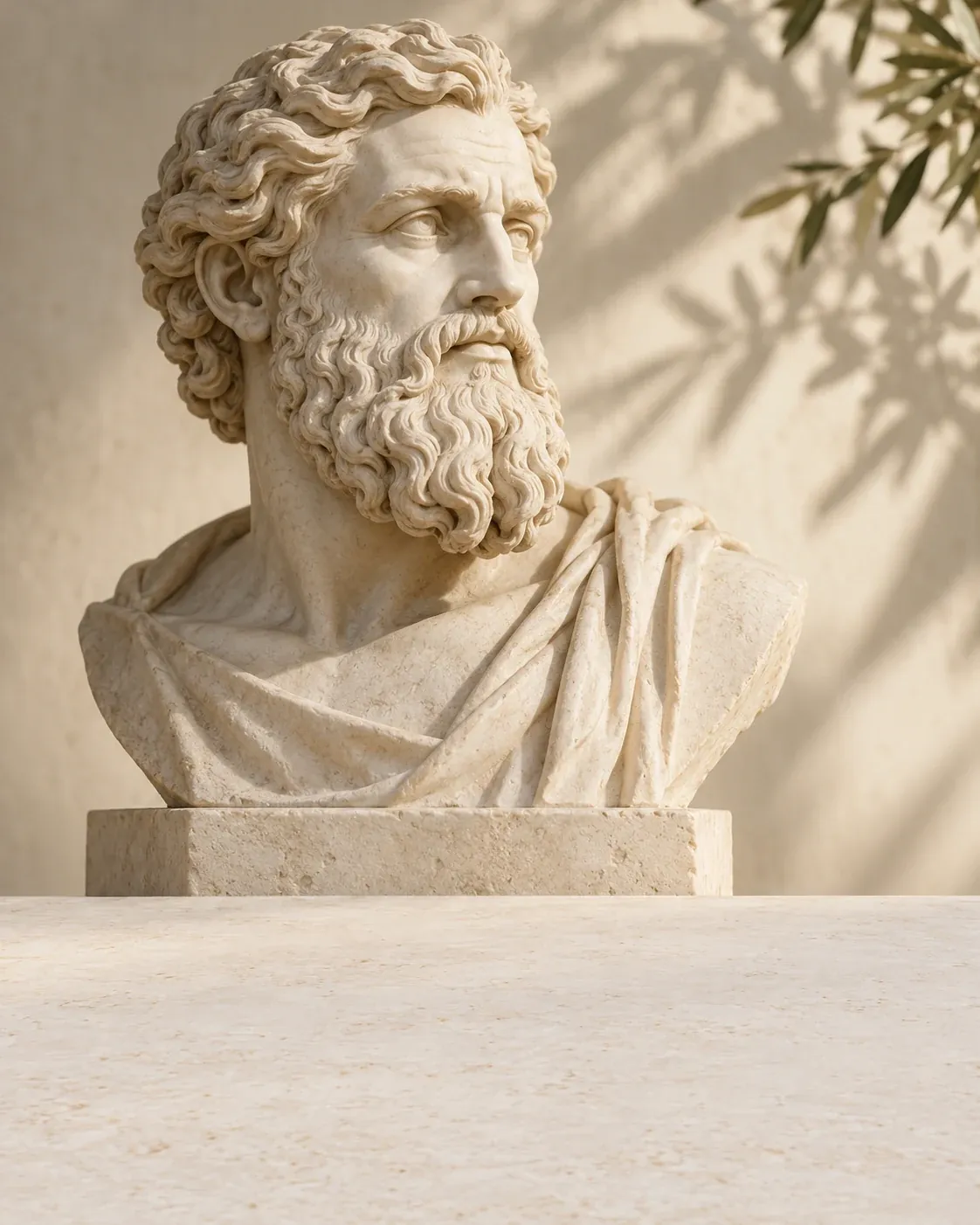
Why do we shave? For hygiene, out of habit, for work. But in Western history the question has also received spiritual answers, often opposed to one another. In his Of Beards and Men (2015), historian Christopher Oldstone-Moore follows this thread across more than two thousand years. What emerges is a useful idea for anyone who experiences shaving as a ritual: shaving, or not shaving, has always also been a way of saying who one wants to be.
The Stoics: the beard as nature
Let us begin with those who defended the beard. In first-century AD Rome, Stoic philosophers wore beards as a sign of consistency. Musonius Rufus, Epictetus’s teacher, considered it a gift of nature, a “covering” given to man as a mane is given to the lion: removing it out of vanity was a small betrayal of oneself.
In the Discourses collected by his pupil Arrian, Epictetus imagines a dialogue with a powerful man who orders him to shave. His answer: if I am a philosopher, I will not cut it off. And if the powerful man threatens to cut off his head, let him do so. For Epictetus, the beard is not fashion: it is the point at which one refuses to yield over what is within one’s control.
Oldstone-Moore recalls that Emperor Hadrian, too, grew a beard in the second century, breaking with four centuries of clean-shaven Roman faces. Historians still debate whether he did so out of admiration for Greek philosophy or for other reasons: the author cautions against overly simple explanations, such as the claim that he wanted to hide scars.
The monks: shaving to lighten the burden
In the Middle Ages, the meaning is reversed. The Latin clergy adopt the clean-shaven face and the tonsure, the shaving of part of the head. Here shaving becomes renunciation: removing something of oneself to make room for something else.
Oldstone-Moore calls this idea the “inner beard.” The visible beard is cut off, but what matters is what is cut away within: unnecessary thoughts, distractions, pride. Pope Gregory the Great (sixth century) is among the authors to whom tradition attributes this symbolic reading.
Around 1160, Abbot Burchard of Bellevaux writes the Apologia de barbis, considered the first book devoted entirely to the beard. He writes it for his monastery’s lay brothers, laymen who wore beards while the monks shaved. The text attempts to give spiritual meaning to both faces: the beard as a sign of strength and wisdom, shaving as a sign of humility and purity.
What is the meaning of shaving?
The Stoics keep their beards to remain faithful to nature. The monks remove them to remain faithful to something beyond the body. These seem like opposing positions, yet they answer the same question: what do I want to show, and what do I want to cultivate?
Oldstone-Moore’s conclusion points in this direction. Throughout the long history of the West, he writes, the beard has often signified nature and the body as the basis of authority; shaving has signified discipline, transcendence of the body and belonging to a community.
What we can do with this today
None of us shaves to enter a monastery. But the idea of the inner beard remains evocative for those who shave slowly. Every morning the blade removes something that has grown back overnight. We can do it quickly, thinking about something else. Or we can use those minutes to remove a little of the noise we carry with us as well.
This is a symbolic reading, not a prescription: those who wear beards have the same opportunities for care and attention, as Musonius and Epictetus themselves remind us. The point is not the smooth face. The point is the gesture performed with intention.
Sources
Christopher Oldstone-Moore, Of Beards and Men: The Revealing History of Facial Hair, University of Chicago Press, 2015, chapters 3 and 5 (Library B029).
Epictetus, Discourses, I, 2.
Musonius Rufus, Discourses, XXI.



 English
 Français
 Italiano