

In a society dominated by the culture of planned obsolescence and intangible digitalisation, our relationship with the material world has undergone a radical transformation. Modern consumer goods are designed to be replaced before they even wear out physically: material consumption gives way to what sociologist Hartmut Rosa calls “moral consumption”, in which objects are quickly discarded and replaced because the incessant pace of innovation makes them prematurely outdated.
The result of this speed is an unexpected form of alienation: we live surrounded by inconsequential objects, mobile phones we change every year and devices whose basic functions we do not even know, which never truly become part of our personal history. To counter this feeling of precariousness, rediscovering the presence of solid, durable objects shaped by manual work proves fundamental to finding stability and rooting our identity.
Objects as “inhabitants of the self”
When we own an object for years or decades — an old radio, a car we repair with our own hands, a fountain pen or an inherited safety razor — a profound psychological phenomenon occurs: that object stops being an anonymous commodity and enters our sensory experience. Bearing the marks of time, use and our care, it becomes a travelling companion.
As Hartmut Rosa explains, the objects we live with for a long time, and which we assume we will not want to discard until they naturally wear out, end up becoming “inhabitants of the self”, extensions of our own identity. Throwing them away does not simply mean getting rid of a piece of plastic, but damaging a fragment of our lived experience. Disposable objects, by contrast, remain fundamentally “alien” to us: we never internalise them and, consequently, they offer no emotional anchorage.
The stability of matter: the lesson of Hannah Arendt and Byung-Chul Han
In his essay The Disappearance of Rituals, philosopher Byung-Chul Han takes up Hannah Arendt’s insight into the existential function of objects: the resistance of things serves to stabilise human life.
The objectivity and stability of material artefacts lie in the fact that human beings, despite their changeable inner nature, mood swings and life’s uncertainties, can always find confirmation of themselves and their continuity by referring to “the same chair and the same table” day after day. Solid things are fixed points in space, just as rituals are fixed points in time.
When the neoliberal frenzy of industrial production destroys the durability of goods to force us into continuous consumption, it also dismantles the resistance of our own lives. A digital device such as a smartphone constantly changes its content, screens and notifications: it lacks that reassuring sameness and, instead of letting us pause, fuels permanent unease.
The “good treatment” of things and the craftsperson’s care
Rituals and artisanal care teach us an alternative way of being in the world: a gentle and respectful relationship with matter. As Richard Sennett observes in The Craftsman, the essence of mastery lies precisely in the deep personal commitment, beyond mere utility, invested in the things we make and use.
Within a ritual practice:
- Things are not consumed, but used: We do not exhaust the object for the sheer pleasure of novelty, but accompany it through time, allowing it to age gracefully.
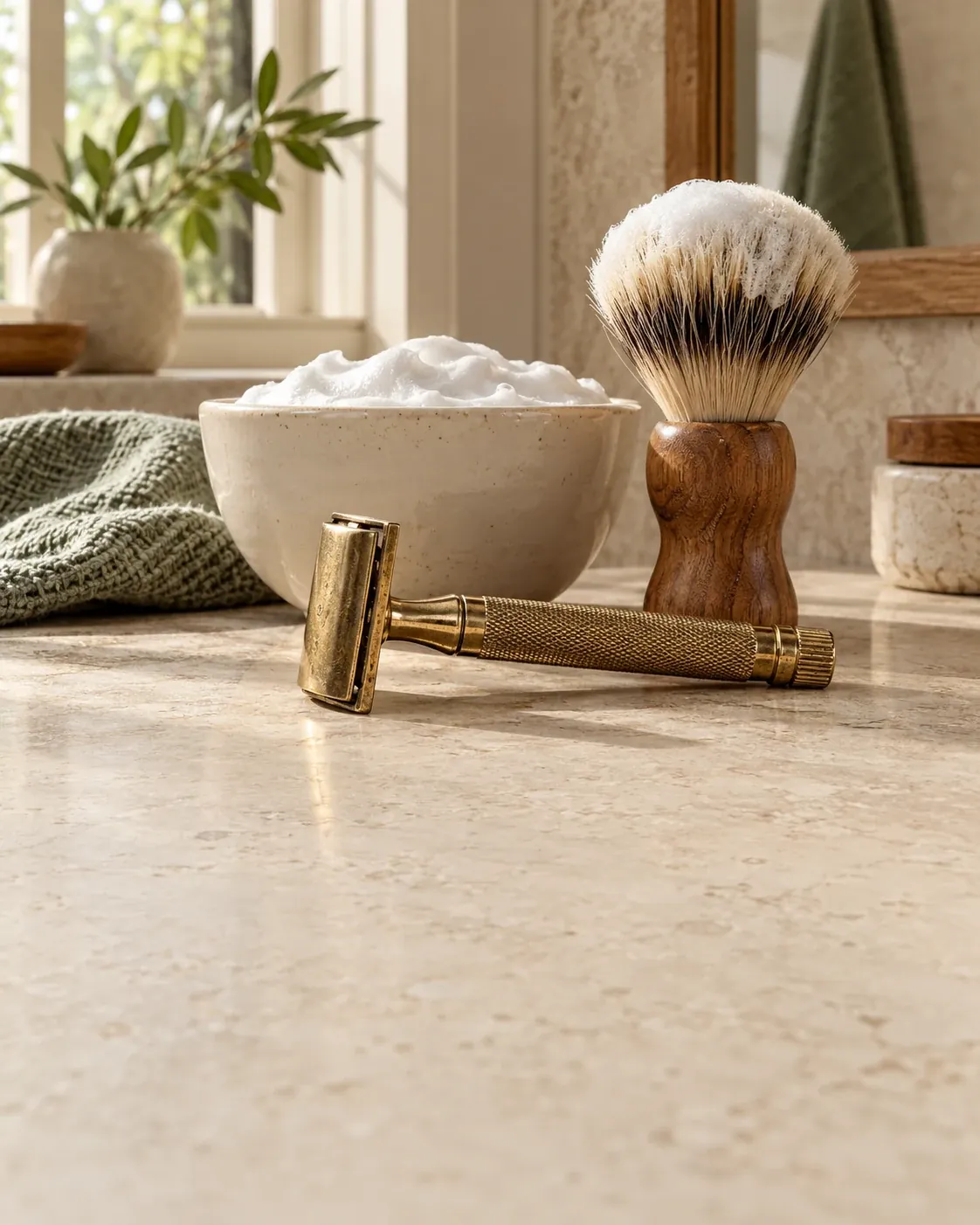
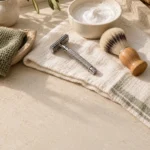
- Care generates fulfilment: Slowly cleaning a vintage razor’s brass head, drying a brush’s bristles or putting away the soap bowl creates a contemplative relationship with the physical world.
- The contentment that “gives wings to the heart”: Byung-Chul Han cites an illuminating image: just as priests learn to handle the chalice and host with extreme delicacy during the liturgy, the good treatment given to everyday objects conveys an intimate feeling of relief and order to the mind.
Why can a vintage razor become an anchor of resistance?
In this setting, choosing to shave with a brass safety razor from the 1950s, a hand-worked wooden brush or an artisan soap kept in a ceramic bowl takes on a revolutionary value. A solid brass razor that has survived decades of history contradicts the culture of disposable plastic. It is a heavy object, cold to the touch when picked up and warm after rinsing, offering the hand a concrete and reassuring resistance.
Every time we take up that tool to perform our morning gestures, we are not merely shaving a beard: we are conversing with an object that has a history, that will not expire tomorrow and that demands our respect. In a world of fleeting images and ephemeral experiences, surrounding ourselves with things that last restores a centre of gravity, reminding us that our identity is built not through accumulating what is consumed, but through caring for what is kept.
Sources
This article is based on the following works in the Shaveslow Library:
– Hartmut Rosa, Accelerazione e alienazione (Alienation and Acceleration), Einaudi, 2015 (Library B026)
– Byung-Chul Han, La scomparsa dei riti (The Disappearance of Rituals), nottetempo, 2021 (Library B023)
– Richard Sennett, L’uomo artigiano (The Craftsman), Feltrinelli, 2008 (Library B027)
 English
 Français
 Italiano