

In his essay The Craftsman, sociologist Richard Sennett argues that technical mastery is not the exclusive inheritance of medieval guilds or specialised manual work, but expresses a primary, universal human impulse: the desire to do a job well for its own sake. The craftsperson’s experience concerns not only those who build furniture or shape ceramics, but anyone who invests a deep personal commitment, beyond mere utility, in what they do.
When we turn facial care from a hurried hygienic chore into a moment of awareness, our bathroom becomes a small craft workshop.
The intimate connection between head and hand
One of the central themes of Sennett’s work concerns the historical and harmful separation of mind and body, theoretical planning and manual execution. In the craftsperson’s work, by contrast, there is a constant dialogue between hand and head: cognitive faculties and intelligence develop through bodily practice and tactile knowledge. As Immanuel Kant observed, the hand is the true “window on the mind”.
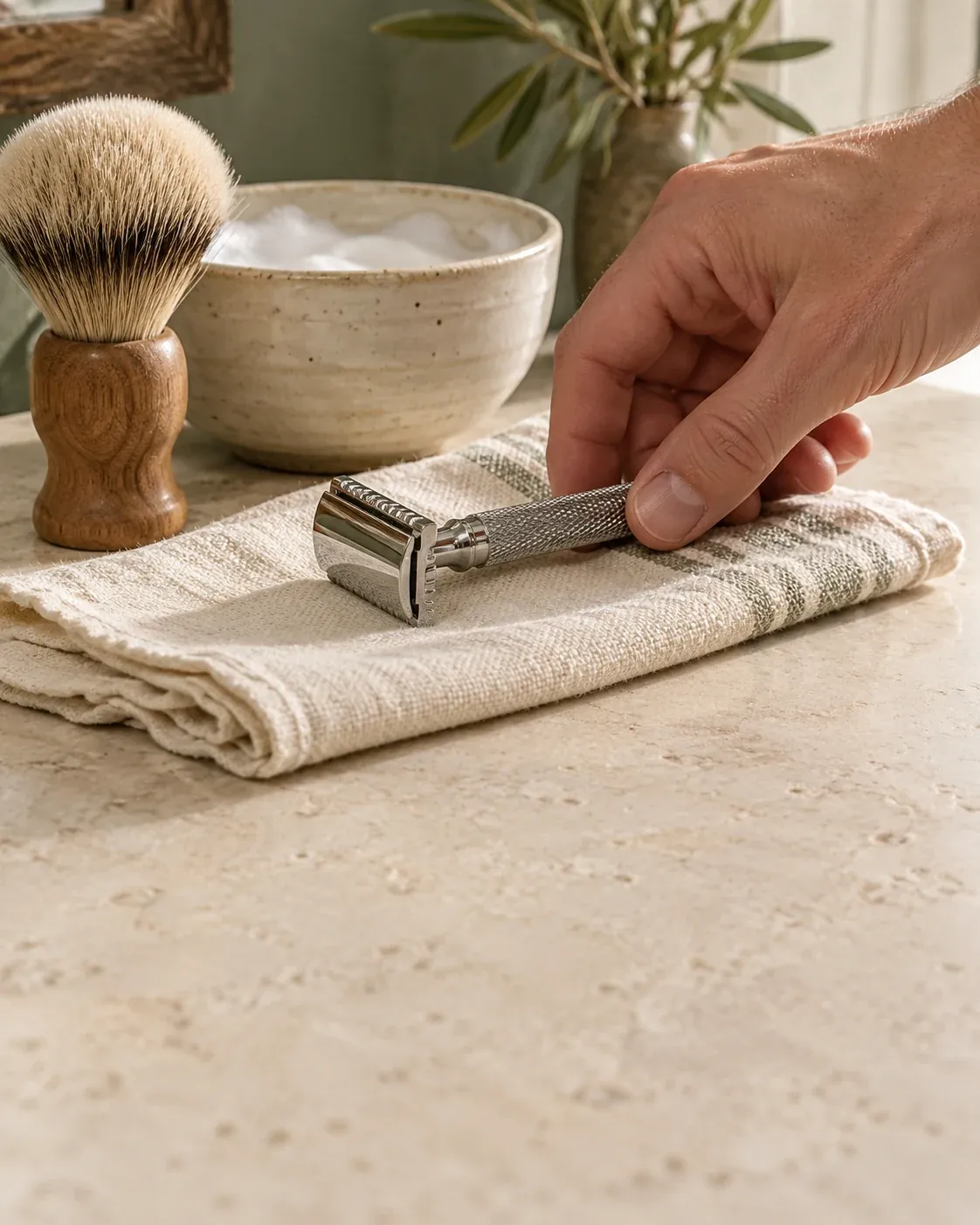
Applying this principle to shaving means rediscovering the value of tactile and bodily knowledge. The barber or enthusiast handling a razor learns to “read” skin and hair with the fingertips and the sense of position, adjusting the blade’s inclination and pressure with a control that sight alone could not guide. In traditional grooming, the hand does not lie: as master barbers observe, it is possible to lie with words or a look, but hands always show the authenticity of the gesture and the deep care invested in the material.
How does repetition go beyond the boredom of routine?
Modern education and culture often devalue repetitive learning, treating it as a mechanical routine that dulls the mind. Sennett and the psychology of perception demonstrate precisely the opposite: developing any complex skill depends on how repetition is structured.
As a skill improves, the content of what is repeated changes. Repetition is not flatness; it becomes rhythm. Rhythm arises from the combination of time, attention and experience:
- The transformation of tacit knowledge: Initially uncertain hand movements consolidate into tacit, embodied knowledge that frees the mind from superficial fears.
- The ability to sustain concentration: As technique improves, the capacity to practise without boredom grows, turning practice into a subtle, rhythmic pleasure.
- An open dialogue between problems and solutions: The craftsperson does not merely solve a static problem, but continually discovers new nuances and details in the object at hand through the gesture.
Lathering soap or guiding a razor every morning does not mean repeating a passive gesture, but refining bodily sensitivity day after day, discovering the intensity hidden in the small details of everyday life.
Tolerating imperfection to achieve mastery
As the craftsperson grows, they must also learn to manage the conflict between obsession with absolute perfection and the flexibility of practice. Seeking static, rigid perfection at all costs can paralyse action and generate frustration. By contrast, the true craftsperson learns to work with the resistance of materials, accept small inaccuracies as opportunities to learn and suspend the urge to finish the job immediately.
Those who choose traditional shaving with a safety razor or straight razor belong to the category of people who love working with their hands, appreciate solid, durable objects and are not afraid to devote time to refining a practical art. In this calm dialogue between mind, hand and tool, shaving becomes a genuine anchor in tangible reality: a moment in which a person reclaims their work, their body and their everyday dignity.
Sources
This article is based on the following works in the Shaveslow Library:
– Richard Sennett, L’uomo artigiano (The Craftsman), Feltrinelli, 2008 (Library B027)




 English
 Français
 Italiano