


There are moments in life when time seems to lose its natural fluidity. When we pass through the stagnation of depression or the overload of prolonged stress, our perception of the world changes radically: we no longer live within a story flowing towards the future, but feel ourselves plunging into what, using an image close to sociologist Hartmut Rosa’s analyses, we might call a “temporal swamp”. In this stagnation, every meaningful connection between past, present and future seems broken. Time appears to rush past outside while remaining motionless within us, leaving us feeling that we can never truly “make our own” our days and our identity.
When mental energy diminishes and the useful hours of the day become few, the temptation is to drift with the flow or regard everyday actions as a mere bureaucratic burden. Yet it is precisely here that a seemingly simple gesture such as morning shaving can become a powerful anchor of stability.
How can ritual make time a home?
Why can a manual ritual make a difference? Philosopher Byung-Chul Han explains that rituals are in time what a home is in space: symbolic techniques for making time a home, rendering it habitable and walkable. Without ritual, the time of our lives is an unsteady flow rushing forward without support; with ritual, time instead becomes a solid structure in which we can finally pause.
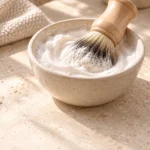
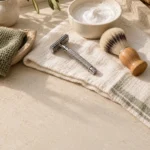
The constant, reassuring repetition of shaving gestures — wetting the face, loading the brush, building the lather, passing the blade — introduces a protected pause into the day. It works as a “closing ritual”: an enclosed interval in which we interrupt the endless accumulation of notifications, images and thoughts that saturate the mind. Through this stability, we give ourselves back a “time of our own”, reclaiming the morning from the frenzy outside.
“Lathering soap for the sake of lathering soap”: mindfulness
The secret to making shaving a true active meditation lies in how we approach it. Buddhist master Thich Nhat Hanh taught that, at the sink, we should “wash the dishes just to wash the dishes”. If, while washing the bowls, we are already thinking of the cup of tea waiting afterwards, we are fleeing into the future and becoming unable to live the only real moment that belongs to us.
Applied to the bathroom, this principle becomes a simple but revolutionary imperative: while we lather soap, lathering soap must be the most important thing in our lives. We must not hurry to get it out of the way or rush towards the next commitment. When the brush caresses the skin, when we listen to the sound of the blade cutting hair, or when we feel the warmth of hot water, we perform each act as though it were a solemn ceremony. Every calm, mindful movement brings us back into the body and stops mental scattering.
The state of Flow and the harmony of the senses
Michael Ham (Leisureguy) compares the traditional shaving ritual to the Japanese tea ceremony. Handling a safety razor requires attention, precision and corresponding control of the angle: it is a task that engages us without overwhelming us — precisely the balance between challenge and skill that, according to psychologist Mihaly Csikszentmihalyi, encourages the state of flow.
The correspondences with the tea ceremony are precise:
- A dedicated place and attire: an orderly, clean space and a contemplative attitude.
- Beautiful, functional tools: objects, often vintage or handcrafted, designed to last and pleasant to touch and see.
- The silence of mental chatter: judgements and worries stay outside while we focus on technique.
- All the senses involved: the warmth of water and cloth, the scent of soap, the sound of the blade cutting hair, the softness of the brush.
- A repeatable structure: a defined sequence of steps repeated each time, offering a sense of completion.
In a state of flow, awareness of time and the mind’s “chatter” spontaneously fall away. The concentration required by the blade on skin prevents negative thoughts from wandering elsewhere. Psychology also identifies a fascinating phenomenon connected with cognitive dissonance: taking time to care for our face with beautiful tools, warmth and pleasant fragrances sends a deep message to our subconscious: “If I am devoting so much time and energy to looking after myself, I must be worth something.” It is a daily reaffirmation of our dignity and worth.
The craftsperson’s rhythm
As sociologist Richard Sennett observes, repeating a manual routine does not produce boredom if it is experienced as a continuous search for refinement: a well-structured routine is called rhythm. In the brush’s circular movement and the razor’s controlled pass there is a rhythm made of action, pause and listening.
Traditional shaving does not claim to solve life’s problems or replace paths of treatment; it is simply a practice of personal care, a moment in which we recreate ourselves every morning in front of the mirror. It is practical proof that, even on the most difficult days, we can always claim an oasis of “good time”, showing ourselves that slowing down is the first step towards feeling life again.
Sources
This article is based on the following works in the Shaveslow Library:
– Hartmut Rosa, Accelerazione e alienazione (Alienation and Acceleration), Einaudi, 2015 (Library B026)
– Byung-Chul Han, La scomparsa dei riti (The Disappearance of Rituals), nottetempo, 2021 (Library B023)
– Thich Nhat Hanh, Il miracolo della presenza mentale (The Miracle of Mindfulness), 1975 (Library B020)
– Michael Ham, Leisureguy’s Guide to Gourmet Shaving, 4th ed., 2010 (Library B001)
– Richard Sennett, L’uomo artigiano (The Craftsman), Feltrinelli, 2008 (Library B027)

 English
 Français
 Italiano