

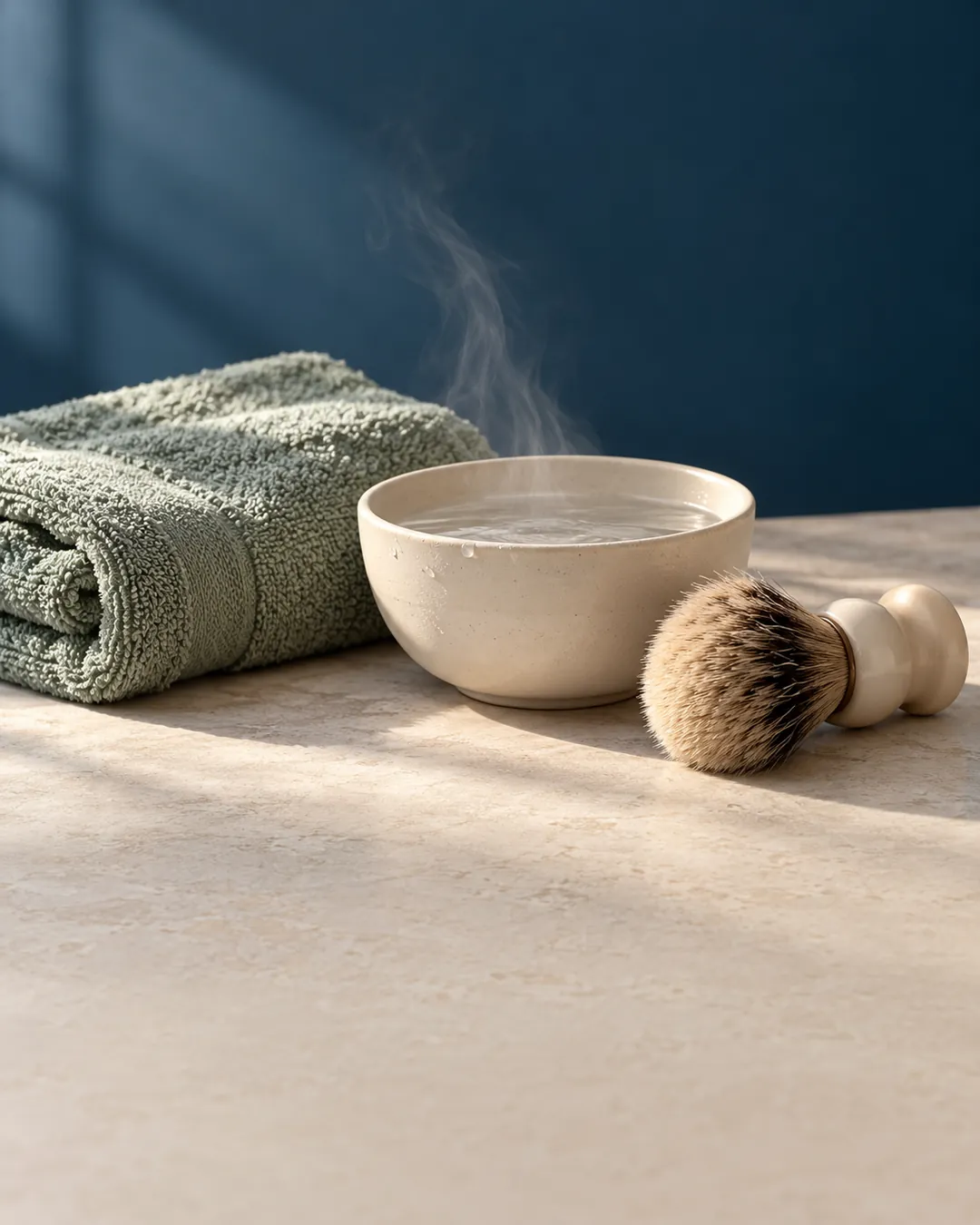
When approaching traditional shaving, preparation is not a mere aesthetic indulgence or a waste of time, but a genuine necessity of physics applied to the human body. Understanding hair structure and the mechanics of cutting reveals why water and heat are the razor’s first and most powerful allies.
The mismatch between skin and hair: the cutting dilemma
The human beard presents an extraordinary mechanical challenge: it can be described as a collection of stiff fibres embedded in a soft, gelatinous matrix. Facial skin has a viscoelastic response with a very low initial elastic modulus, approximately 1 MPa. By contrast, a dry beard hair has an elastic modulus between 3 and 4 GPa, making it fully 1,000 times stiffer than the skin that hosts it.
Because hair is anchored relatively loosely in facial tissues, when a blade encounters a dry, hard fibre it releases its pushing force by shifting the hair along the skin’s plane rather than cutting it cleanly. This produces the unpleasant “tug and pull” sensation that causes microtrauma, redness and deep irritation at the follicle’s root.
From “copper” to “aluminium”: the power of water
Physical models used to study shaving dynamics compare a dry beard hair’s consistency to that of a copper wire of equal diameter. Trying to sever hundreds of microscopic copper wires dry demands enormous effort from the blade, destroying its edge in very few passes and aggressively stressing the skin.
This is where the magic of hydration comes in. Water penetrates the keratin structure, inserting itself between hydrogen bonds and softening the fibre. Once beard hair is fully saturated with water, its elastic modulus drops to 1–2 GPa. In physical modelling terms, water-saturated hair changes from the rigid consistency of copper to the more flexible consistency of aluminium wire.
According to the dermatologist Zoe Draelos, a water-saturated beard hair takes about 65% less force to cut than a dry one; a later review by Gillette researchers puts the reduction at around 40%. The blade encounters drastically less resistance, gliding smoothly and severing the fibre with maximum precision and minimum friction.
Beard hydration in figures: what changes?
- Facial skin: an elastic modulus of about 1 MPa.
- Dry beard hair: 3–4 GPa, about 1,000 times stiffer than the skin around it.
- Fully hydrated beard hair: 1–2 GPa, from the stiffness of copper wire to that of aluminium wire.
- Time needed: about 3–4 minutes of warm, damp cloth or lathering with the brush.
How long does the beard need to absorb water?
Hydration does not happen instantly, however. For water to penetrate the hair cortex beyond the protective cuticle layer, skin and beard must be given the right exposure time.
Applying a warm, damp cloth or massaging the lather with the brush for between 3 and 4 minutes allows water to saturate the keratin fibres completely. The warmth of the water softens the tissues, while the brush’s circular action lifts flattened hairs and removes superficial dead cells, preparing the ideal path for the razor.
Understanding this physiological mechanism turns preparation from a mere preliminary task into a conscious act of respect and care for our skin.
Beard hydration: common questions
Why does a dry beard tug when you shave?
How long should you hydrate your beard before shaving?
Sources
This article is based on the following works in the Shaveslow Library:
– Zoe Diana Draelos, Cosmetics and Dermatological Problems and Solutions, 3rd ed., 2011 (Library B021)
– K. Cowley, K. Vanoosthuyze, “Insights into shaving and its impact on skin”, British Journal of Dermatology, 2012 (Library B024)
– K. Cowley, K. Vanoosthuyze, “The biomechanics of blade shaving”, International Journal of Cosmetic Science, 2016, DOI 10.1111/ics.12330

 English
 Français
 Italiano