

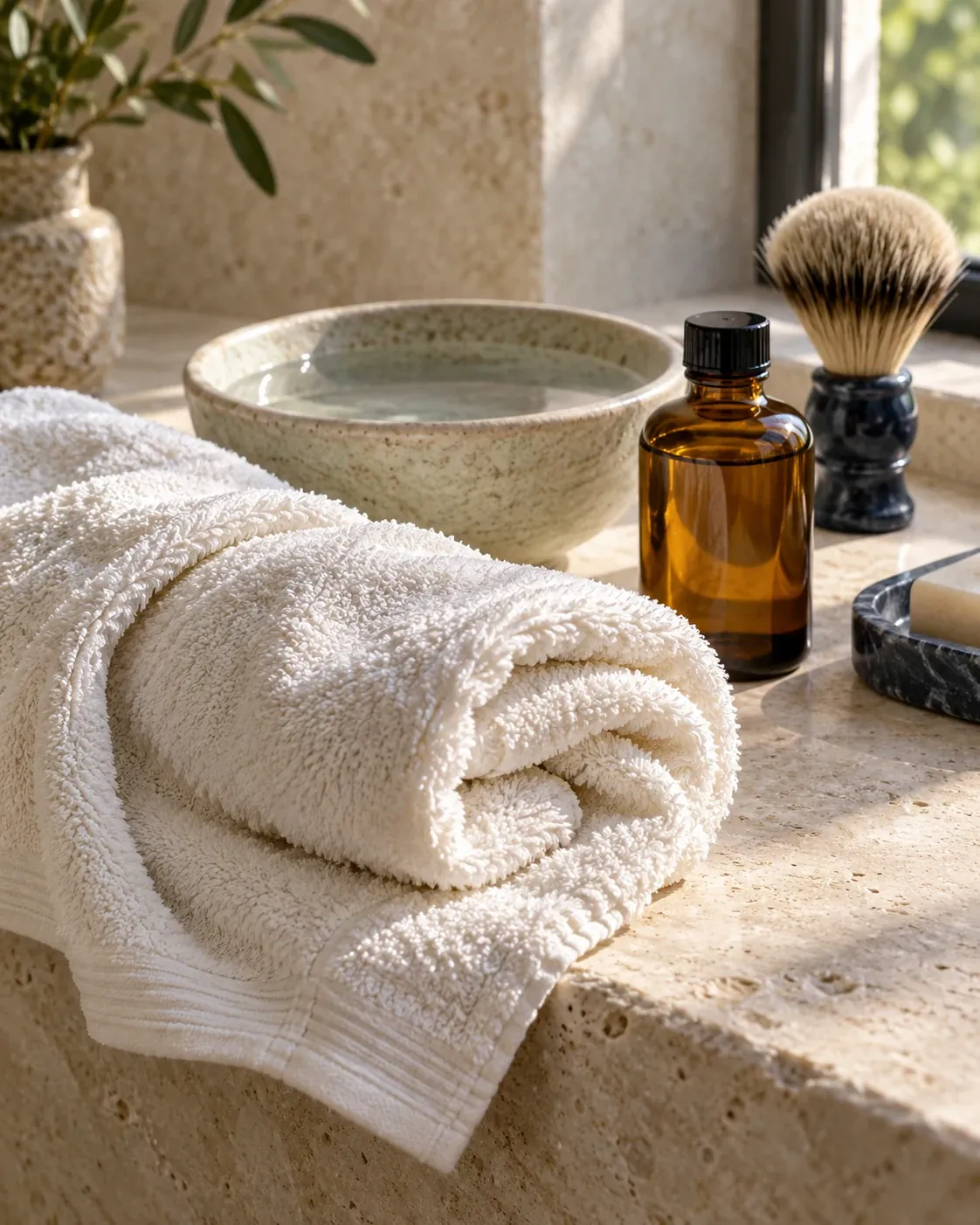
A comfortable shave begins before the blade touches your face. Good preshave preparation needs only water, a little time and a suitable shaving product: together they help prepare the beard and create the conditions for a smooth glide. The aim is to soften the hair while keeping the skin comfortable, rather than to make the towel as hot as possible.
1. Why hydration changes beard hair
Beard hair is largely made of keratin. A review by Cowley and Vanoosthuyze reports an elastic modulus of about 3–4 GPa for dry beard hair, falling to about 1–2 GPa when fully hydrated. These are measurements of the hair fibre, not of the skin.
A later review reports a reduction of around 40% in cutting force with full hydration. This experimental result is not a guaranteed reduction in irritation for every shaver: blade condition, technique and skin sensitivity still matter.
For the physics behind this, see “The Physics of Hydration“.
2. Water, cleansing and time
Wash your face gently with lukewarm water and a mild cleanser, then rinse. There is no need to strip the skin or scrub vigorously. Shaving after a shower is a practical way to start with a damp beard. If you shave at the basin, keep the area moist for a few minutes before lathering; do not let it dry while you prepare your tools.
Comfortably warm water is enough. Very hot water is not necessary for a good preshave, and a burning sensation is a reason to stop. Adjust the warmth and contact time to your own skin rather than following a fixed temperature or treating a timetable as a rule.
3. The warm-towel ritual at home
Dampen a clean cotton towel with warm water, wring it out and check that it feels comfortable against the inside of your wrist before bringing it to your face. Rest it gently over the beard area, keeping your nose and mouth clear. Re-wet it if needed. The towel should feel soothing, never painfully hot.
A warm, damp cloth is an optional way to keep the beard moist. It does not replace shaving lather, and adding heat does not make an unsuitable product suitable for your skin. For a simple home routine, warm tap water also avoids relying on a microwave heating time that varies with the towel and appliance.
4. Preshave oils, creams and gels
Preshave oil: start with a small amount
Preshave oils commonly use vegetable oils such as jojoba, sweet almond or castor oil. A thin layer can change the feel of the razor’s glide. Apply a small amount to damp skin and follow the product’s directions. More oil is not necessarily better: excess can weigh down the lather and make the brush or razor harder to rinse.
Creams and gels: choose for tolerance
Preshave creams and gels offer different textures and finishes. Some contain menthol, camphor or eucalyptus; a cooling sensation does not by itself show that a formula is gentler. If your skin is reactive, consider a simple, fragrance-free option. Do not assume that every refreshing formula is suitable for oily or acne-prone skin.
5. What does a good preshave preparation look like?
Cleanse gently, keep the beard damp, add a preshave product only if it suits your routine, then build a well-hydrated lather. A few unhurried minutes are more useful than a hurried application of excessive heat. The timings below are practical guides, not biological guarantees.
- Cleanse and rinse: about 1–2 minutes, without scrubbing.
- Optional preshave product: a small amount on damp skin, following the label.
- Keep the beard moist for a few minutes, with a comfortably warm cloth if you prefer.
- Lather with the brush and begin shaving before the lather dries.
For building the lather itself, see “The Art of Lathering Shaving Soap“.
Preshave preparation: common questions
Do you need very hot water before shaving?
Is a preshave oil necessary?
Does a warm towel replace shaving lather?
Sources and further reading
K. Cowley and K. Vanoosthuyze, Insights into shaving and its impact on skin, British Journal of Dermatology, 166 (Supplement 1), 2012, pp. 6–12. DOI: 10.1111/j.1365-2133.2011.10783.x.
K. Cowley et al., The biomechanics of blade shaving, International Journal of Cosmetic Science, 2016. DOI: 10.1111/ics.12330. These industry-funded reviews provide experimental context; they do not establish a guaranteed personal outcome.
American Academy of Dermatology: Hair removal: How to shave; Skin care tips for men; How to prevent razor bumps. Practical guidance on gentle cleansing, preparing the beard and shaving comfort.

 English
 Français
 Italiano