

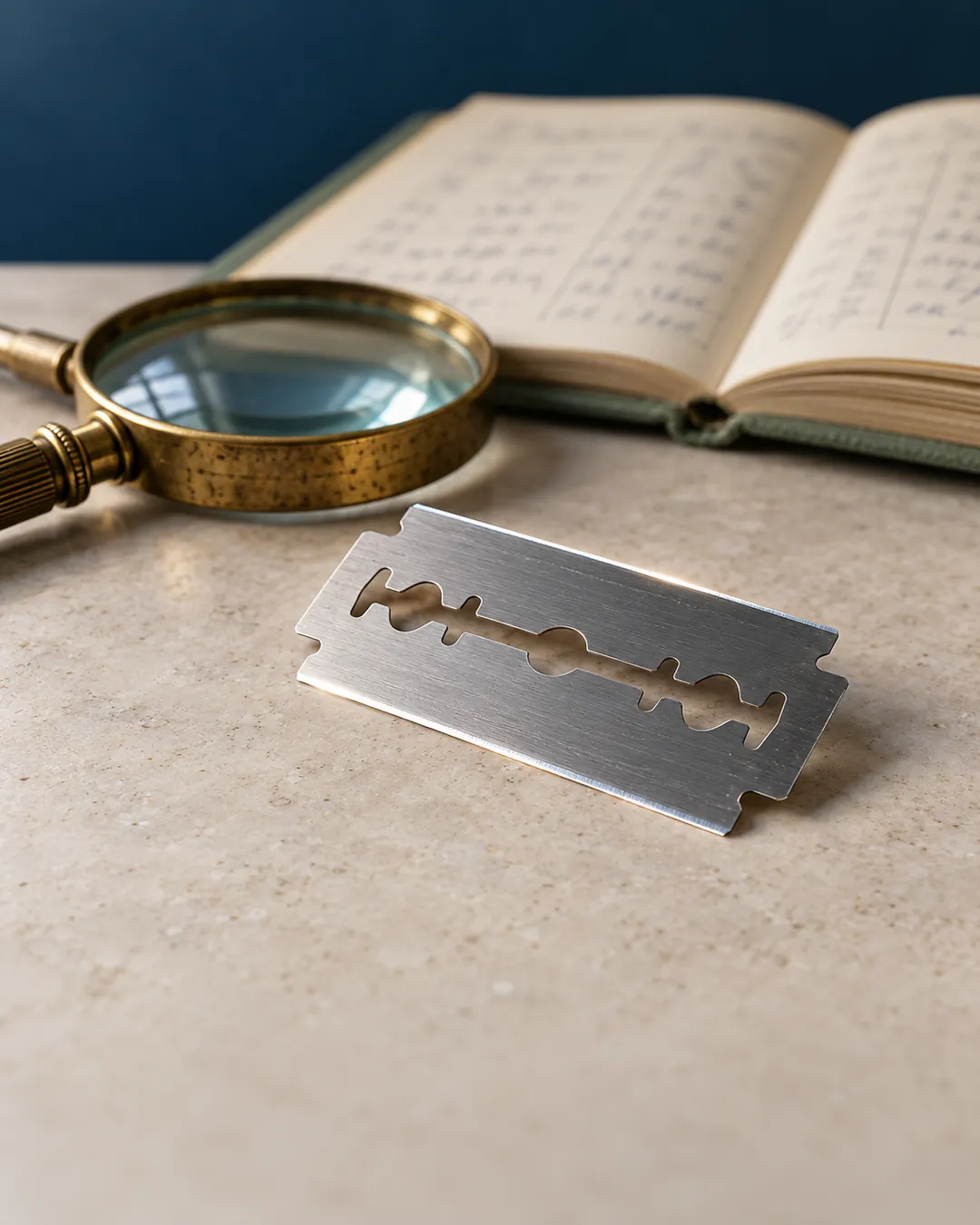
Sooner or later every blade stops cutting. We notice it as a slight tug, a pass that no longer clears the stubble, the feeling of scraping instead of gliding. But what, exactly, wore it out? Time in the drawer, a damp bathroom, the quality of the steel? Or us?
In the 1930s someone set out to answer that properly. At the Mellon Institute of Industrial Research in Pittsburgh, Elbridge J. Casselman spent five years studying shaving on a fellowship funded by a razor maker, the Magazine Repeating Razor Company. With the dermatologist Lester Hollander he ran what amounted to a shaving clinic: thirty-one men, most of them Institute staff, who shaved to precise instructions and logged effort, discomfort and irritation. The findings appeared in 1937 in the Journal of the American Medical Association and, for a wider audience, in Scientific American.
Measuring an edge
To know how much an edge lost in use, you need an instrument, so Casselman patented one. A blade on a swinging arm had to cut a fine, freely hanging rayon fibre, and the tester measured the lowest speed at which it succeeded: the lower the speed, the keener the edge. On that scale the sharpest blades ever tested read half a unit and a “perfect” edge stayed below 1.5; many men threw their blade away somewhere between 6 and 9; above 10 it was useless for shaving.
With that yardstick and a microscope, the researchers could finally pull the causes apart.
Worn by shaving, not by resting
The first finding overturned a common belief: a blade dulls while it shaves, not while it waits. Corrosion between shaves turned out to be a very minor factor, unless the blade was left actually wet for hours. Drying it and putting it away carefully is still good practice, but the drawer is not the enemy.
The beard is. Casselman noted that dry hair is harder than lead, aluminium or annealed copper, and ruins an edge about as fast as dry paper. Add the grit and dust that settle on the skin, some of it harder than the steel itself. Plenty of blades blamed for being “soft”, he observed, had simply met an unwashed face.
What preparation is worth
The clinic’s most telling figures concern preparation time. Shaving dry, a blade did not on average last a single full shave, and the shave was painful. With three minutes of preparation it managed about four; after a ten-minute shower, about five. The same edge, in other words, lasted far longer depending on how much time we had given the water.
The recommended routine was simple: wash the face with hot water and soap for half a minute, rinse, then work the shaving soap in by hand with plenty of water, two and a half to three minutes in all, before picking up the brush. Grey or white beards soften more slowly and needed longer still. Our piece on the physics of hydration explains why; here it is enough to see that every minute of patience shows up in the life of the edge.
No two beards alike
The clinic also uncovered huge differences between people. Some men dulled blades eight times faster than others; the amount of skin and hair removed at each shave varied up to fourfold. Even the same man changed from day to day, and blades wore faster in summer than in winter.
The researchers found that men fell into two groups: those who changed blades when shaving started to feel uncomfortable, and those who changed when a close shave took more effort. So there is no correct number of shaves per blade, only the right number for a particular face in a particular season. It is the same reason, as we argue in our piece on the “ideal” blade, that other people’s reviews only go so far.
The perfect edge and the slanting stroke
As for the steel, the surprise was how little its quality mattered: within the range of razor-grade steels, one well-finished edge lasted about as long as another. What decided durability was above all the absence of tiny serrations along the edge. Blade resharpeners, meanwhile, could give a spent blade one more shave at best.
Two observations concern technique. A slightly slanting, diagonal stroke prolonged the useful life of a blade that was starting to fade, and reduced the pulling sensation. And a blade that had already been used at least once rarely nicked the capillaries: with safety razors, the clinic recorded less trauma from blades past their first shave than from brand-new ones.
A blade lasts as long as our patience
Read today, those 1937 tables say something simple: a blade’s life is written not only in the steel but in the way we prepare. A washed face, a beard given time to soften, short and unhurried strokes. The same time that makes a shave gentler also makes it less wasteful. Here the slow ritual is not a luxury; it is what lets everything, even a thin strip of steel, give its best.
Sources and further reading
- Elbridge J. Casselman, “Science Turns to Shaving”, Scientific American, vol. 157, no. 5, November 1937, pp. 261–264, 314, 316: doi.org/10.1038/scientificamerican1137-261 (Library B042).
- Lester Hollander, Elbridge J. Casselman, “Factors Involved in Satisfactory Shaving”, Journal of the American Medical Association, vol. 109, 1937, p. 95 (Library B043).

 English
 Français
 Italiano