

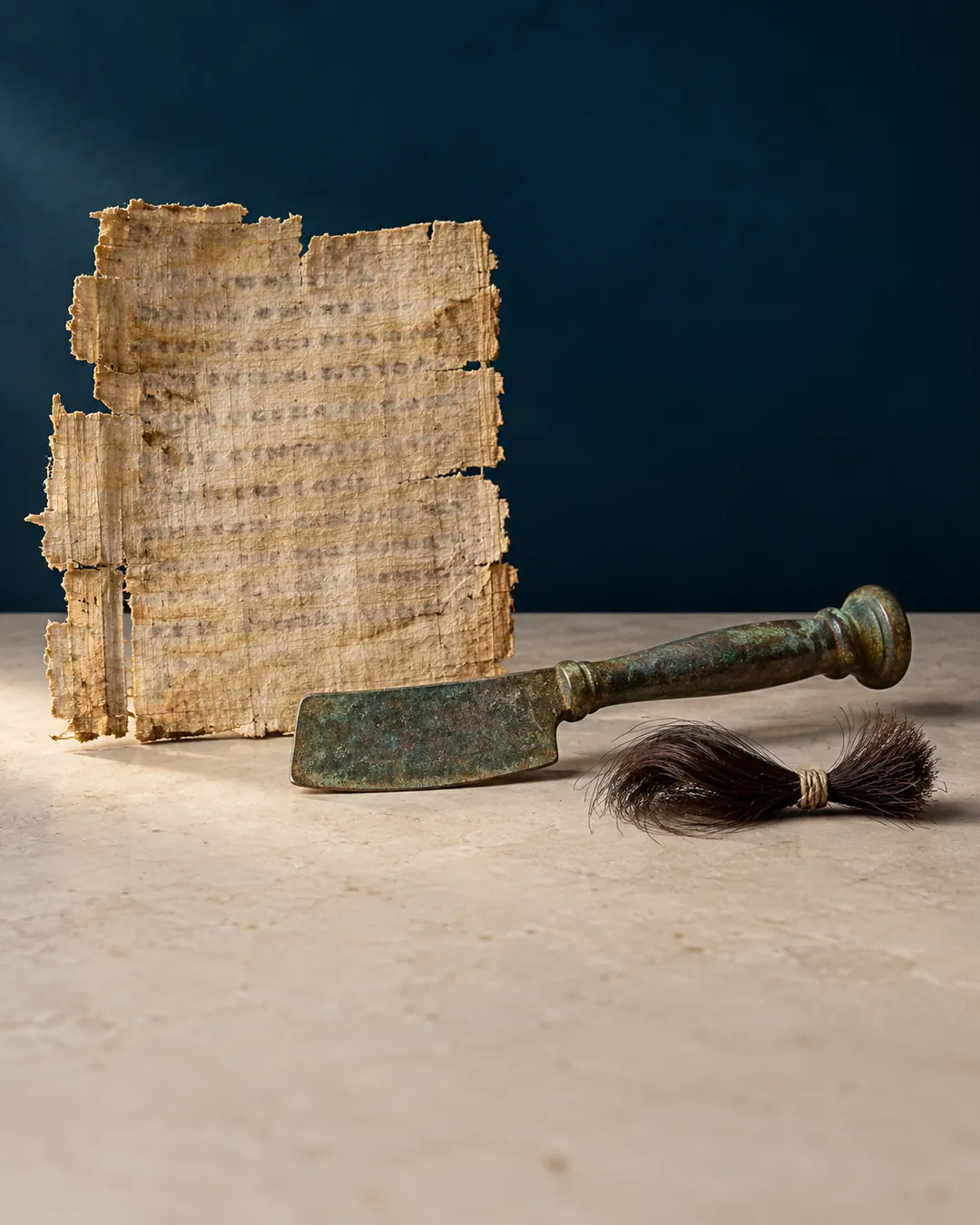
For anyone who enjoys a slow shave, shaving is a chosen act: the moment, the tools, the rhythm, even the decision to let it go for a few days. We take that freedom for granted. Yet there have been times and places where losing your beard had nothing to do with you. It was a penalty, decided by others and carried out in public.
The historian Petra Sijpesteijn of Leiden University has studied one such case through three papyri from Egypt in the first decades after the Arab conquest of 639. They are administrative documents, not chronicles: officials’ letters about taxes, fugitives and punishments. That is exactly why they are so revealing.
Three papyri
The first is a Coptic letter from around 643, still unpublished. An Egyptian Christian asks for help from Senouthios, a secretary and tax official in an Upper Egyptian district: he has been beaten, his hair and beard have been shaved off, and his life has been threatened. The details are unclear, but victim and attacker both seem to have worked for the new administration.
The second dates from 709. The governor Qurra ibn Sharīk writes in Arabic to the local administrator Basileios at Ishqūh, urging him to speed up tax collection. Then he adds a precise rule: if a collector uses a larger measure than he should, or takes more than he has been assigned, he is to receive “a hundred lashes”, have his hair and beard shaved off and be fined thirty dinars. Here the shaving punishes a clear offence: fraud against taxpayers.
The third, from around 730–750, comes from the Fayyum oasis. A village headman who had fled had obtained a safe-conduct; an official still wanted to cut off his beard, but relented when an acquaintance interceded.
In all three cases the victims are Egyptian Christians or Jews serving the Arab administration, and the penalty is imposed by government officials, with no court involved. A Coptic chronicle, the History of the Patriarchs, records that around 714–715 a governor had the beards of many Egyptians shaved off. It is a partisan source, written to denounce abuses, but the papyri confirm that the practice existed.
Why the beard?
There is no evidence that forced shaving was a regular punishment in Egypt before the conquest. Egyptians, moreover, wore beards, as many Byzantine subjects did from the seventh century on: there was something to take away. Sijpesteijn suggests the punishment worked for three reasons.
It made the offender instantly recognisable, since a forcibly shaven face stood out. It struck at his manhood, in a world where beardlessness called to mind eunuchs and boys. And it violated his personal space and autonomy in a way everyone could see. Physically it was bearable, and almost always came with lashes, fines or public exposure, but it wounded honour.
In the ninth century the writer al-Jāḥiẓ observed that in Baghdad no punishment from the authorities was more dreaded by men than having their heads and beards shaved.
An idea shared around the Mediterranean
It was not an isolated invention. In Visigothic Spain in 673, King Wamba spared the life of the rebel Paul and his companions, who were shaved and paraded in public instead; a little earlier, a law of King Recceswinth punished forgers with flogging, shaving of the beard and loss of the right hand. In 741 the Byzantine law code known as the Ecloga prescribed shaving, together with lashes and exile, for certain offences. Sijpesteijn reads these cases as part of a common late antique culture in which beards and hair spoke of honour, belonging and power.
The same act, though, could mean the opposite. Monks received the tonsure on entering the monastery, some mystics shaved their entire face to place themselves outside society, and pilgrims shaved or trimmed their hair at the end of the pilgrimage. Voluntary or imposed, shaving always marked a passage. What changed was who held the razor.
Shaving by choice
Reading these papyri is not about judging the past by today’s standards. It is about noticing something the daily ritual makes us forget: a beard is part of a person, and deciding what to do with it is a form of freedom. We touched on this with the Stoics and the monks, for whom shaving was an inner choice, and with Benjamin Franklin, who counted the ability to shave himself among life’s small happinesses.
Every morning at the mirror, the razor is in our own hands. It is a small privilege, so obvious that it becomes invisible. Perhaps it is worth noticing it now and then.
Sources and further reading
- Petra M. Sijpesteijn, “Shaving Hair and Beards in Early Islamic Egypt: An Arab Innovation?”, Al-Masāq: Journal of the Medieval Mediterranean, 30:1, 2018, pp. 9–25, open access (CC BY-NC-ND 4.0): doi.org/10.1080/09503110.2018.1425809 (Library B041).




 English
 Français
 Italiano