

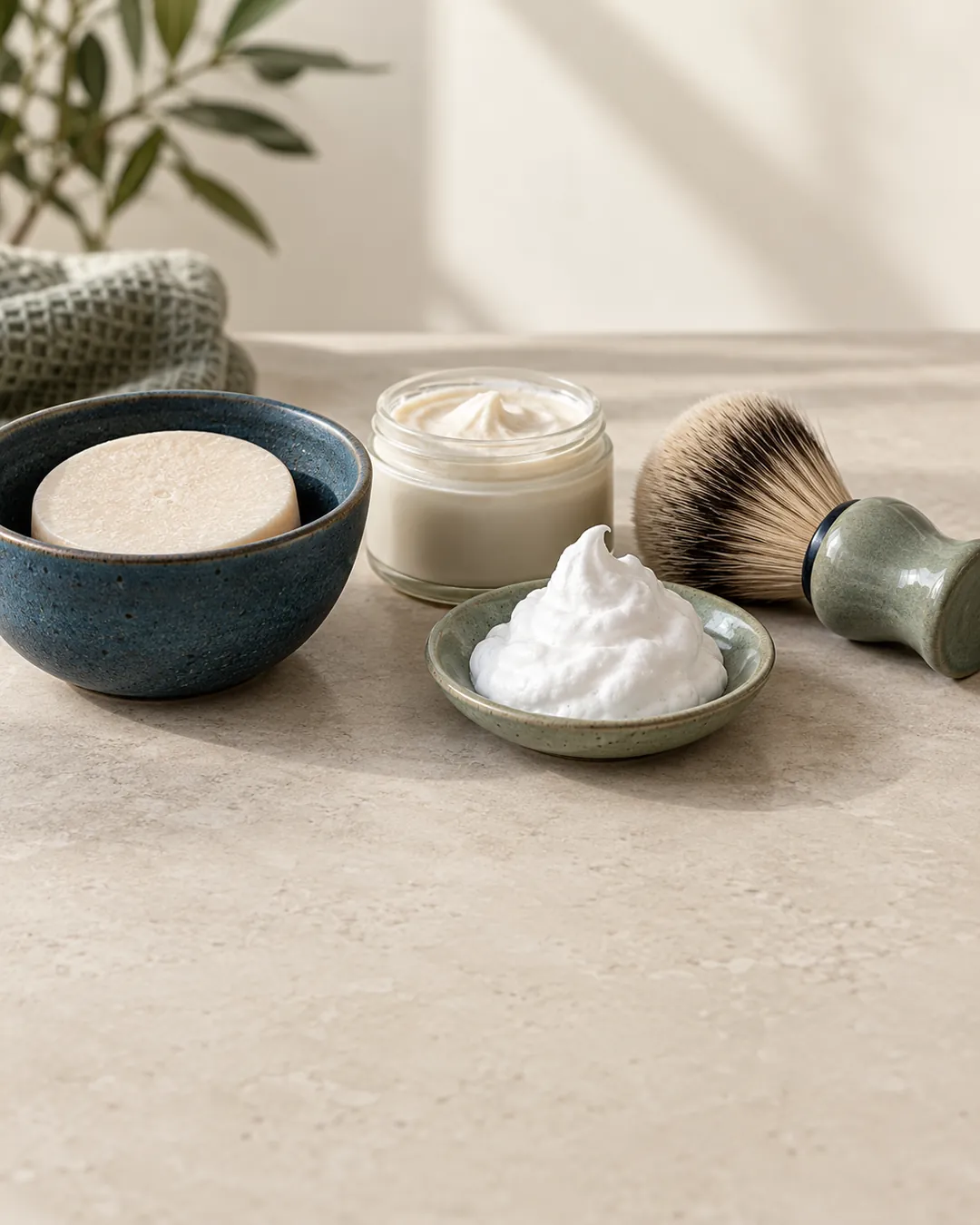
A bathroom shelf can hold a puck of soap in a bowl, a tube of cream and a can of foam. On rushed mornings, perhaps the bar soap by the sink or the shampoo from the shower as well. They all seem to do the same thing: cover the beard in lather. But what actually changes, for the whiskers and for the skin, from one format to another?
To find out, we put together a dermatology handbook by Zoe Diana Draelos, a pharmacist’s guide by Gérald Beylot and a 1937 study that has aged remarkably well.
One job, many formats
Start with what they share. Any shaving product has two tasks: help water soften the beard, and leave a layer between blade and skin to cut friction. Water does the heavy lifting: according to Draelos, a water-saturated whisker takes about 65% less force to cut than a dry one. Our piece on the physics of hydration explains why.
Back in 1937, the researcher Elbridge J. Casselman and the dermatologist Lester Hollander were already clear about it: water is the real softener, and soap matters mainly because it strips away the film of sebum that keeps water out of the hair. They added a point that still holds: a thick, creamy lather does not mean the beard is ready. It only means softening has begun.
True soap and syndets: a question of pH
Draelos divides cleansers into three families. True soap is made by reacting a fat with an alkali; it has a pH of 9 to 10 and removes oil thoroughly. Syndets, or synthetic detergents, contain less than 10% soap and have a pH adjusted to 5.5–7, closer to that of skin, which is acidic, between 4.5 and 6.5. Combars combine the two.
Traditional shaving soaps and lathering creams belong to the first family: they contain sodium or potassium hydroxide, extra fats to protect the skin (they are superfatted) and glycerin to hold water. So they are alkaline. Does that matter? For healthy skin, Draelos says, not much: it quickly returns to its own pH after washing. In 1937 Casselman called shaving soaps probably the purest soaps made for any purpose, and valued two things in them: freedom from excess alkali and a lather slow to dry on the face. For eczema or very reactive skin it is a different story, and that is where more pH-neutral products may make sense.
One telling detail: that tight feeling after washing, which many people take as a sign of cleanliness, is according to Draelos simply the perception of altered skin pH, not proof of being clean.
Puck, cream, gel and can
The formats, Beylot explains, differ mainly in how you use them. Canned foam goes straight on. Gel has to be worked into a wet beard. Cream and soap have to be turned into lather, either on the face with a little lukewarm water or with a damp brush, built up gently.
According to Draelos, shaving soaps were the main product from the fourteenth century until the First World War; lathering creams arrived in 1936; today, at least in the United States, aerosols have all but replaced everything else. A cream, she notes, is essentially a modern version of shaving soap, with more water and a few additives for stability. Draelos favours gels that foam on the face, since there is some evidence they lubricate better, although the reason is unclear. That is the view of a dermatologist writing for the mass market, and we report it as such.
No format is magic. What counts in every case is time: Draelos advises leaving the product on the face for three to four minutes before shaving, and the 1937 clinic recommended two and a half to three minutes of preparation. The brush, Casselman noted, earns its place mainly because it carries plenty of hot water to the beard and holds it there.
Why not bar soap or shampoo?
All three sources agree on one point: shaving products are made for shaving. Bar soap, shampoo and conditioner, Draelos warns, leave a film on the blade that dulls it sooner, and do little to reduce friction between edge and skin. Every product, she concludes, is designed for its own job and suits others poorly.
There is, however, a sensible use for toilet soap. Hollander and Casselman advised washing the face first with hot water and a mild soap for half a minute, rinsing, and only then moving on to the shaving soap, to clear away sebum and the grit that ruins an edge. Beylot, too, starts preparation with a wash.
Choosing without dogma
So the choice between puck, cream and gel is less technical than it looks. Water, time and technique make far more difference than the format. Soap in a bowl with a brush does have one advantage no table can measure, though: it asks you to slow down. Building the lather, feeling it thicken, spreading it calmly are already part of the ritual. Perhaps that is why, after a century of aerosols, so many people are going back to the puck.
For general information only, not medical advice: if you have eczema, irritation or a problem that persists, see a dermatologist.
Sources and further reading
- Zoe Diana Draelos, Cosmetics and Dermatologic Problems and Solutions, 3rd edn, Informa Healthcare, 2011, ch. 15 “Personal hygiene, cleansers, and xerosis” and ch. 31 “Folliculitis and shaving” (Library B021).
- Gérald Beylot, “Les produits de rasage”, Actualités pharmaceutiques, no. 529, October 2013, pp. 59–60: doi.org/10.1016/j.actpha.2013.07.014 (Library B039).
- Elbridge J. Casselman, “Science Turns to Shaving”, Scientific American, vol. 157, no. 5, November 1937: doi.org/10.1038/scientificamerican1137-261 (Library B042).
- Lester Hollander, Elbridge J. Casselman, “Factors Involved in Satisfactory Shaving”, Journal of the American Medical Association, vol. 109, 1937, p. 95 (Library B043).

 English
 Français
 Italiano