

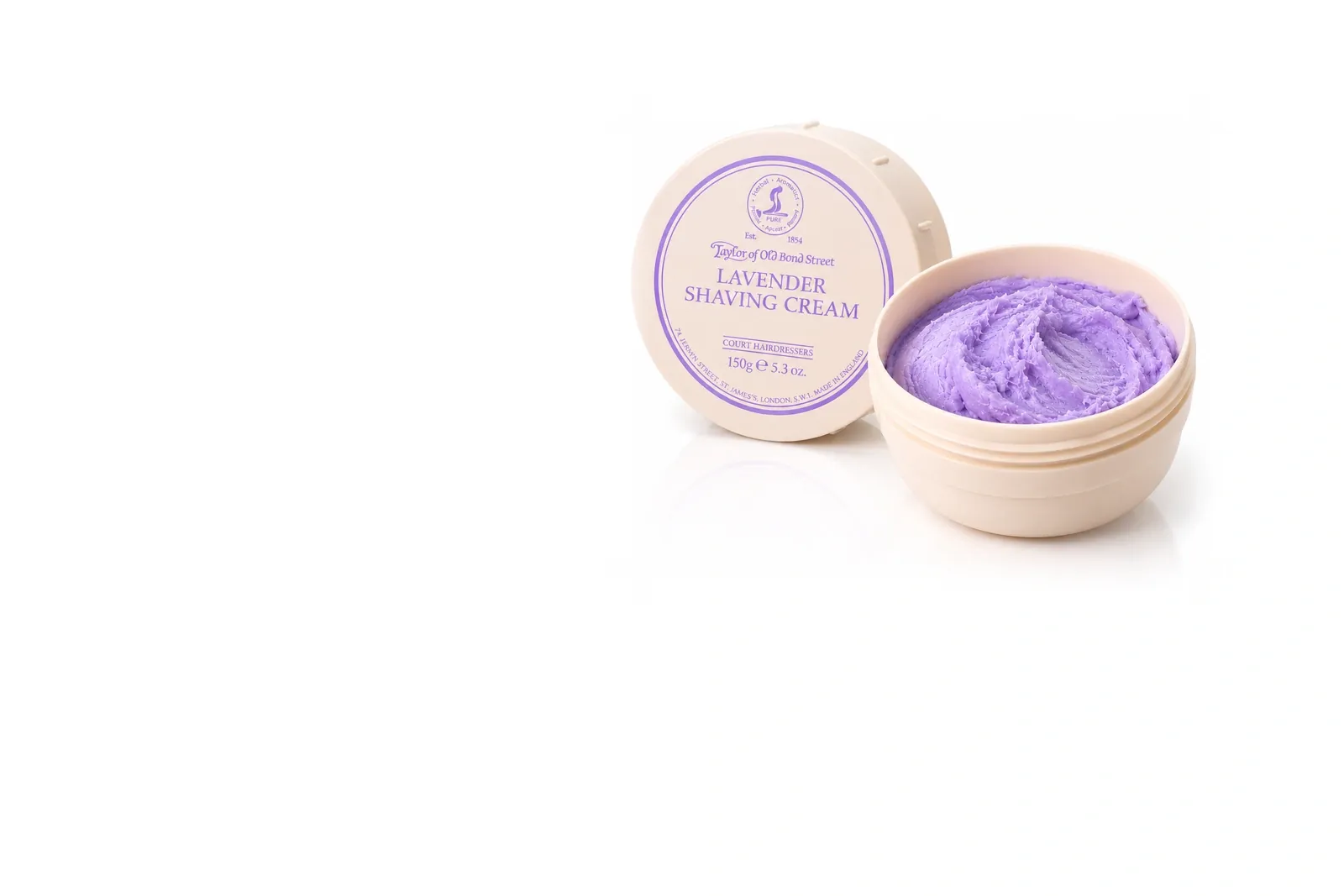
A cream from the British tradition, a generous lather and a fragrance that has no need to raise its voice. My experience with Taylor of Old Bond Street Lavender: sensory pleasure, convincing performance and a few thoughts on the formula.
Bought online, without trying it first. First impressions: one shave.
The pleasure of familiar things
I have always had a soft spot for lavender. It is a scent I often look for, one I return to naturally and associate with a particular kind of olfactory pleasure. Not necessarily in search of something new: sometimes I simply want to find a familiar scent again, at its most pleasant.
So it was only natural that sooner or later I would come across Taylor of Old Bond Street’s Lavender Shaving Cream.
The British house belongs to that world of traditional shaving in which preparation matters as much as the result. Brushes, bowls, creams, soaps and lotions are not just functional tools, but objects that mark out a sequence of gestures.
The packaging reflects that identity. An ivory jar, a classically laid-out blue label, the maker’s name and a reference to London’s historic Jermyn Street. No particular wish to look modern at all costs.
Open the jar and the first encounter is, naturally, with lavender.
A distinct scent, perfectly recognisable, gentle and never intrusive. No olfactory ambiguity: it is lavender, simply lavender.
Completing that first impression is the lovely lilac colour of the cream. A predictable choice, of course, but no less charming for it. Scent and colour meet in pleasant harmony, offering a small moment of sensory pleasure as soon as the lid comes off.
The shave has not yet begun, and yet the ritual already has something to say.
A London tradition dating back to 1854
Taylor of Old Bond Street traces its origins to 1854, when Jeremiah Taylor opened a personal-care business in London.
Over time the brand built its own identity in men’s grooming, becoming especially well known for its shaving creams and traditional fragrances.
The Lavender belongs to this family of products, alongside scents such as Sandalwood, Rose and Jermyn Street.
The appeal to tradition, however, should not lead us to imagine that today’s formulas are identical to those of the nineteenth century. The history of a brand and the chemical history of its products do not necessarily coincide.
What survives is above all a certain way of thinking about shaving: not just as a job to get done, but as a moment worth paying attention to.
It is a distinction that feels very close to the philosophy of Shaveslow.
Cream or soap? A question of texture
Taylor of Old Bond Street officially presents the product as a Shaving Cream.
The name could mislead anyone who associates creams with the soft formulas sold in tubes.
In the jar, the Lavender is a compact, essentially solid mass, closer in appearance to a soft soap than to a fluid cream.
Texture alone is not enough to classify a product chemically. There are very dense shaving creams and particularly soft soaps.
In this case the formula contains fatty acids and alkaline agents typical of soap-based systems. It is therefore fair to describe it as a soap-based shaving cream, respecting the official name without ignoring its physical character.
That firmness, as I found when lathering, is no obstacle at all to building a lather.
Quite the opposite.
Lathering: the Omega Quarantotto and a few seconds of patience
For the test I chose an equally classic companion: the Omega Quarantotto, the famous 10048 boar-bristle brush.
I left it to soak in hot water for about ten minutes, giving it time to get ready for work.
I then lathered the cream in a bowl, as I usually do.
A little water was enough and, above all, very little time. After only a few seconds of work, the cream turned into a dense, velvety lather that quickly filled the brush.
How fast it lathered impressed me.
I did not have to work at it for long to reach a satisfying consistency, nor make repeated adjustments to the amount of water.
On the first, generous application the lather proved soft and creamy, well aerated and slightly open in texture.
An interesting structure, in which the density felt while lathering went hand in hand with a certain lightness once spread on the face.
Of course, the most voluminous lather is not necessarily the most protective. The amount of water, the stability of the lather and how it behaves under the blade are separate things.
But this stage promised a pleasant shave.
For bowl and face lathering in general, see “The Art of Lathering Shaving Soap“.
The blade test: Parker 31R and Astra Green
To judge the cream, I chose to do without any pre-shave product.
No oil, no preparatory cream: I wanted to see how the Lavender behaved without help from other lubricating cosmetics.
That is not necessarily the best condition for every skin, but it makes my experience with the product easier to read.
The razor was a Parker 31R, a replaceable-blade shavette, fitted with a Russian-made Astra Green.
With a shavette, the relationship between hand, blade and skin is particularly direct. Angle, pressure and the quality of the glide matter a great deal.
I reviewed this razor separately: see “Parker 31R“.
The shave was pleasant and smooth, both on the with-the-grain pass and on the against-the-grain pass that followed.
The cream supported the blade well, offering a comfort I appreciated all the more given the lack of a pre-shave.
The overall feeling was of an effective preparation that let me concentrate on the gesture without constantly worrying about the lather.
The result was thoroughly convincing.
After the rinse: softness, suppleness and a few small snags
Once the shave was over, my skin felt soft and supple.
A pleasant sensation, consistent with the comfort I felt as the blade passed.
I felt only slight tenderness in a few spots on my neck, where I had gone over the same area more with the shavette.
On my chin there were also two or three tiny weepers. I ran the potassium alum over my whole face, lingering on the chin. The effect was immediate.
After another rinse I finished the ritual with an alcohol-based aftershave.
On first contact I felt a slight sting, quickly soothed by the freshness of the splash.
A few hours later, my skin was how I like to find it after a satisfying shave: supple, dry and pleasant, apart from that lingering tenderness in a few spots on the neck.
I would not automatically blame the cream for that. Repeated passes with the shavette are a possible explanation for mechanical irritation, although they do not rule out every other factor.
Traditional shaving asks for attention even when everything seems to be going perfectly.
A lavender that knows its moment
One interesting detail concerns how long the scent lasts.
After rinsing and applying the alcohol-based aftershave, the lavender disappeared from my perception.
That was to be expected, given how gentle the cream is and how much stronger the splash I used smells.
I do not consider it a flaw.
I enjoyed the Lavender most when opening the jar, building the lather and shaving. Those are the moments in which its fragrance finds its place.
I have no way of judging how long it would have lasted without the aftershave.
What I can say is that the scent accompanied the ritual pleasantly without becoming intrusive.
And for me that matters far more than whether it lingers in the hours that follow.
Inside the jar: what the formula tells us
The INCI list on the original label of my jar lets us look at the product’s cosmetic structure more precisely than the marketing descriptions do.
The declared ingredients are:
Aqua (Water), Stearic Acid, Myristic Acid, Potassium Hydroxide, Coconut Fatty Acid, Glycerin, Lavandula Angustifolia (Lavender) Oil, Triethanolamine, Sodium Hydroxide, Benzyl Alcohol, Methylchloroisothiazolinone, Methylisothiazolinone, Linalool, Geraniol, Limonene, CI 17200 (Red No.33), CI 42090 (Blue No.1).
It is a relatively short formula, with seventeen declared ingredients.
Stearic acid and myristic acid make up an important part of the product’s structure. Together with coconut fatty acids and the alkaline agents, they form the soap system responsible for its cleansing and lathering properties.
Potassium hydroxide and sodium hydroxide can take part in neutralising the fatty acids, while triethanolamine helps adjust the pH and neutralise.
Glycerin is a humectant that interacts with water and contributes to the overall character of the formula.
This combination is consistent with the rich, workable lather I saw during the test.
The ingredient list cannot, however, tell us the exact pH, the concentration of each substance or any objective measure of glide.
The composition suggests how the product was designed. The shave tells how it behaved in my conditions of use.
Is it made with tallow?
A frequent question among traditional shavers concerns tallow, the animal fat used in some soap formulas.
The Lavender’s INCI list does not include Sodium Tallowate or Potassium Tallowate, the names that would explicitly indicate tallow-derived fatty acid salts.
That does not, however, allow us to certify that the product is entirely plant-based.
Ingredients such as stearic acid and glycerin can come from raw materials of different origins. Their source is not stated on the label.
The most accurate conclusion is therefore that the formula does not explicitly declare tallow, but does not let us establish with certainty the absence of every animal derivative.
Confirmation from the maker would be needed before presenting it as a vegan cream.
Lavender and its aromatic components
The formula contains Lavandula Angustifolia Oil, lavender essential oil.
True lavender, a member of the Lamiaceae family, is an aromatic plant widely used in perfumery and cosmetics.
Its scent profile can include floral, herbal and fresh notes, with nuances that vary with the raw material and the composition.
In the Taylor cream, I perceived an immediately recognisable, gentle lavender.
The INCI list also includes Linalool, Geraniol and Limonene, fragrance components that can occur in essential oils and that are also of interest from an allergy standpoint.
Their presence does not automatically make the product a problem, but it is useful information for anyone with known sensitivities or allergies to particular fragrance substances.
A natural origin does not, on its own, guarantee better skin tolerance.
The lilac colour: a cosmetic choice
The colour of the cream is undoubtedly part of its identity.
The INCI list declares two colourants: CI 17200, red, and CI 42090, blue.
Their presence is consistent with the lilac colour seen in the jar.
It is important to separate this aesthetic element from the qualities of the lavender essential oil: the colour of the finished product is no proof of the quantity or quality of the oil used.
Personally, I find the colour enriches the experience. It does not necessarily add anything to the cream’s performance, but it adds to the pleasure of the first encounter.
And in a ritual, the visual side has its place too.
Preservatives and tolerance: a necessary note
The part of the formula that deserves most attention is the presence of Methylchloroisothiazolinone and Methylisothiazolinone, commonly shortened to MCI and MI.
They are antimicrobial preservatives used to limit the growth of microorganisms in cosmetic products.
They are also known for their sensitising potential, which is why their use is subject to specific regulatory restrictions in the European Union.
For the 3:1 MCI/MI mixture, EU rules allow a maximum concentration of 0.0015%, equivalent to 15 parts per million, in rinse-off products.
That limit applies to the mixture, not to each of the two ingredients taken separately.
Shaving cream, used and then rinsed off, generally counts as a rinse-off cosmetic.
The presence of the two preservatives on the label is therefore not, in itself, a sign of non-compliance.
On the other hand, the INCI list does not reveal the concentrations actually used. It would not be correct to declare the formula compliant on the strength of the label alone, just as it would not be correct to suggest the opposite.
Sensitising potential is a separate matter from the ordinary mechanical irritation that can occur during a shave.
In my case, the slight localised tenderness on my neck appeared in areas where I had made repeated passes with the shavette. I have nothing to suggest an allergic reaction.
Anyone who knows they are allergic to MCI, MI or specific fragrance components should check the composition carefully before use.
This does not change my positive impressions of the shave, but it puts them in the right context.
An independent review should be able to recognise a product’s qualities without overlooking information that matters for safety and tolerance.
Lavender, well-being and the limits of promises
Lavender is often associated with calm and relaxation.
Its use in aromatherapy and other settings has been studied, but it would not be correct to transfer any findings automatically to a shaving cream.
We have no specific evidence to credit the Lavender Shaving Cream with a therapeutic effect against stress or anxiety.
And, in the end, we do not need any to enjoy it.
For me, the pleasure comes from something much simpler: recognising a beloved scent, paying attention to it, preparing the brush and giving myself the time for an unhurried shave.
It is a personal experience, not a medical treatment.
But that subjective dimension is one of the foundations of Shaveslow.
Shaveslow Verdict: the pleasure of finding what you were looking for
I had clear expectations of Taylor of Old Bond Street’s Lavender.
I wanted a lavender scent that was recognisable, pleasant and not intrusive. I was also looking for a cream that would give a workable lather and a comfortable shave.
The product met both expectations brilliantly.
The scent is distinct and gentle. The lovely lilac colour adds a visual dimension I particularly enjoy.
With my Omega Quarantotto, lathering was very fast. A few seconds and a little water were enough for an abundant, soft, velvety lather.
The Parker 31R with an Astra Green blade glided pleasantly both with and against the grain.
All without any pre-shave product.
After rinsing, my skin was soft and supple. Some slight tenderness remained in a few spots on my neck, along with two or three tiny weepers on my chin: snags I do not hide, but that I cannot automatically blame on the cream.
A few hours later my skin was supple and dry, just as I want it after a good shave.
As for the formula, the presence of MCI/MI and of potentially sensitising fragrance components deserves attention, especially for people with known allergies. I consider it an integral part of the assessment, not a footnote to bury at the bottom of the page.
It will be interesting to see how the Lavender behaves with other tools and under different preparation conditions.
But the result was a genuinely happy one.
It is a cream I would use without hesitation several times a week.
Not because it has revolutionised my idea of shaving, but because it gave me exactly what I was looking for: a beautiful lavender scent, a lather that is a pleasure to build and a comfortable shave.
Sometimes pleasure does not come from surprise, but from the satisfaction of finding something we love, done properly.
Taylor of Old Bond Street Lavender: test sheet
| Product | Taylor of Old Bond Street Lavender Shaving Cream |
| Size | 150 g jar |
| Texture | Compact, almost solid |
| Scent | Lavender, gentle and recognisable |
| Brush | Omega 10048 “Quarantotto”, boar bristle |
| Preparation | Brush soaked in hot water for 10 minutes |
| Lathering | In a bowl, with little water |
| Razor | Parker 31R |
| Blade | Astra Green, Russian-made |
| Pre-shave | None |
| Passes | With the grain and against the grain |
| Post-shave | Potassium alum on the whole face, rinse, alcohol-based aftershave |
| Later observation | Supple, dry skin; slight lingering tenderness on the neck |
| Number of tests | One |
| Stated PAO | 12 months after opening |
Sources
- Taylor of Old Bond Street — Lavender Shaving Cream Bowl 150g. Official product page, trade name, size and manufacturer’s claims. www.tayloroldbondst.co.uk
- Taylor of Old Bond Street — Original label of the jar examined. Primary source for the INCI list, directions for use and the 12-month period after opening. Personal photographs, October 2026.
- European Chemicals Agency (ECHA) — Cosmetic Products Regulation, Annex V, Entry 39. EU restrictions on the Methylchloroisothiazolinone/Methylisothiazolinone mixture, 3:1 ratio and maximum limit in rinse-off products. echa.europa.eu
- European Chemicals Agency (ECHA) — Cosmetic Products Regulation, Annex V, Entry 57. Conditions of use for Methylisothiazolinone and its regulatory distinction from the MCI/MI mixture. echa.europa.eu
- Scientific Committee on Consumer Safety (SCCS) — Opinion on the safety of the use of Methylisothiazolinone in cosmetic products. Regulatory Toxicology and Pharmacology, 2016, 76, 211–212. DOI: 10.1016/j.yrtph.2016.01.001. Sensitisation risk assessment. pubmed.ncbi.nlm.nih.gov
- European Commission — Fragrance Allergens Labelling. Official information on fragrance allergens and cosmetic labelling requirements. single-market-economy.ec.europa.eu
- Commission Regulation (EU) 2023/1545. Update of EU rules on the labelling of fragrance allergens. eur-lex.europa.eu
A note on method: the practical assessment comes from one personal shave. Information on the composition comes from the label of the product examined; the cosmetic remarks are a technical interpretation of the declared ingredients, not the result of laboratory analysis of the finished formula. The manufacturer’s commercial claims are not treated as independent evidence of efficacy.

 English
 Français
 Italiano