

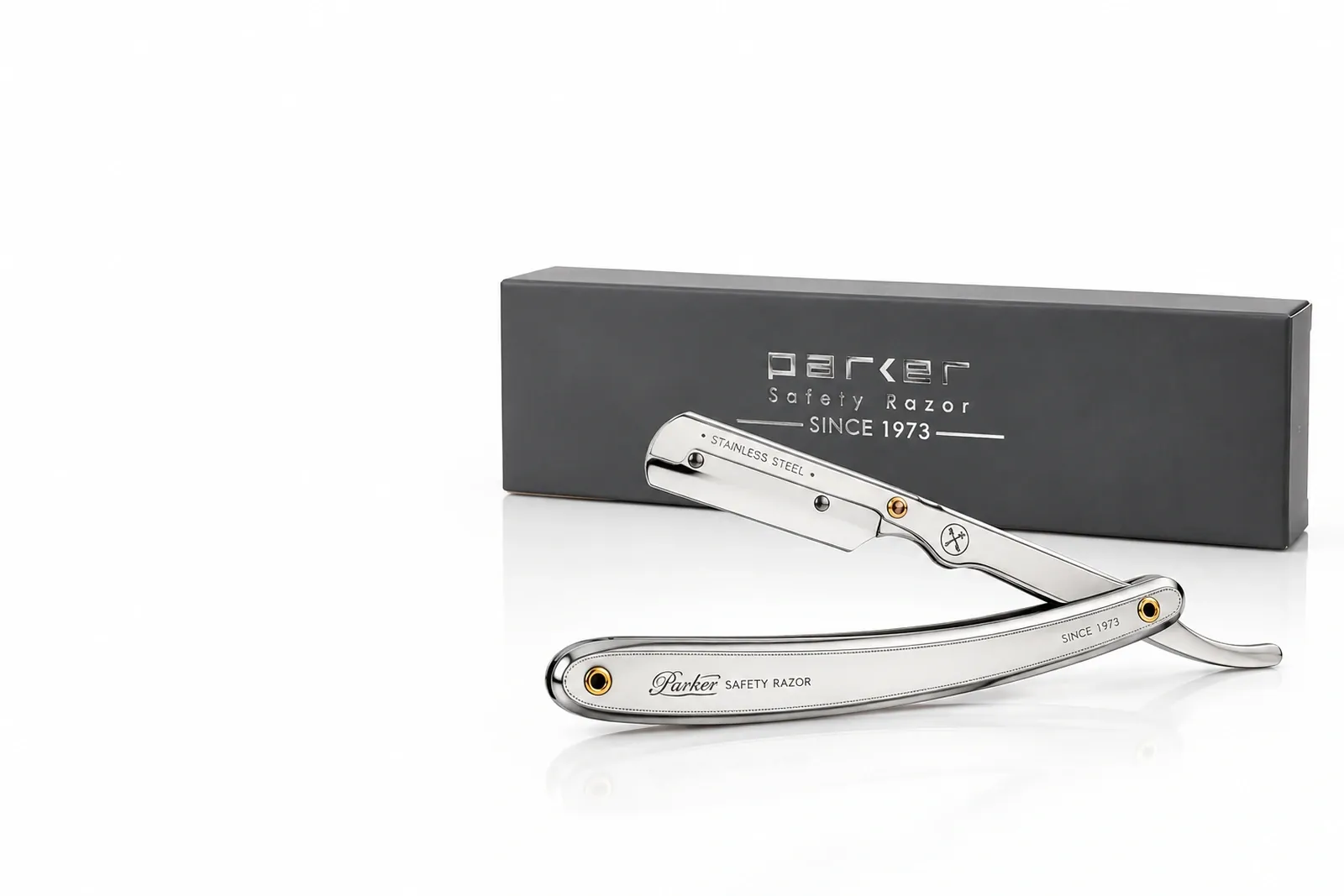
An affordable shavette, a surprising finish and a close shave. But perhaps the real pleasure begins when you lay down your arms.
I bought the Parker 31R online. This review describes my first shave with it.
Some objects surprise you with what they can do. Others catch your eye before you have even used them, for the simple pleasure of looking at them. In my case, the Parker 31R managed both.
My first impression was above all visual. Its polished, reflective metal surface has a brilliance I did not expect from a razor sold at such a competitive price. It is a finish that catches the light and gives the object an air of quality well above what its market position might suggest.
Of course, a beautiful surface is not enough to judge the quality of a tool. Resistance to wear, the precision of the fittings and long-term durability call for closer observation. But aesthetic pleasure has its place in traditional shaving too. And from our very first encounter, the Parker 31R earned it.
How is the Parker 31R built?
The Parker 31R, also known as the SR1, belongs to the shavette family: razors with the handle and handling of a straight razor, but fitted with a replaceable blade.
The difference is substantial. A traditional straight razor has a permanent blade that needs edge maintenance, honing when necessary and stropping. A shavette, on the other hand, uses replaceable factory blades. When the edge no longer performs as it should, you change the blade.
The Parker takes a standard half double-edge blade, the kind used in ordinary DE safety razors. That opens up a wide choice of blades, each with its own characteristics and cutting feel.
Retailers’ technical sheets describe the Parker 31R as a shavette with a stainless steel handle and blade arm. The closure is a clip-to-close mechanism: the half blade sits in the holder and is held in place by a metal clasp.
It is a relatively simple solution, but one that calls for care when changing the blade. Before every shave it is essential to check that the blade is seated correctly, that the edge protrudes evenly and that the clasp is fully closed.
Retailers’ sheets give its weight as between 40 and 48 grams, depending on the source.
Beyond the figure, it is above all the weight distribution that convinces me. The Parker sits naturally in the hand and gives a feeling of balance that makes the movements easier to control, without tiring the hand.
The polished metal finish, however pleasing to the eye, may have one small drawback: a less secure grip when the handle is wet or soapy. Other users have pointed this out too. Personally, during this first shave, I had no trouble at all, but I recognise that in certain conditions the smooth surface could become slippery. A detail worth keeping in mind, especially when handling a tool with a fully exposed edge.
The finish deserves a further note. Its shine can resemble chrome plating, and that is exactly the impression I had when looking at it. The technical information I consulted, however, does not make it possible to say for certain whether it has an electroplated chrome coating or simply polished steel.
What I can describe without reservation is the visual result: an extremely bright surface that enhances an object of relatively simple construction.
The first shave
To christen the Parker 31R, I chose half of a Russian-made Astra Green. It is a blade I already know, and that very familiarity seemed a good reason to use it with a new tool.
When you try a razor for the first time, changing the blade as well adds another variable. Using one you already know does not remove every uncertainty, but at least it gives you a familiar point of reference.
I started with a with-the-grain pass, paying close attention to the angle and direction of each stroke. I applied no deliberate pressure, letting the weight, the balance and the edge do the work.
Even after this first pass, my impressions were positive. The cut was efficient and the Parker seemed to follow the movements of my hand without needing constant correction. Despite the nature of a shavette, I found it surprisingly easy to tame.
After lathering my face again, I went straight to the against-the-grain pass.
On my neck the hair does not grow in a single direction but forms real whorls. Finding the against-the-grain direction is therefore particularly tricky: a stroke against the growth in one spot can become an across-the-grain or even a with-the-grain stroke a few millimetres further on.
In these conditions, the temptation to go over the same area several times is always there. A few extra passes left some slight redness on my neck.
On my chin, always one of my most delicate areas, two or three small nicks appeared.
The overall result was nonetheless a close shave, with a handling I particularly enjoyed.
It would not be fair to blame the nicks on a flaw in the razor, just as it would not be fair to rule out any influence of its geometry. Pressure, angle, repeated passes, the characteristics of the blade and the shape of the skin can all play a part.
The freedom of the edge
One of the most fascinating aspects of open-blade shaving is the chance to read your own face through the gesture.
The hand chooses the paths, changes the angle, stretches the skin and approaches each area as needed. It is a kind of freedom that leaves room for experience, sensitivity and even a certain creativity.
But freedom is not improvisation.
An exposed edge has none of the protection of a safety razor. An involuntary sideways movement, a wrong angle or too much pressure can cause cuts.
The Parker 31R does not change that reality. During my first test, however, it let me enjoy the freedom of movement typical of a shavette without feeling that I had to keep fighting the tool.
That may be the most important distinction to emerge from the test: a razor can be easy to control without being forgiving of mistakes.
The last gestures on the skin
Once the shave was over, I quickly ran the alum over my whole face, lingering on the chin, where the blade had left two or three small nicks. It is an area I know well and, once again, it proved the most delicate.
I then applied an alcohol-based aftershave, completing what I consider the part most properly belonging to the shave itself.
Later, some slight redness appeared on my neck, where I had insisted most during the against-the-grain pass. I treated it with La Roche-Posay Cicaplast Baume B5+ and felt immediate relief.
I will not dwell on this balm here: it deserves a closer look of its own, and I will soon devote a review to it.
The fact remains that this first experience with the Parker 31R gave me a close shave and a pleasant sense of control, while leaving a few small marks of the work done. A result I find encouraging, bearing in mind that a single shave is not enough to fully know a tool’s character.
Laying down arms
There was one moment in this first experience with the Parker 31R that I enjoyed almost as much as the shave itself: the moment I laid down my arms.
My beard was now shaved close. A little redness on my neck, where the irregular growth forms real whorls, and two or three nicks on my chin, my weak spot, reminded me that a shavette, however balanced and pleasant to handle, remains a tool that demands respect.
But the ritual was not yet over.
I picked up the Parker and set about cleaning it with a care that went beyond the simple need to keep it in good condition. I cleaned it, dried it and polished it carefully, lingering over the pleasure of watching the brilliance that had struck me from the very first moment return.
I was in no hurry to put it away.
There was something deeply satisfying in restoring the razor’s shine, in contemplating once more that polished surface which, despite the modest price, had given me an impression of quality.
Finally, I put it back in its case.
And I caught myself hoping that, the next time I opened it, that brilliant finish would dazzle me again, just as it had at our first meeting.
Perhaps that, too, is what slow shaving means. Not only giving yourself the time you need to shave, but learning to find pleasure in the gestures that come afterwards, when the work is done and nothing is left but to take care of the tools that have kept us company.
Shaveslow Verdict
The Parker 31R passed its first encounter with my beard with flying colours. It won me over with the perceived quality of its construction, the natural feel of its handle and a cutting efficiency I appreciated from the very first passes.
It is not a tool to be taken lightly. The freedom it offers calls for an attentive hand and a conscious technique. But that very relationship between precision, responsibility and the pleasure of the gesture is, in my eyes, an important part of its appeal.
It is still too early to judge its durability or how it behaves with other blades. What I can say is that the first encounter left me with something more than the satisfaction of a close shave: the desire to use it again.
And for a razor that has only just joined my collection, that is no small thing.
In the same shave I also tried Taylor of Old Bond Street Lavender shaving cream: I describe it in a dedicated review.
Sources
- The Invisible Edge — Parker 31R Professional Razor. Description of the blade holder and construction. theinvisibleedge.co.uk
- Vintage Shave — Parker SR1 (31R) Professional. Commercial specifications of the model. vintageshave.fi
- Wet Shave Essentials — Parker 31R. Blade compatibility and product description. 4men.ie
- Man Itself — Rasoir Shavette 31R SR1 Parker. Blade holder system and directions for use. manitself.fr
- Shaving Advisor — Parker SR1 Review. Independent review used for context on the possible slipperiness of a wet handle. shavingadvisor.com
Editorial note: this review describes a first personal experience with the Parker 31R. Assessments of ergonomics, comfort and results are subjective. Construction details come from the retailers’ technical sheets listed in the sources; they are not an independent test of materials or performance.

 English
 Français
 Italiano