

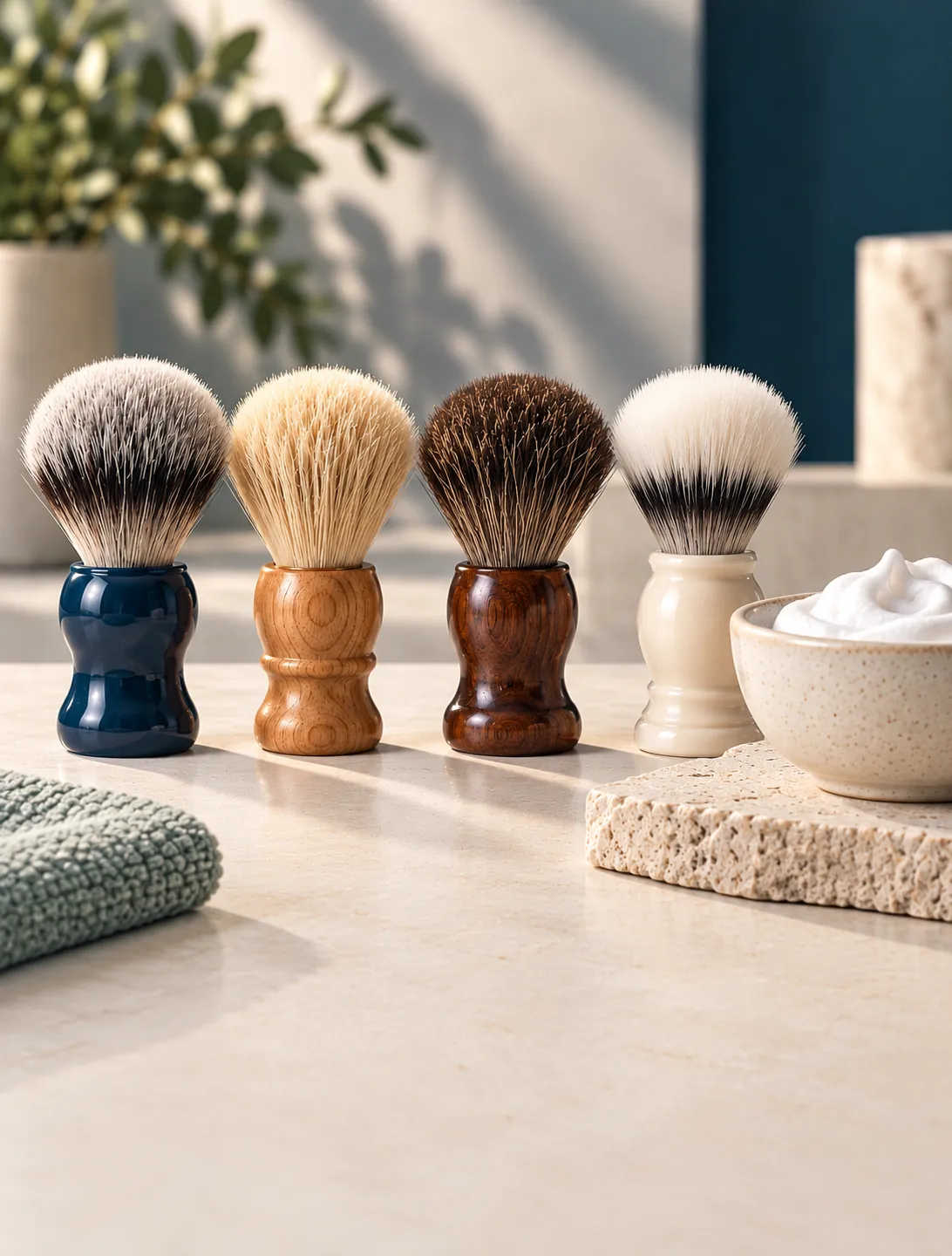
A brush cuts nothing, yet it shapes much of the shave. It carries water, mixes it with soap or cream and air, spreads the lather over the face and lifts the whiskers before the blade arrives. The most important job, softening the beard, is done by water and time (see “The Physics of Hydration“); the brush helps them along.
In his guide to traditional shaving, Michael Ham names four shaving brush types: synthetic, horse, boar and badger. Each holds water, builds lather and feels on the skin in its own way. There is no ranking, only the brush that suits your habits, and sometimes your mood.
Badger: softness and capacity
Most shavers, Ham notes, end up preferring badger, taken from the Asian badger. It is soft, holds plenty of water and lather, and needs no break-in.
Makers sell it in grades with names such as pure, best, super or silvertip. Ham warns that these categories are not well defined and vary from one manufacturer to another. One rule nearly always holds: hair with lighter tips is softer, and dearer. Descriptions you often read, such as silvertip being gathered only from the animal’s neck in winter, cannot be verified and are best taken for what they are: sales stories.
There is one more question a badger-brush buyer is entitled to ask. Most badger hair on the market comes from China, mainly from the Asian badger (Meles leucurus). An investigation by PETA Asia documented animals kept in small cages and killed for their hair, caught both legally and illegally; the UK’s Badger Trust called those practices wholly unacceptable and urges makers and buyers to choose synthetic alternatives. Not every supply chain is the same, but the origin of the hair is rarely stated, and asking the seller is already a mindful act.
Boar: break-in as ritual
The boar-bristle brush is the oldest kind and one of the cheapest. New, it is stiff and can feel scratchy. It improves with use: according to Ham, a week already makes a big difference, but the break-in goes on for a long time as the bristle tips split and become finer and softer. Ham suggests about two weeks of daily use for a brush from Italy’s Omega and six for one from Portugal’s Semogue.
Boar absorbs water into the fibre itself, more than badger does, so a few minutes’ soak in hot water before use helps. In return it offers firm backbone, handy with hard soaps, and a livelier feel on the skin. Some choose it for exactly that, and some enjoy the slow softening of the knot as a small story shared with their brush.
Horse: a middle way
Horsehair brushes, or horse-and-badger mixes, are made above all by a few Spanish firms. Ham describes horsehair as finer and softer than boar, though not quite up to badger: not widely used, but perfectly good for shaving.
They are often sold as the ethical choice, on the grounds that the hair comes only from grooming. In fact the source varies: tail and mane hair may come from clipping or from slaughter. Here too, the only way to know is to ask.
Synthetic: ready at once
Synthetic brushes have been around for a long time. The cheapest, in white nylon, look like a plastic whisk broom: they make lather, but they aren’t pleasant. The newer kind, Ham notes, are engineered specifically for shaving and deserve the nickname “artificial badger”: they make lather as good as a fine badger and hold plenty of it.
Synthetic fibre does not absorb water internally, so there is no soaking, no break-in, and the brush dries quickly, which makes it handy for travel. It is the natural choice for anyone with allergies or who prefers to avoid animal products. A tip from Ham: give it a shake after wetting, or it will release too much water as you start to lather. The “generations” often used to market synthetics are trade names, not a technical classification.
How do the shaving brush types compare?
| Hair | Water | Break-in | On the skin |
|---|---|---|---|
| Badger | Holds a lot | None | Soft, more or less depending on grade |
| Boar | Absorbs a lot into the fibre: soak before use | Long, one to six weeks | Lively, softens with use |
| Horse | Depends on the maker | Depends on the maker | Finer than boar |
| Synthetic | Surface only: shake it out | None | Soft from day one |
Looking after it
A good brush lasts many years with a little care. After shaving, rinse it thoroughly until no soap remains, in warm but not boiling water, which over time can weaken the glue that holds the knot. Then shake it out, without squeezing or twisting, and let it air-dry somewhere ventilated, ideally on a stand with the knot facing down. A closed cabinet with a damp knot is the worst place for it.
For the lathering itself, in a bowl or on the face, see “The Art of Lathering Shaving Soap“.
Shaving brushes: common questions
Which shaving brush is the softest?
Does a boar brush need breaking in?
How should you dry a shaving brush?
Choosing without hurry
The brush is one of the shaving tools you handle most. Softness matters, but so do its weight in the hand, the sound it makes on the soap, the time it asks for before it is ready. Badger gives instant comfort and raises questions about origin; boar asks for patience and repays it; horse sits in between; synthetic is ready at once and involves no animals. None of them is wrong. Try, watch how the lather changes and how your morning changes, and let the choice settle in its own time.
Sources and further reading
- Michael Ham, Leisureguy’s Guide to Gourmet Shaving, 4th ed., 2010, “Step 5: Apply lather – Shaving brush” (Library B001).
- Badger Trust, “Badger Trust statement on the PETA Asia investigation into the badger hair trade”: badgertrust.org.uk
- PETA, investigation into the Chinese badger-hair industry: investigations.peta.org
 English
 Français
 Italiano