

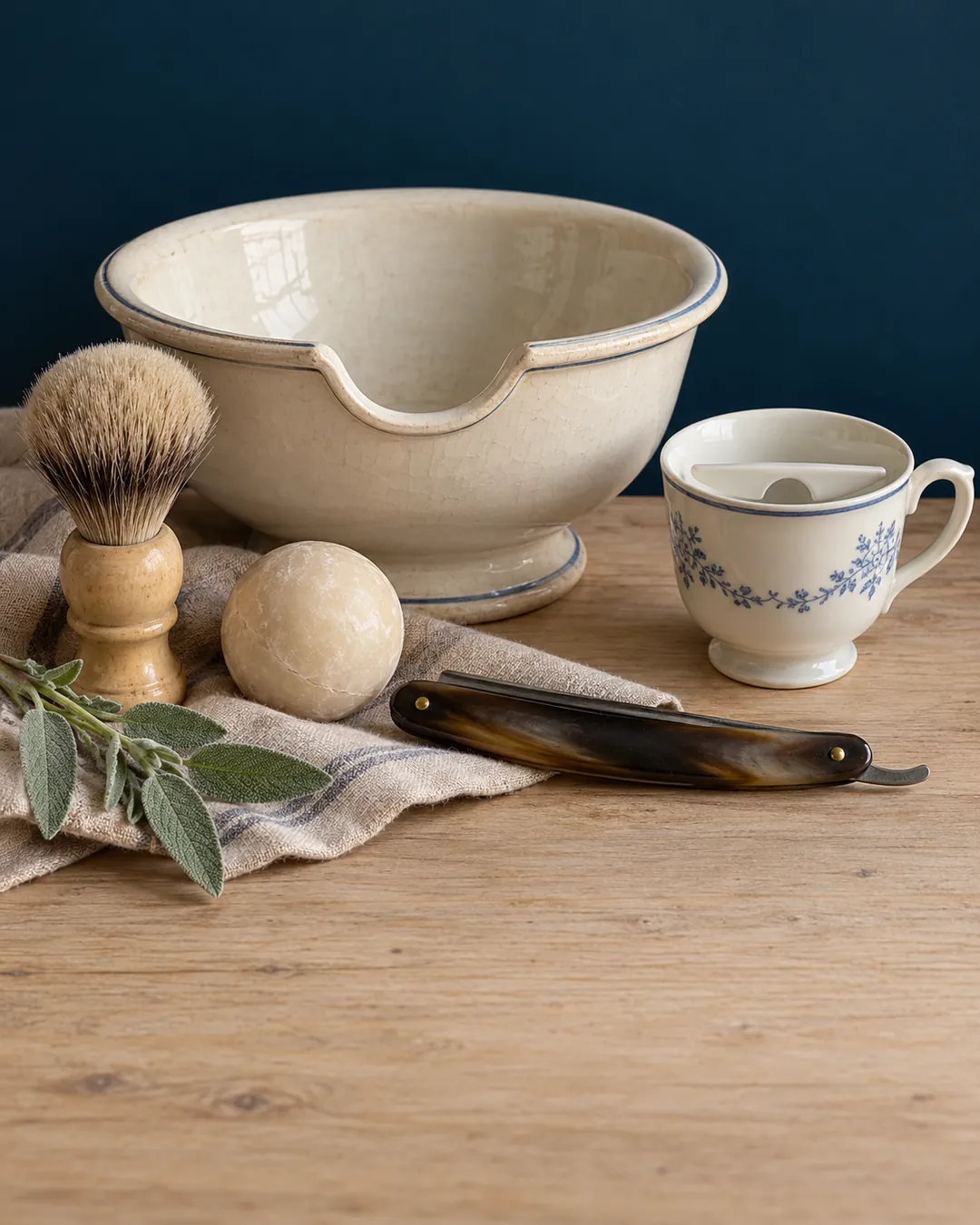
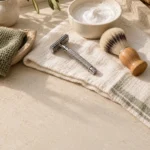
Today a slow shaver’s kit fits on a single shelf: a razor, a brush, a soap, a bowl. Over the centuries, though, shaving gathered a small collection of objects that have all but vanished from our bathrooms. We find them in museums and on market stalls. Gail Durbin, who worked for Norfolk’s museums, brought many of them together in a slim book on wigs, hairdressing and shaving bygones. Looking closely at these antique shaving items is a way of understanding how men shaved before us.
The barber’s bowl and its many identities
Many antique barber’s bowls are still labelled “bleeding bowls”. Durbin puts that right. They are shallow dishes with a broad rim and a U-shaped notch, made of earthenware, porcelain, metal or wood. The customer held the bowl to his neck, the notch fitting around it, and the barber used it to catch lather and whiskers. One delftware example from around 1740 even has a small depression for the soap, and the barber’s tools painted inside.
A large metal bowl hung outside the shop could also serve as a trade sign in place of the striped pole.
Wash balls and orris powder
In the seventeenth and eighteenth centuries, shaving soap came as a ball, shaped by hand or in a mould and often stamped with the maker’s name. For home use there were spherical silver soap boxes, pierced so the soap could dry. A barber might instead use a powdered soap scented with orris root.
The nineteenth century brought pottery jars with transfer-printed lids, then liquids, sticks and creams. Pears advertised a shilling stick that, it claimed, would last twelve months. A promise we still recognise: a good shaving soap really does go a long way.
Jugs, mugs and a brush from France
Hot water did not come from a tap. In wealthier homes a servant carried it from the kitchen in a jug; museums keep a silver one from 1713, baluster-shaped, its handle bound in leather against the heat.
Around 1840 the shaving mug appeared, used both at home and by barbers: one compartment for soap, one for water, a heavy base against spills. Often made on the Continent and decorated with views of British resorts, mugs were sold as holiday souvenirs.
The shaving brush, too, is younger than we might think. According to Durbin it came from France in the 1750s but did not become universal until a century later. Before that, barbers made lather with a sponge or their fingertips, as in the shop described in 1688. Badger was prized for softness and long life; hog bristle was cheaper and often preferred by barbers. The best handles were boxwood, whose fine grain absorbs little water.
Moustache cups
Perhaps the most curious object of all. Early in Victoria’s reign moustaches were a foreign oddity; from about 1850 they became fashionable, then respectable. Around 1855 the Staffordshire potters Harvey Adams and Company began making cups with a small pierced ledge near the rim to keep the moustache dry while drinking tea. They stayed popular for some fifty years, often given as gifts or souvenirs. Today we come across them at antique fairs without always knowing what they were for.
Seven razors, one for each day
During the nineteenth century, seven-day sets also appeared: seven straight razors, each with the name of a day etched on the blade. Anders Larsen dismisses them as a sales gimmick; one well-kept razor is all you need. That takes nothing from the charm of those cases, which speak of a time when a razor was something you owned rather than threw away. Durbin records another telling detail. When Gillette’s blades arrived, packets urged users to discard them after use, yet patented blade sharpeners multiplied, one promising two hundred shaves from a single blade.
For what really wears a blade down, see “What Really Dulls a Razor Blade“.
What these antique shaving items tell us
Together, these objects recall a time when shaving required different preparations: heating and carrying water, working up soap and keeping a blade sharp. It was not necessarily slow, or always pleasant. Yet many of those gestures survive. Today we can choose to give them time and rediscover the pleasure of using objects made to last.
On why durable objects still matter, see “The Resistance of Things That Last“.
Sources and further reading
- Gail Durbin, Wig, Hairdressing and Shaving Bygones, Shire Album 117, Shire Publications, Princes Risborough, 1984, section “Shaving equipment” and captions (Library B015). Bibliographic overview: https://vintagefashionguild.org/blog/wig-hairdressing-and-shaving-bygones/.
- Anders Larsen, Sharp Practice: The Real Man’s Guide to Shaving, Corgi, 2007, chapter “The Cut-throat Razor” (Library B002).
 English
 Français
 Italiano