

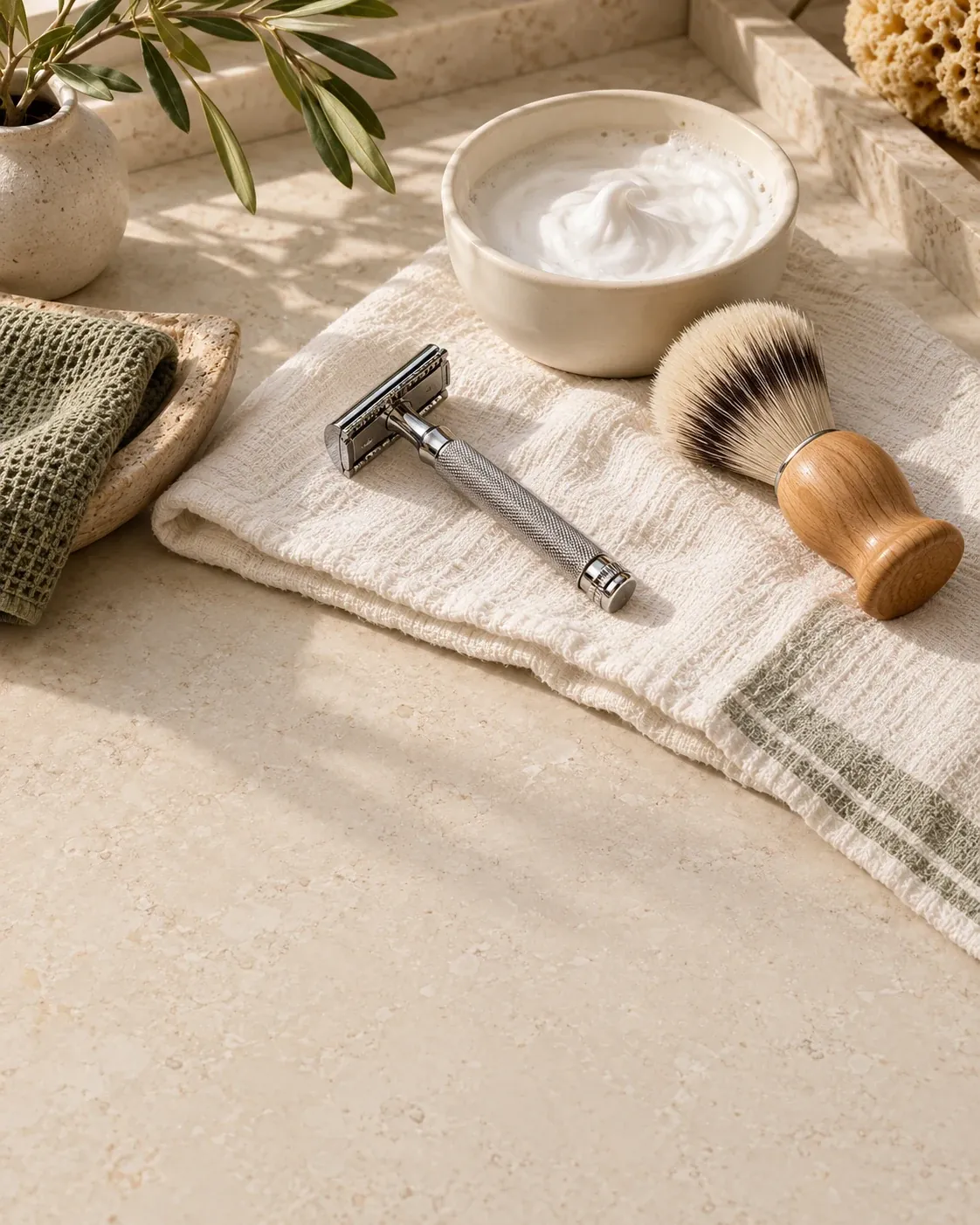
There is a passage that anyone who shaves slowly should know. It comes neither from a barbering manual nor from an advertisement, but from Benjamin Franklin’s Autobiography, written between 1771 and 1790. Franklin is discussing how to improve life in a city (clean streets, street lamps), and at a certain point broadens the discussion:
“Human happiness arises not so much from great strokes of good fortune, which seldom happen, as from the small advantages that occur every day. Thus, if you teach a poor young man to shave himself and keep his razor in order, you may contribute more to the happiness of his life than by giving him a thousand guineas.”
A thousand guineas was a fortune. Yet Franklin places a daily gesture on the other side of the scales: shaving yourself with a razor you take care of.
Why shaving yourself was an achievement
Today it seems obvious to shave at home. In the eighteenth century it was not. Historian Alun Withey, who has studied inventories, diaries and shop accounts from England between 1650 and 1900, shows that for much of that period the principal person doing the shaving was the barber. People went once, twice, at most three times a week, often on Saturday to look presentable at church on Sunday. The price ranged from a penny to a shilling, depending on the shop.
Things change after the middle of the eighteenth century. Two innovations make independence possible:
- Sheffield cast steel, which allows more reliable and less expensive razors;
- the first manuals for shaving yourself, such as that of French cutler Jean-Jacques Perret (1770) and the English guides by Savigny (1786) and Kingsbury (1797).
Shaving yourself thus becomes a small form of independence: from the barber, his hours and his charges. But it also becomes, Withey writes, an exercise in self-control: in the eighteenth-century culture of politeness, the smooth face is an “open” face, shown without masks, and knowing how to care for it is a sign of self-mastery.
The razor “kept in order”
There is a detail in Franklin’s passage that is often missed: shaving is not enough; you must keep your razor in order. At the time, that meant strop and hone. The razor was an object to maintain, not replace.
It is the same spirit we find, two centuries later, in those who choose a straight razor or a shavette. In his guide The Art of the Straight Razor Shave (2005), Christopher Moss describes honing as a “surprisingly relaxing” activity. And he sums up the method in a motto that applies beyond the bathroom too: “Go gently, go slowly and don’t go too far”, proceed slowly and gently, and do not overdo it.
In slow shaving, caring for the tool is part of the ritual. Drying the blade, rinsing the brush, putting everything back in its place: these are brief gestures, but they bring the shave to a close like a door drawn gently shut.
Learning: from fathers, from friends, on your own
How did people learn? Withey cites the diary of Ralph Jackson, a young apprentice from north-east England, who in 1757 records his first shaves, undertaken with the help of friends. Others learned by watching their father. Apprentice barbers even practised on sheep’s heads.
This chain broke in the twentieth century. In Sharp Practice (2006), Anders Larsen, and Michael Ham in the Guide to Gourmet Shaving, describe generations of boys left alone in front of the mirror with a disposable razor and a can: cuts, burning, nobody to explain. Both end their books with the same invitation: a son’s first shave is a transition that deserves guidance.
A small, everyday happiness
What does Franklin’s passage tell us today? Not that shaving makes us happy in itself. It says something subtler: that well-being is also built through small skills, the ones that make us a little more independent every morning. Knowing how to build a lather, read the direction of your beard growth, feel when the blade needs changing: these are small kinds of knowledge that stay with us.
Shave Therapy starts here. It promises no cures: it tells the experience of those who have found a point of stability in a gesture repeated attentively every day.
Sources
- Benjamin Franklin, Autobiography (written 1771–1790), part three.
- Alun Withey, Concerning Beards: Facial Hair, Health and Practice in England, 1650–1900, Bloomsbury Academic, 2021 (Library B028).
- Christopher Moss, The Art of the Straight Razor Shave: A Basic Guide, 2005 (B022).
- Anders Larsen, Sharp Practice, 2006 (B002).
- Michael Ham, Leisureguy’s Guide to Gourmet Shaving, 4th ed., 2010 (B001).


 English
 Français
 Italiano