

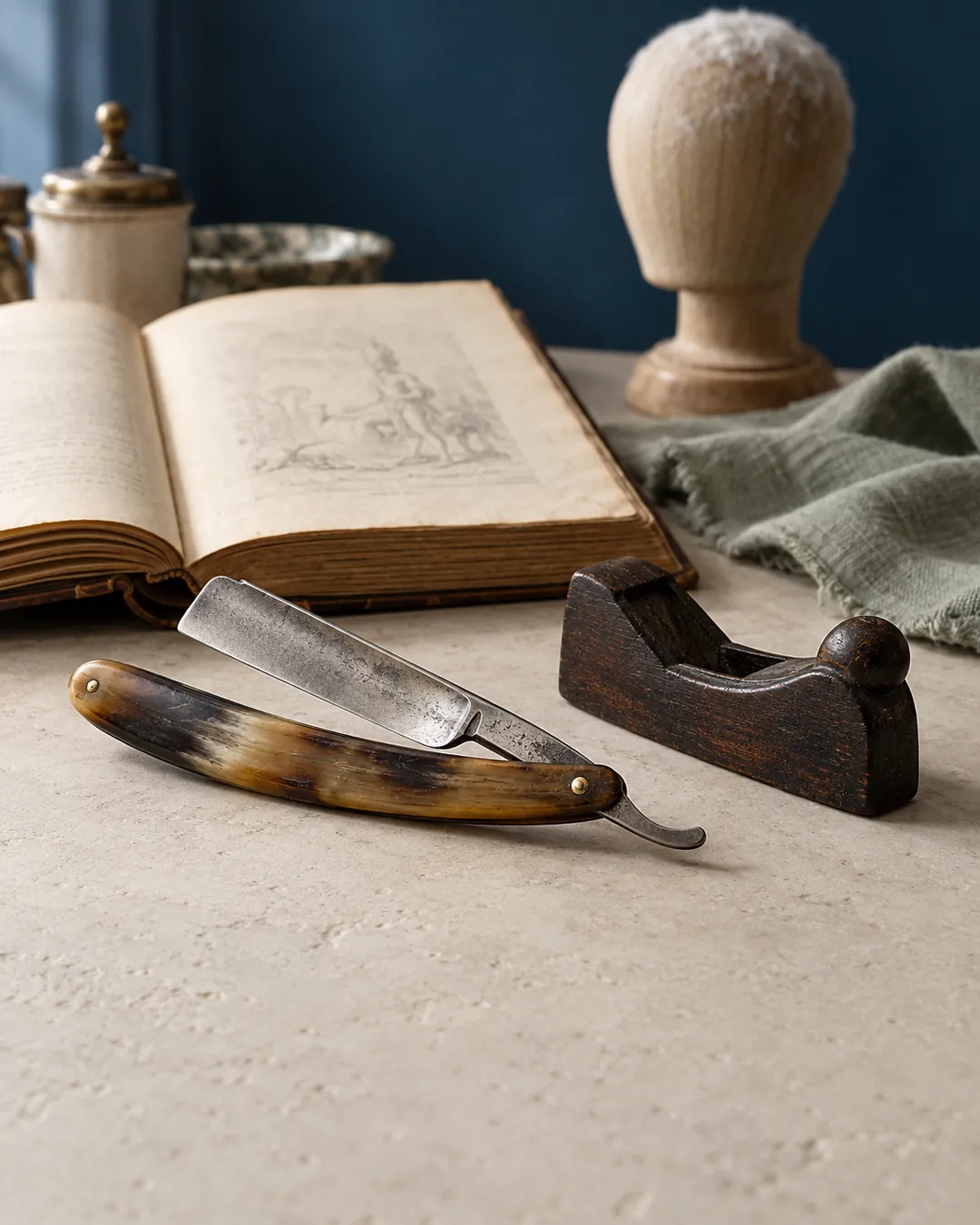
In 1769 a Paris cutler named Jean-Jacques Perret published a small book with an odd title: La Pogonotomie, ou l’art d’apprendre à se raser soi-même, “pogonotomy, or the art of learning to shave oneself”. The Greek coinage simply means “beard-cutting”. The subtitle also promises advice on hones, on making strops, and even a note on bloodletting. But the heart of the book is in those first words: learning to shave yourself.
For much of the seventeenth century, a shave was something a man received at the barber’s. Perret was writing just as that began to change, and he was among the first to put a method on paper for men who wanted to do it themselves. In his preface he says he is surprised that no master of the trade had ever explained the subject clearly.
Why shave yourself?
His first argument is not thrift but cleanliness. In the shop, he points out, the same razor, the same wash ball and the same towel go from face to face, including faces covered in spots and sores. He reasons with the ideas of his day, talking of “corpuscles” lodging in the pores of the steel, yet his concern about shared shaving tools touches on questions we now recognise as relevant to hygiene. He adds a simpler point: men who shave themselves, he writes, have “le visage uni et plus ragoûtant”, a smoother and more pleasing face.
The “plane” razor
For beginners Perret had his own invention, first made in 1762: the rasoir à rabot, or plane razor. An ordinary razor blade slid into a wooden guard shaped like a carpenter’s plane, which gave it its name. Only the edge showed; the wood stretched the skin on its own and kept the blade from biting too deep. Perret claimed that this guard allowed a close shave with less risk of cuts, even for someone with shaky hands or only one arm, and made it possible to shave the back of the neck. These were the inventor’s claims, not safety guarantees by modern standards. The first guards were rosewood; he later switched to ebony, which stayed cleaner.
What makes it interesting is how he meant it to be used. The guard was a learning aid. Once your hand was steady you took it off and carried on with the bare blade; if your confidence wavered, you put it back. Start protected, then earn your freedom. More than a century before the factory-made safety razor, the principle of a guided blade was already on the table.
The method, step by step
His chapter on shaving “by the ordinary method” remains a fascinating historical account. The instructions that follow describe Perret’s method in 1769; they are not necessarily techniques to reproduce with today’s razors. Start with two razors already stropped, so that if the first one pulls, the second is ready: you must not let the lather dry on your face. Hot water, or at least warm, and not much soap: three or four light touches of the wash ball, then work the lather up by hand, repeating if the beard is heavy.
Then posture. Keep the arm “suspendu et comme à demi-mort”, hanging loose, almost lifeless, so that all the movement comes from the wrist. The free hand stretches the skin, and the fingers move down with the blade: the closer the point of tension is to the edge, he writes, the less you risk, the less it hurts and the closer the shave. The spine sits about two lignes off the skin, a little under five millimetres.
His favourite verb is faucher, to mow, as with a scythe. You don’t push the blade straight; you let the whole length of the edge work, from heel towards point, in a slicing stroke. Near a spot you do the reverse, point to heel, with the lightest touch. For the moustache, lift the tip of your nose with two fingers; for the corners of the mouth, open it as the blade comes down; in hollow cheeks, push the skin out from inside with your tongue.
A first pass with the grain, a little more lather, then a second pass against it. For stubborn hairs that lie flat or cross each other, Perret gives advice we would now call beard mapping: find which way they grow and shave across, sideways or upwards accordingly. Every face has its tender spots, and they are worth studying patiently.
Practising on a wig block
His last suggestion is the most charming. To learn without drawing blood, take a wig block of wood, leather or pasteboard and powder its face. Set it in front of a mirror, stand behind it and go through the whole shave, skin stretching included, taking the powder off without scratching the surface and wiping the blade as if the powder were lather. Ten or twelve sessions, he promises, will do even for the clumsiest. He wishes barbers would train their apprentices the same way for three or four months before letting a trembling hand loose on a human face.
What he leaves us
Not everything in Perret should be taken at face value; his theories about hair and pores belong to the eighteenth century. But the fundamentals are all there, and traditional shavers still repeat them: taut skin, a relaxed wrist, a stroke that runs along the edge, reading the grain, patience in the early days. And so is the most modern idea of all: a good shave is not a gift, it is something you learn.
Perret’s remarks on hygiene and medicine are historical documents, not health advice.
Sources and further reading
- Jean-Jacques Perret, La Pogonotomie, ou l’art d’apprendre à se raser soi-même, Paris, Dufour, 1769, preface and chapters V–VII; Wellcome Library copy, digitised, public domain: https://archive.org/details/b33023050 (Library B038).
- Alun Withey, Concerning Beards: Facial Hair, Health and Practice in England, 1650–1900, Bloomsbury Academic, 2021, open access (CC BY-NC-ND 3.0): https://library.oapen.org/handle/20.500.12657/58843 (Library B028), on the shift from the barber’s chair to shaving at home.

 English
 Français
 Italiano