

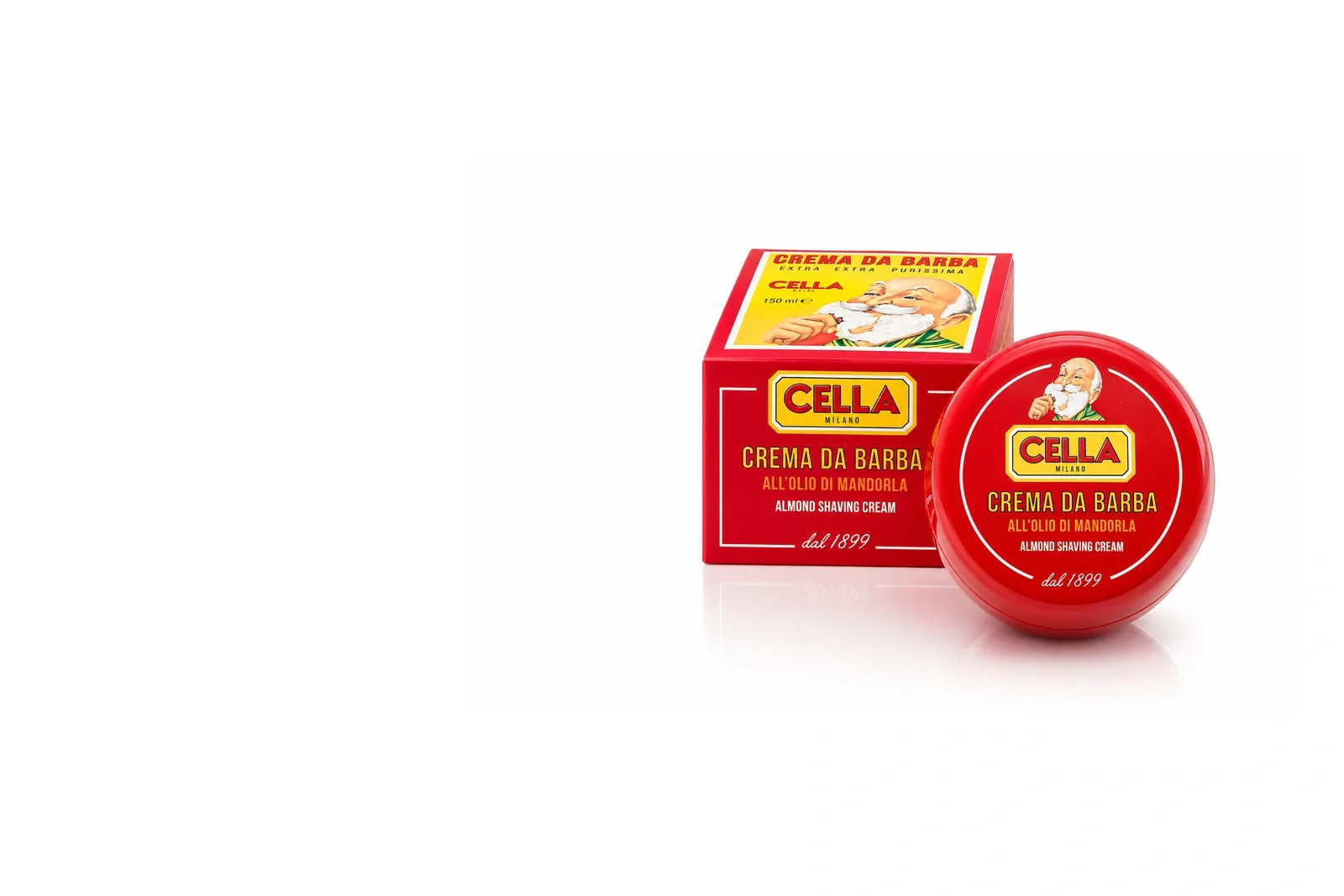
I bought this Cella Milano shaving cream myself, about a month ago. This review describes my second shave with it.
A shaving cream with a long Italian tradition, a lather that asks for patience and a scent that can turn a few minutes in front of the mirror into a moment entirely your own.
Some products win you over with their performance, others with their scent, others still with the history they carry. And then there are a few that manage to bring all of these together, without necessarily being perfect.
Cella Milano shaving cream, in its unmistakable red tub, belongs for me to that last group.
It was not the quickest cream to lather I have ever used. Its lather took some work and, during the shave, it even seemed to want to dry out. And yet, looking back on the experience, two things stay with me above all: the pleasure of working it slowly with the brush, and that extraordinary almond scent which, by the end of the shave, seemed to have taken over the whole room.
But let’s take things in order.
An Italian story that begins in 1899
To understand the appeal of Cella, you have to go back to Milan at the end of the nineteenth century.
The brand traces its origins to 1899, a time when personal care, perfumery and shaving were going through major changes. The barbershop was still a point of reference, but shaving was gradually becoming part of life at home as well.
According to the history published by the company, Cella made its name producing soaps and other personal care products. Over the twentieth century, its shaving cream became one of the brand’s signature products.
An interesting part of this story concerns the packaging and the advertising.
The famous smiling character associated with Cella, known as Mr Felice, stands for a shave enjoyed naturally and in good humour. The image of the man in pyjamas, his face covered in lather, suggests a moment at home, far from the formality of the barber’s chair.
It is an image I particularly like, because it gives shaving back something intimate and everyday.
The cream was historically sold in large formats for professional use as well. The 150 ml red tub, on the other hand, belongs to the product’s domestic side: compact, recognisable, made to keep the brush company in the daily ritual.
Cella still presents its cream today as the heir to the tradition that began in 1899. That does not necessarily mean the current formula is chemically identical to the original: the historical continuity of a brand and the unchanging nature of a recipe are two different claims.
And, as far as I am concerned, you don’t need to believe that nothing has changed in more than a century to appreciate the character of this product.
Is red Cella a cream or a soap?
Red Cella is sold as a shaving cream, but its formula and declared production process place it closer to the family of soft shaving soaps.
The manufacturer describes a hot-process saponification, followed by a maturing phase under controlled conditions.
Saponification is the chemical process through which fats react with alkaline substances to form soaps. In Cella’s case, the ingredient list printed on the documented packaging includes coconut oil, beef tallow, stearic acid and potassium and sodium hydroxides.
The result is a soft-textured preparation, made to be worked with water and a brush until it gives the lather you need for shaving.
The presence of beef tallow deserves a word: this formula uses an ingredient of animal origin and, for that reason, cannot be considered vegan.
That is not, in itself, a guarantee of superiority over products made exclusively with plant-based ingredients. Performance depends on the composition as a whole and on how the product is used.
And it is precisely in use that Cella starts to reveal itself.
Pure almond
You only need to open the tub to understand what the star of this cream’s scent is.
Almond.
Not a fragrance in which you go looking for some hint of almond, nor a complex accord in which you gradually pick out different notes. To my nose at least, Cella presents a full, immediate, wonderfully pleasant almond.
Pure almond, I would say.
It is a scent that recalls marzipan and certain traditional pastries, but which I personally don’t find cloying. It has something familiar, something old about it, without ever feeling dusty or dated.
The declared composition contains both sweet almond oil and fragrance ingredients, including benzaldehyde.
The latter is particularly interesting: it is an aromatic molecule associated with the characteristic smell of bitter almond and marzipan.
Of course, the presence of benzaldehyde does not allow us to reconstruct the whole fragrance, nor to establish how much each component contributes. It does, however, offer a chemically plausible explanation for such a recognisable almond note.
Sweet almond oil, on the other hand, plays a different role in the formula. A lipid ingredient should not be confused with the source of the whole scent.
For me, this olfactory identity is one of Cella’s greatest strengths.
And it becomes even more so once the brush gets to work.
The pleasure of a lather in no hurry
Not all shaving creams behave the same way.
Some produce an abundant lather quickly, almost without asking for any attention. Others need to be got to know, worked, accompanied with just the right amount of water.
In my experience, Cella belongs to the second group.
I used my Omega 10048 brush and built the lather in a bowl. It did not happen straight away: I had to work the product for a while before reaching the consistency I wanted.
For bowl and face lathering in general, see “The Art of Lathering Shaving Soap“.
But I don’t see that as a flaw at all.
On the contrary, it was one of the most enjoyable moments of the whole shave.
I like watching the lather take shape under the brush, gradually taking in air and water, growing in volume and becoming creamier and creamier. It is a slow, almost hypnotic transformation.
Meanwhile, the almond scent rises from the bowl and starts to spread through the room.
The brush keeps moving, the lather keeps growing and everything else can wait.
It is one of those moments when I like to put the world on pause.
After all, the Shaveslow philosophy grows partly out of this: the chance to give value back to gestures that, in the rush of daily life, we tend to treat as mere tasks to be ticked off.
There is no need to build a lather more slowly than necessary. But when that time becomes a pleasure, why would we want to cut it short?
For a traditional cream that lathers in seconds, see my review of “Taylor of Old Bond Street Lavender“.
Dense, creamy, but perhaps a little thirsty
Once ready, Cella’s lather struck me as dense and creamy.
Its consistency was satisfying, rich enough to spread over the face and to support the razor’s passes.
I did, however, notice one detail worth mentioning.
After a while, the lather gave me the impression that it was tending to dry out.
I can’t rule out that I contributed to this myself. Perhaps, eager to start shaving, I didn’t add all the water it needed. Or perhaps I didn’t work the lather long enough to reach its best balance.
It is a possibility, not a conclusion.
The question is interesting because it also comes up in some independent reviews.
Shave Gazette, for example, describes a lather that is dense at first but can dry out relatively quickly. Other users, on the other hand, report good stability and easier lathering.
This difference in experiences calls for caution.
The amount of product, the water used, the brush and the time spent lathering can all affect the result. Without controlled comparative tests, it would not be fair to blame the drying entirely on the formula.
For my part, I see this as something to explore in my next shaves rather than a proven flaw.
Cella probably still has something to teach me.
The razor test
For this shave I used a King C. Gillette with a Derby Premium blade, doing three passes.
Skin preparation was entrusted to the pre-shave from Cella’s classic line, while I used the Omega 10048 brush to build the lather.
Its behaviour during the shave was very satisfying.
I found the blade’s glide pleasant, smooth and effective. Despite the feeling that the lather might be drying out, I didn’t notice any real difficulty in glide.
The razor worked naturally and the result was close and precise.
It is important, however, not to automatically credit all of these qualities to the cream.
The pre-shave may have helped prepare the skin and improve glide. The razor’s geometry, the blade and personal technique also play their part in the result.
What I can say is simpler and, I think, more useful: in the setup I used, Cella supported a pleasant and effective shave.
I didn’t feel the need to compensate with extra pressure or to change the way I shave in any noticeable way.
And, above all, the comfort I felt stayed satisfying right to the end.
The pleasure that stays on the skin
It was after I put the razor down that Cella gave me one of its greatest satisfactions.
No burning. No irritation that I could feel.
To the touch, my skin was very soft, perfectly smooth both with and against the grain.
A particularly pleasant feeling, considering the three passes I had just done.
Naturally, I can’t turn this experience into a promise for everyone. Skin reacts to shaving differently from person to person, and two shaves do not prove any specific dermatological property.
But my experience was unmistakably positive.
And it matches what I read in several independent reviews, which also describe comfortable, soft skin after the shave.
With one caveat: since I also used the Cella pre-shave, I can’t isolate with certainty the contribution of the cream alone.
It is an important distinction, especially when you are trying to judge a product without confusing the overall experience with the performance of a single component.
Three products, one ritual
For this test I chose to use three products from Cella Milano’s classic line: the red pre-shave, the almond cream and the aftershave lotion.
A small coordinated ritual, at least in terms of brand identity.
When it came to scent, though, I noticed an interesting difference.
The pre-shave and the aftershave seemed quite similar to each other, while the cream keeps a more clearly almond identity.
The cream remains dominated by almond, while the other products express a more layered fragrance.
And yet these differences create no dissonance at all. On the contrary, the result is surprisingly harmonious. The full, enveloping almond of the cream meets the herbal nuances of the pre-shave and the aftershave, and the two olfactory souls end up blending and completing each other. Neither really prevails over the other: together they build a balanced scent with an old-world character, one that accompanies the whole ritual and seems to find its fullest expression right at the end.
To finish the shave I applied the red Cella aftershave lotion.
I felt only a very slight initial tingle, which disappeared almost immediately.
No lasting discomfort, no feeling of irritation.
The lotion brought the ritual to a pleasant close, while the room still held that old-world scent that had accompanied the whole preparation.
And this may be one of the most evocative qualities of the experience: the shave ends, but its sensory presence lingers for a while longer.
Inside the formula: tradition and cosmetic science
The INCI list printed on the 150 ml red packaging documented for this review includes:
- Cocos Nucifera (Coconut) Oil
- Adeps Bovis (Tallow)
- Stearic Acid
- Aqua (Water)
- Potassium Hydroxide
- Sodium Hydroxide
- Potassium Carbonate
- Glycerin
- Prunus Amygdalus Dulcis (Sweet Almond) Oil
- Parfum (Fragrance)
- Benzaldehyde
- Alpha-Isomethyl Ionone
- Benzyl Alcohol
- Benzyl Benzoate
This list comes from a photograph of a retail package found online, consistent in size and identification with the product I used. It was not checked directly on the original box of my own tub.
The formula is based on traditional saponification raw materials: coconut oil, beef tallow and stearic acid.
Potassium and sodium hydroxides are used to obtain the soaps by reacting with the fats. Their presence in the ingredient list does not, on its own, tell us how much free alkali remains in the finished product.
Glycerin is a humectant, while sweet almond oil is a lipid component of the formula.
It is important, however, to avoid over-interpreting.
The presence of glycerin or almond oil does not automatically prove a measurable moisturising effect on the skin after shaving. Supporting such a claim would require specific experimental data on the finished product.
The fragrance blend includes benzaldehyde and other declared fragrance ingredients, some of which may be relevant for people who are sensitive to fragrances.
Even a scent I personally find delightful may be unsuitable for someone with individual sensitivities.
Cella is therefore a product with a traditional formula, but that does not mean it should automatically be considered gentler, more natural or dermatologically superior to modern alternatives.
Its quality should be judged by what it actually delivers, not by the age of the recipe it refers to.
What others think
Red Cella’s reputation in the traditional shaving community is generally favourable, but not without reservations.
Independent reviews and user discussions highlight a few recurring themes: the almond scent, the consistency of the lather, the glide and the value for money.
The scent is perhaps the most divisive element.
For some it pleasantly recalls almond, marzipan and traditional pastry; for others it is too sweet or not very interesting.
Ease of lathering is another point on which opinions differ. Some get an abundant lather quickly, while others find they need to work it longer and pay special attention to the amount of water.
Protection divides opinion too: some find it excellent, while others would have liked a thicker or slicker lather. On post-shave comfort, however, the reviews I consulted agree and are positive.
These reviews are not comparative scientific tests. They are personal experiences, often with different tools and methods.
Their value lies above all in helping us spot aspects to watch and possible limits to check.
In my case, I find in the other accounts the pleasure of the scent, some uncertainty about managing the water and the final comfort: my skin stayed pleasantly soft, with no irritation that I could feel.
The differences between one experience and another are not a contradiction to be resolved.
They simply show that a shave is always the result of an encounter between a product, a technique and a person.
Shaveslow Verdict
The red Cella Milano won me over.
Not because it is a perfect cream, nor because it carries more than a century of tradition. Nor because its almond scent alone would be enough to make me like it.
It won me over with the experience as a whole.
With that lather that asks for a little patience and that I like to watch as it takes shape. With the full, recognisable scent that accompanies every movement of the brush. With the glide of the razor and the softness I found on my skin after three passes.
The lather’s possible tendency to dry out remains something to explore. I don’t want to ignore it, but nor do I want to turn a first impression into a final verdict.
And perhaps this is one of the pleasures of traditional shaving: getting to know products, giving them more than one chance, discovering small adjustments that can change the experience.
Cella reminded me that preparing the lather is not just the step you need before shaving.
It can be a moment to savour in its own right.
A brush, a bowl, a little water. The scent of almond slowly spreading through the air.
And the world, for a few minutes, can wait.
Sources
The following sources document the historical, production and cosmetic information and provide outside accounts. The sensory assessments and observations on the shave are my own personal experience.
- Cella Milano — Our history (official website): https://www.cellamilano.it/it/la-nostra-storia
- Cella Milano — Shaving cream in bowl: https://www.cellamilano1899.com/products/shaving-cream
- Cella Milano — The History and phases of the process: https://www.cellamilano1899.com/pages/the-history-of-the-process
- Maggard Razors — Cella Milano “Red” Crema da Barba, product page with the production process and the INCI list: https://maggardrazors.com/products/cella-milano-red-crema-da-barba-almond-shave-cream-150ml
- Shave Gazette — Cella Shaving Soap Review: https://shavegazette.com/reviews/cella-shaving-soap-review/
- Shaving Advisor — Cella Almond Shaving Cream Soap Review (site with declared affiliate links): https://shavingadvisor.com/soaps/cella-almond-shaving-cream-soap-review/
- Badger & Blade — Cella Shaving Soap Review, with the author’s later reassessment: https://www.badgerandblade.com/forum/threads/cella-shaving-soap-review.393604/
- Tools of Men — Cella Shaving Cream Review: https://www.toolsofmen.com/shaving-razors/cella
Methodological note: information from the manufacturer is reported as company statements. Third-party reviews are individual experiences, not clinical tests. The documented INCI belongs to a photographed retail package and was not checked directly on the personal batch used for this test.

 English
 Français
 Italiano