

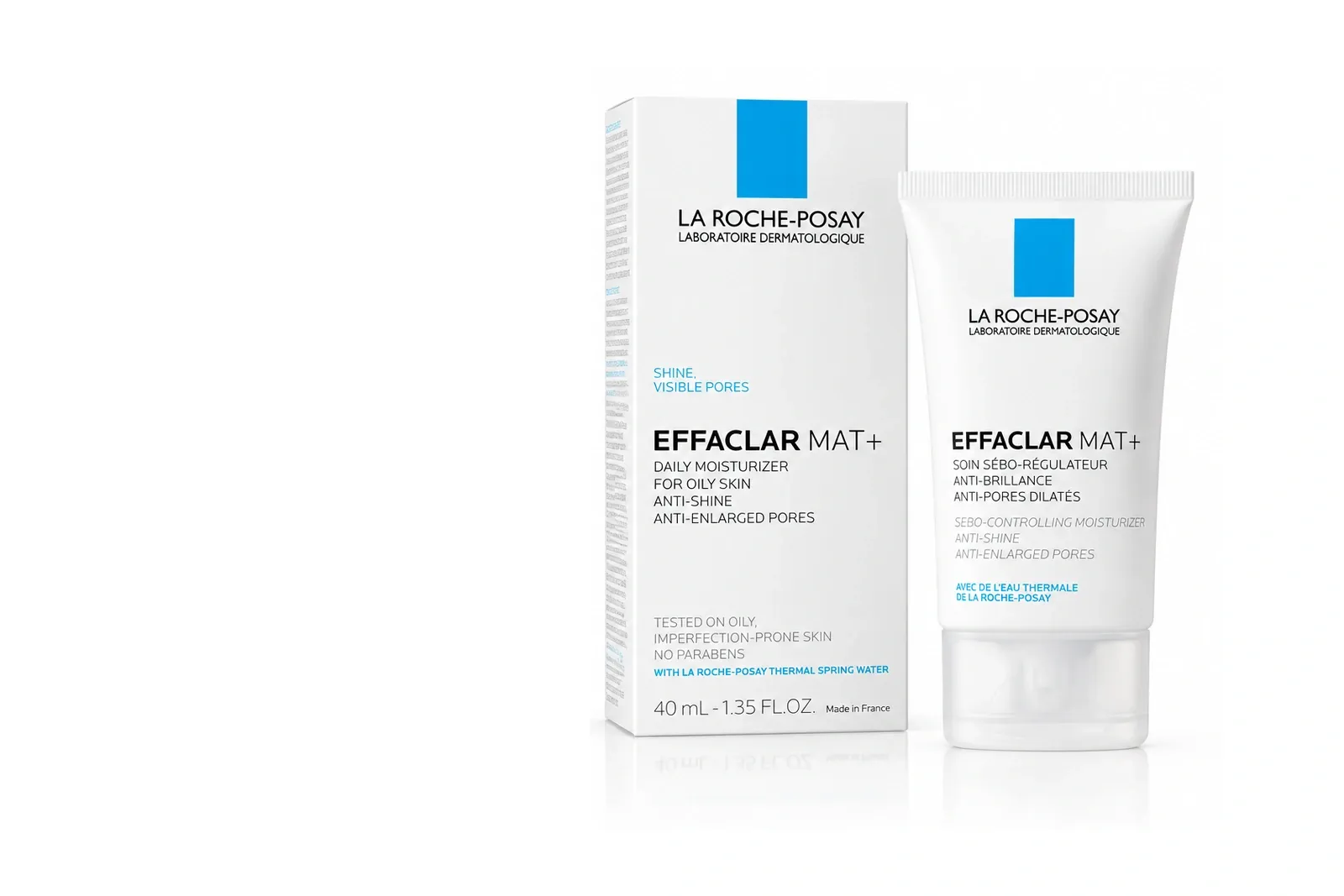
A cream that wasn’t made as an aftershave, but that can turn the last step of the shave into a surprising experience of softness, matte finish and comfort.
Bought myself. I’ve been using it for three months: two or three times a week in the warm months, once a week now that the weather is cooler.
The pleasure of shaving doesn’t end at the mirror
There is a moment, after a good shave, when everything seems to be in its place. The skin is clean, the aftershave has left its familiar freshness and the ritual can be considered complete.
And yet, especially on hot days, that pleasant feeling can change quickly. The face starts to shine again, perspiration makes itself felt, and a surface that was fresh and dry at first becomes less pleasant to the touch.
It isn’t necessarily the aftershave’s fault. It is simply the result of different needs: soothing the skin, keeping it hydrated, controlling sebum and limiting shine are not the same thing.
That is what drew me to La Roche-Posay Effaclar Mat+, a mattifying moisturiser I chose to add to my daily ritual.
I wasn’t looking for a new aftershave. I was looking for something that would let me prolong that pleasant feeling of dry skin which, for me, is an integral part of post-shave well-being.
A product made for a different need
Effaclar Mat+ is a 40 ml sebum-regulating moisturiser developed by La Roche-Posay for combination and oily skin, including sensitive skin.
The manufacturer presents it as a treatment to counter shine, visibly reduce the size of pores and help control excess sebum.
It is not an aftershave, nor is it marketed as a treatment for freshly shaved skin.
La Roche-Posay claims a mattifying effect for up to eight hours and hydration for up to twenty-four. These are the manufacturer’s figures and won’t necessarily be reproduced on every skin.
What makes Effaclar Mat+ interesting for anyone who shaves the traditional way is precisely this different intended use.
While many post-shave products favour freshness, emollience and immediate comfort, this cream focuses its cosmetic action above all on the skin’s finish.
And that is exactly the quality I was looking for.
My ritual: the aftershave is not the last step
The basic structure of my routine hasn’t changed.
Once the shave is done, I still use a traditional aftershave, usually an alcohol-based splash. I enjoy its sensory qualities and feel no need to give it up.
I wait for the splash to dry, and only then do I apply Effaclar Mat+.
It’s an extra step, but it has a precise purpose: a dry, matte finish that feels pleasant to the touch.
The first surprise is the texture.
Straight out of the tube, the product looks like a fairly dense cream. You might expect a rich, perhaps slightly greasy feel, as with some moisturisers.
On my skin, though, something different happens.
Within a few seconds of applying it, the feeling of the cream almost completely disappears. No greasiness, no oily film, no residue that makes my face unpleasant to touch.
The skin quickly becomes dry and smooth.
The closest comparison I can find is face powder.
Not because the product leaves any visible powder, but because of that particular velvety feeling when you run your fingers over the skin. An almost powdered finish, surprisingly pleasant.
In my case, the effect is striking.
And above all, it isn’t a feeling that fades after a few minutes.
The dry finish lasts a long time, even on the neck, an area I personally find more prone to perspiration.
That doesn’t mean the product stops you sweating. It means that, in my experience, the skin keeps a pleasantly dry surface feel even in conditions where I would normally feel more moisture.
It’s a difference I clearly notice, and it has made Effaclar Mat+ a much-appreciated complement to my ritual.
Why does the skin feel almost powdered?
To understand this feeling, it helps to look at the formula published by La Roche-Posay.
The ingredients include silica, perlite and cosmetic polymers that contribute to the product’s sensory and mattifying properties.
Perlite is a porous mineral also used for its absorbent capacity. Silica appears in many cosmetic formulas to control shine and change the surface finish.
La Roche-Posay attributes the immediate mattifying effect to the combination of perlite and absorbent microspheres.
The formula also contains dimethicone and other ingredients that can contribute to slip, spreadability and the final feel of the product.
This combination offers a cosmetically plausible explanation for the sensation I describe as a powder effect.
We cannot, however, attribute that feeling with certainty to a single ingredient, or measure the contribution of each component without knowing the concentrations and having specific experimental data.
An important distinction: sebum and sweat
When we talk about shiny skin, we often treat it as a single phenomenon.
In reality, sebum and sweat are two different secretions.
Sebum is produced by the sebaceous glands and helps protect the skin’s surface. When there is a lot of it, it can give the face a shiny look.
Sweat, on the other hand, is produced by the sweat glands and helps regulate body temperature.
Effaclar Mat+ is a sebum-regulating, mattifying treatment, not an antiperspirant.
The dry feeling I notice, even on the neck, is therefore no proof that sweating is reduced.
It is more accurate to see it as a sensory, surface effect of the formula, consistent with the presence of absorbent particles and ingredients that change the skin’s finish.
For me this distinction doesn’t make the product any less interesting. On the contrary, it helps me understand its role.
I don’t ask it to stop the skin doing its natural work. I simply ask it to make the feeling on its surface more pleasant.
Mattifying without giving up hydration
One widespread belief is that skin that feels dry to the touch must be dry skin.
It isn’t so.
Skin dryness depends, among other factors, on the water content of the stratum corneum and on how well the skin barrier works. Mattness is about how the surface looks and how it reflects light.
A cream can therefore leave a matte finish and, at the same time, contain moisturising ingredients.
Effaclar Mat+ contains glycerin, a humectant widely used in cosmetics to help hold water in the upper layers of the skin.
La Roche-Posay claims up to twenty-four hours of hydration.
That claim should not be mistaken for proof that the treatment is enough for every skin type, especially after a particularly aggressive shave.
The dry feeling I enjoy is not, on its own, an objective measure of how hydrated the skin is.
Ingredients worth a closer look
The formula published on the official French website also contains alcohol denat., salicylic acid, capryloyl salicylic acid and fragrance.
These ingredients deserve attention when considering using the product after a shave.
Salicylic acid and capryloyl salicylic acid belong to a family of ingredients also used for their exfoliating properties.
Denatured alcohol can contribute to the character of the formula, while the fragrance gives it its olfactory identity.
None of these ingredients automatically makes a cosmetic unsuitable for the skin. Tolerance depends on the overall formula, the concentrations, how often it is used and individual sensitivity.
Shaving, however, can cause irritation and redness, especially when the blade works the skin hard.
That is why applying Effaclar Mat+ straight after a close shave calls for caution, particularly on skin that is already sensitised, red or nicked.
The fact that I use it after an alcohol-based splash does not mean this combination is advisable for everyone.
Anyone who experiences burning, recurring irritation or particular sensitivity should favour products formulated specifically for post-shave comfort, and think carefully before adding further treatments.
Who might Effaclar Mat+ suit?
Effaclar Mat+ may appeal above all to those with combination or oily skin who want a less shiny finish after their skincare routine.
In traditional shaving, it can be a complement for those who dislike the feel of a rich cosmetic film and prefer a dry, velvety surface.
I would not, however, consider it an automatic choice for very dry, compromised or easily irritated skin.
It’s also worth remembering that it does not replace sun protection when that is needed.
Using it after shaving remains a personal adaptation of the product’s normal cosmetic purpose, not a post-shave protocol specifically validated by the manufacturer.
Shaveslow Verdict: a small gesture that changes how the ritual feels
Traditional shaving teaches us to pay attention to details.
To the temperature of the water, the consistency of the lather, the pressure of the blade, the direction of the hair and the feeling each pass leaves on the skin.
And yet we sometimes pay less attention to what happens afterwards.
Once the razor is put away and the aftershave applied, we consider the ritual over.
Effaclar Mat+ led me to reconsider exactly this moment.
It hasn’t replaced the products I already used. It has added something I was personally looking for: a dry, matte, almost powdered finish that keeps a particularly pleasant feel for a long time.
Its initially creamy texture, how quickly it loses any greasy feel and how long the effect lasts on the face and neck are what struck me most.
I can’t claim that everyone will get the same result, or that the product suits every shaving routine.
But I can tell you what I have experienced myself.
And in my experience, Effaclar Mat+ has found a precise place: not instead of the aftershave, but after it.
Because the pleasure of a good shave shouldn’t end at the mirror.
It should stay with us in the hours that follow.
Sources and references
- La Roche-Posay — Effaclar Mat+, official French product page. Product description, intended use, INCI list, key ingredients, directions and efficacy claims. The manufacturer’s percentages come from a four-week cosmetoclinical test with self-assessment by 150 women and are not an independent test on freshly shaved male skin. www.laroche-posay.fr
- La Roche-Posay Africa — Effaclar Mat. Additional information on the formula, perlite, absorbent microspheres and mattifying properties. africa.laroche-posay.com
- Cowley K., Vanoosthuyze K. — The biomechanics of blade shaving. International Journal of Cosmetic Science, 2016. On the physical mechanics of shaving and its possible irritant effects on the skin. pubmed.ncbi.nlm.nih.gov
- Male skin and ingredients relevant to male skin care. British Journal of Dermatology, 2012. On male skin care, shaving and the role of moisturising ingredients, including glycerin and emollients. pubmed.ncbi.nlm.nih.gov
- Facial hair shaving behavior and skin problems of shaved areas of males. The Journal of Dermatology, 2021. Observational study of shaving habits and related skin problems. pubmed.ncbi.nlm.nih.gov
- Allergic Contact Dermatitis Associated With Men’s Personal Care Products: A Review of Allergens. 2024 scientific review of allergic contact reactions to men’s cosmetics, including aftershaves and moisturisers. pubmed.ncbi.nlm.nih.gov
A note on method
The sensory experience described here is a personal account, not a clinical study. The quantitative performance claimed by La Roche-Posay is reported as manufacturer information.
The ingredient list is the one published on the official French website, consulted on 29 October 2026. As I no longer have the outer box with the INCI, I cannot certify that the list matches the exact batch I bought.
Using it after shaving is the author’s personal choice, not a use specifically documented by the manufacturer.
 English
 Français
 Italiano