

How often do we find ourselves doing something with our hands while our minds are already three steps ahead, focused on commitments, problems or things to do afterwards? When we live in this state of constant anticipation, we end up draining the present of its value, turning every gesture into a mere obstacle to get past as quickly as possible.
In his celebrated manual The Miracle of Mindfulness, Zen master Thich Nhat Hanh offers a teaching of disarming simplicity that revolutionises how we approach our daily routine.
What are the two ways of washing dishes (and lathering soap)?
Thich Nhat Hanh explains that there are essentially two ways of washing dishes: the first is to wash the dishes in order to have clean dishes, while the second is to wash the dishes in order to wash the dishes.
At first glance this may seem a trivial distinction, but it contains a profound insight. If, while washing the bowls, we think only of the cup of tea waiting for us later, we will try to hurry to get the chore out of the way. But at that very moment, the master observes, we are not truly alive: we have been sucked into the future, unable to notice the miracle of life and inhabit the only real moment that belongs to us.
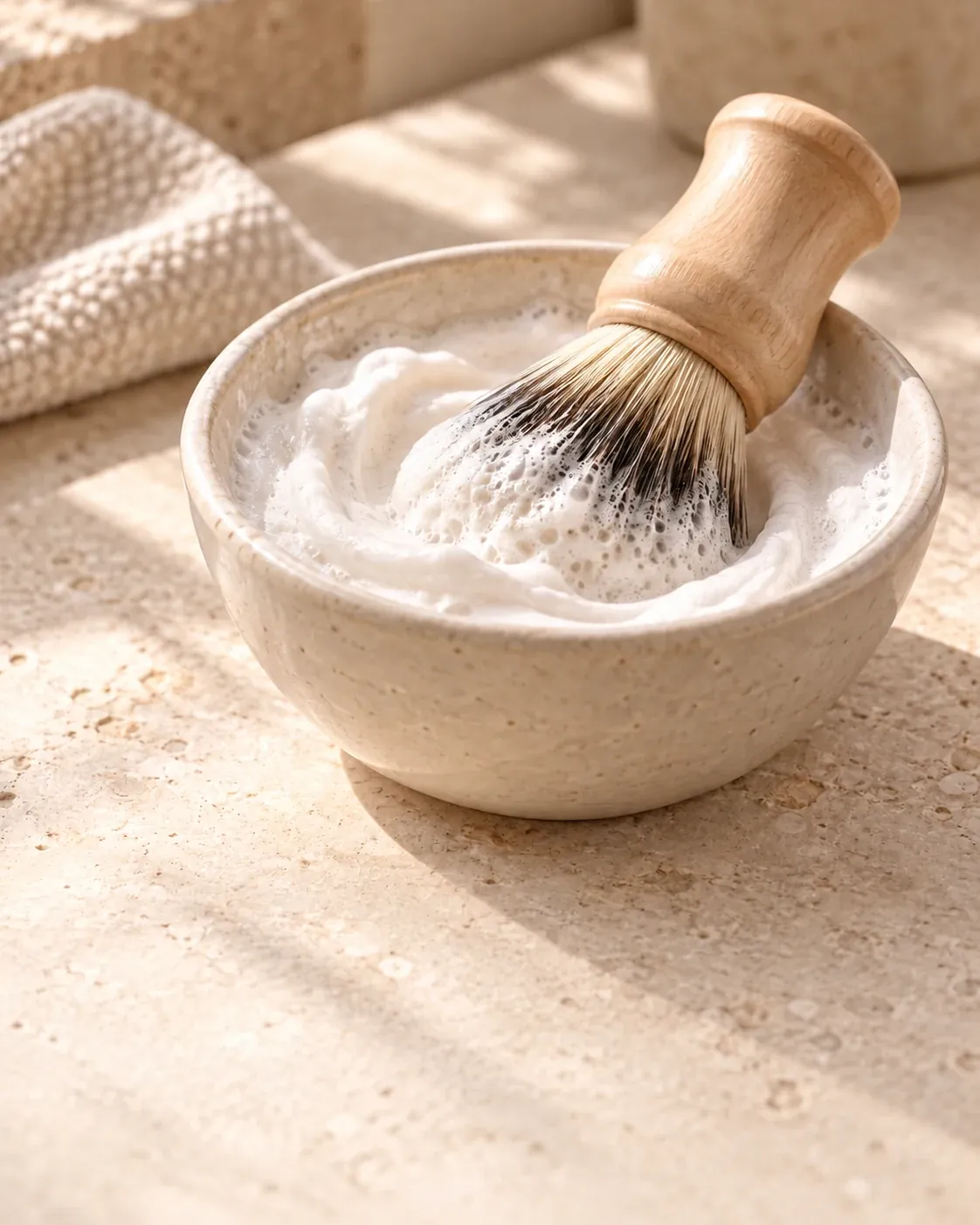
If we truly want to live, then while washing dishes, washing dishes must become the most important thing in our lives. Applied to our morning ritual in front of the mirror, this principle becomes a fundamental rule: while we lather shaving soap, lathering soap must be the only thing that matters.
The cushion of lather as an object of contemplation
When we approach the bowl with this frame of mind, preparing to shave stops being a tedious preliminary task and becomes a form of meditation in action.
Every detail of the gesture regains dignity and sacredness:
- The response of the brush: Feeling the bristles meet the warm water and load the soap.
- The birth of the lather: Observing the gradual transformation of the cream from smooth to dense, glossy and protective.
- The tactile feeling on the face: Perceiving the warm, moisturising caress of the brush as it massages the skin and lifts the beard hairs.
The aim is not to rush through the task to “get it out of the way”, but to immerse ourselves entirely in the gesture, treating the bowl and brush as true objects of contemplation.
The breath as a bridge between body and mind
What should we do if the mind, accustomed to racing, starts to wander or is besieged by anxious thoughts and worries? Thich Nhat Hanh teaches that mindful breathing is the natural bridge connecting life to consciousness, bringing the body and thoughts together.
Whenever we notice that we have lost concentration or feel impatient, we need only bring our attention back to the flow of air entering and leaving our lungs. The breath acts as a miraculous anchor that calls back the scattered mind and gathers it together, restoring our self-command.
The true miracle is in the present
We often imagine meditation as a complex abstraction or a withdrawal from the world. On the contrary, mindfulness reminds us that the true miracle is not walking on water or in the air, but walking on earth and being fully aware of every single second.
Making room for mindfulness while shaving means giving ourselves an oasis of unconditional peace. When we lather soap for the sheer pleasure of lathering soap, the mind grows quiet, stress dissolves, and we discover that even on a difficult day it is possible to reclaim a fragment of pure joy and complete presence.
Sources
This article is based on the following works in the Shaveslow Library:
– Thich Nhat Hanh, Il miracolo della presenza mentale (The Miracle of Mindfulness), 1975 (Library B020)

 English
 Français
 Italiano