

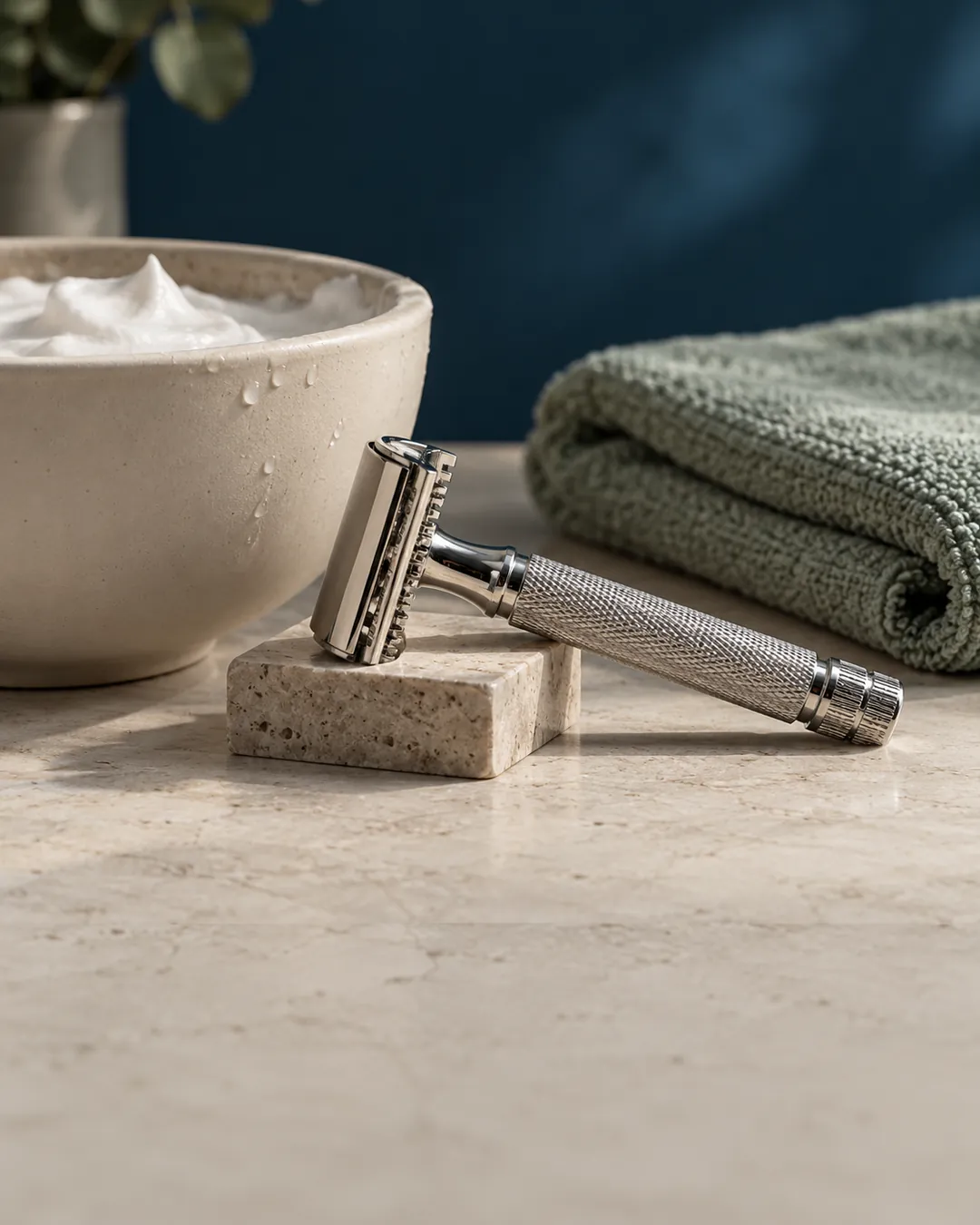
We usually describe a traditional shave in terms of sight and touch: the mirror, the blade angle, the pressure, the skin under our fingertips. But one sense works quietly, and in fact depends on quiet: hearing. Anyone who shaves with a safety razor or a straight razor soon learns that the blade talks. It pays to listen.
The right sound and the wrong one
Michael Ham, author of one of the most widely read guides in the wet-shaving community, gives sound a section of its own. His advice is practical: before you start, switch off the extractor fan, the radio, the running tap. In a quiet room you can hear the razor at work, and not every sound is the same. Cutting whiskers can produce a small, crisp crackle. A duller or dragging sound may signal a change, but sound alone cannot diagnose a wrong angle or skin irritation.
Ham is clear that this is not a Zen idea, pleasant as the sound may be. It is feedback. The appropriate angle varies from razor to razor. Ham describes listening for changes in the cutting sound as the blade meets the stubble; sound alone, however, cannot confirm that the angle is safe or effective. His troubleshooting chapter even lists “Bathroom Too Loud” as a problem. Shaving without hearing, he says, is like “flying blind”.
Razors that speak up
Some razors make the sound easier to hear. Ham mentions the Merkur Progress and Futur and the heavy Vision, which hold the blade in a way that amplifies what happens beneath the lather. With a well-matched blade, he writes, the Vision sounds like an elephant crashing through distant brush. With any razor, though, you will hear it if the room is quiet.
With a shavette or a straight razor, listening matters even more. There is no head to fix the angle; it all rests on the hand, and the ear becomes a second instrument of control.
The hiss of the strop
For straight-razor users, the sound begins before the shave. In Sharp Practice, Anders Larsen describes stropping almost as a small performance: linen first, then leather, the blade drawn slowly, the hiss echoing off the tiles. The right pressure, he explains, is light enough to produce that snake-like hiss. Again, the sound is a gauge: press too hard and it disappears.
Larsen goes further than technique, though. Asked what he thinks about while stropping, he answers: nothing, “the opposite of thinking”. It is where he clears out the bad stuff and finds peace. The steady rhythm of the strop is good for the edge, and it slows the person holding the razor. A relaxed hand, he reminds us, is exactly what you want when the blade reaches your face.
The bathroom as a listening room
Shaving was not always a quiet act. The historian Eleanor Decamp, cited by Alun Withey, has reconstructed the “soundscape” of early modern barbershops: the snip of scissors, the slap of hands, the barber’s endless chatter. Shaving alone, behind a closed bathroom door, changed that too. It made the shave one of the few moments in the day when we choose what we hear.
What about the soundtrack?
Every Shave Note on Shaveslow has its own Shaving soundtrack. Is that a contradiction? Not necessarily. Larsen himself admits he shaves to Pink Floyd. There is room for both: music before and after, or quietly during preparation, then a few passes in silence while the blade works, especially when you are learning a new razor or a tricky area like the neck. It is not a rule, just a way to make space for two kinds of listening.
In the end, listening to your razor is one more exercise in attention, with a rare advantage: it answers straight away. The crackle of cut whiskers can be useful feedback, but it does not prove that the angle or pressure is right. If the sound becomes an unfamiliar scrape or the skin feels uncomfortable, pause and check the angle, pressure and lubrication. Listening helps, but it cannot replace what your skin tells you.
Sources and further reading
- Michael Ham, Leisureguy’s Guide to Gourmet Shaving: Shaving Made Enjoyable, 4th ed., Pogonotomy Press, 2010, technique chapter (“The sound”) and troubleshooting (“Bathroom Too Loud”) (Library B001). Verified bibliographic record: https://openlibrary.org/books/OL39481741M/Leisureguy%27s_guide_to_gourmet_shaving.
- Anders Larsen, Sharp Practice: The Real Man’s Guide to Shaving, Corgi, 2007, chapter “Stropping and Honing” (Library B002).
- Alun Withey, “Barbers and their Shops in Early Modern Britain”, blog, 20 September 2018, drawing on Eleanor Decamp, Civic and Medical Worlds in Early Modern England, Palgrave Macmillan, 2016: https://dralun.wordpress.com/2018/09/20/barbers-and-their-shops-in-early-modern-britain/.


 English
 Français
 Italiano