

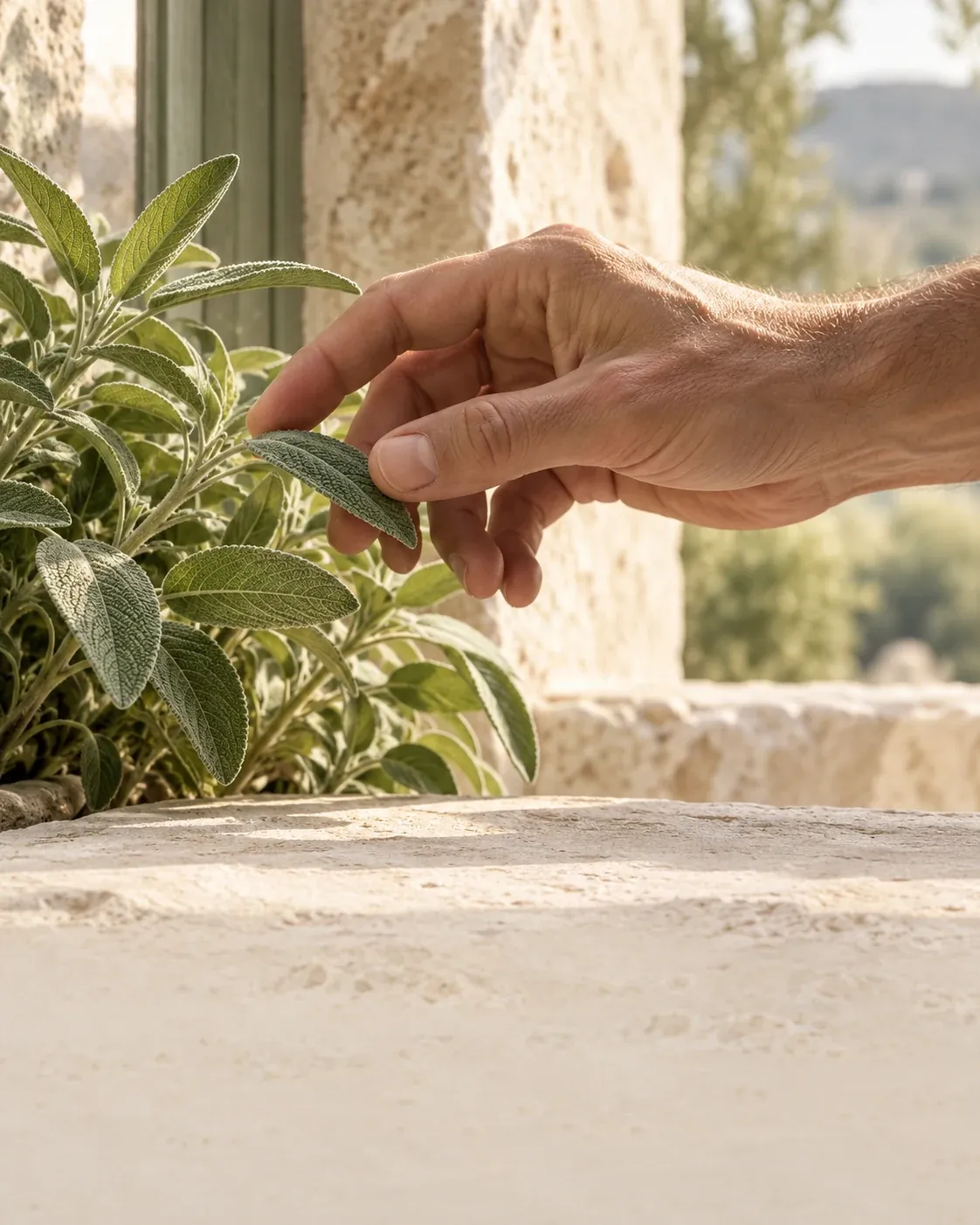
In an age that celebrates mental agility, quick reflexes and speed of execution, those who choose to move slowly are often regarded with suspicion, labelled lazy or inept. Yet true slowness has nothing to do with clumsiness or apathy. As French philosopher Pierre Sansot shows in his celebrated essay Du bon usage de la lenteur (The Good Use of Slowness), slowness is neither a character flaw nor a lack of energy, but a genuine and freely chosen way of life.
Deciding to be slow means refusing to force duration and choosing not to be overwhelmed or jostled by time. Applied to the morning ritual, this philosophy turns shaving into an art of movement and sensitivity.
Brushing against reality, not bustling about (“Effleurer et non s’affairer”)
Among Pierre Sansot’s most poetic maxims is an invitation of disarming elegance: effleurer et non s’affairer, that is, “brush lightly rather than bustle about”.
Busyness is the attitude of those who want to enlist or subjugate the world to their immediate purposes, piling up tasks and running without pause. Those who bustle grasp things with greed or impatience, ending up never savouring anything and becoming blind to the surrounding beauty. By contrast, brushing lightly expresses deep respect for reality: a gentle and attentive way of approaching things and beings, letting them reveal their nature at their own pace.
During traditional shaving, the principle of “not bustling about” translates into a very precise technical gesture:
- Lightness of touch: The safety razor should not be pressed against the tissues; the blade should glide, barely touching the epidermis, guided only by its own weight.
- Sensory listening: Brushing the face with the shaving brush or lather means tuning into the warmth of the water and the fragrance of the soap, welcoming the present moment rather than chasing the clock.
What gives a ritual its grace?
What is the grace of a gesture? Pierre Sansot observes that grace arises from the alliance between necessity and freedom.
- There is necessity because the gestures performed cannot and should not be different from what they are: they follow a precise and rigorous path.
- There is freedom because those movements are not performed under the threat of an external constraint or compulsion, but flow naturally.
When we watch a gesture performed with grace, we perceive an intimate sense of harmony. In daily shaving, the hand guiding the razor follows a geometric necessity (maintaining the correct angle to the skin), yet does so with the ease of someone in no hurry. Slowness is not an artificial slow-motion pose, but the fundamental condition for the hand to find its balance, turning an ordinary action into a moment of genuine harmony.
Not forgetting ourselves along the way
Sansot reminds us that the true virtue of slowness lies in increasing our ability to welcome the world without forgetting ourselves along the way. Those who are always running, who try to compress duration to do everything faster, end up living in a perpetual famine of time, drained of energy and unable to enjoy the fruits of their days.
Allowing ourselves a slow rhythm in front of the bathroom mirror means claiming our right to an oasis of inner tranquillity. It means remembering that life is not a rushing river to master at any cost, but a subtle light and an unfolding of precious drops. Learning to handle the blade lightly, with respect and patience, is the first step towards learning, every day, to touch life with grace.
Sources
This article is based on the following works in the Shaveslow Library:
– Pierre Sansot, Sul buon uso della lentezza (Du bon usage de la lenteur – The Good Use of Slowness), 1998 (Library B019)

 English
 Français
 Italiano