

Anyone new to traditional wet shaving soon meets a mountain of opinions. This blade is smooth, that one harsh; this soap has great slickness, that one dries the skin. Then you try them, and your own face tells a different story. That is hardly surprising: beards and skin vary enormously. So how do you find out, on your own and without fooling yourself, what actually works for you?
A simple and rigorous answer comes from a laboratory nearly ninety years old.
Born in a lab
In the 1930s, at the Mellon Institute in Pittsburgh, the researcher Elbridge J. Casselman and the dermatologist Lester Hollander studied shaving for years with a group of men who shaved daily to precise instructions. The work, it should be said, was funded by a razor maker. They had instruments to measure blade sharpness and the amount of skin and hair removed, but every important conclusion was checked with a method that, as Casselman wrote in Scientific American in 1937, the average man could use at home: the “comparison shave”.
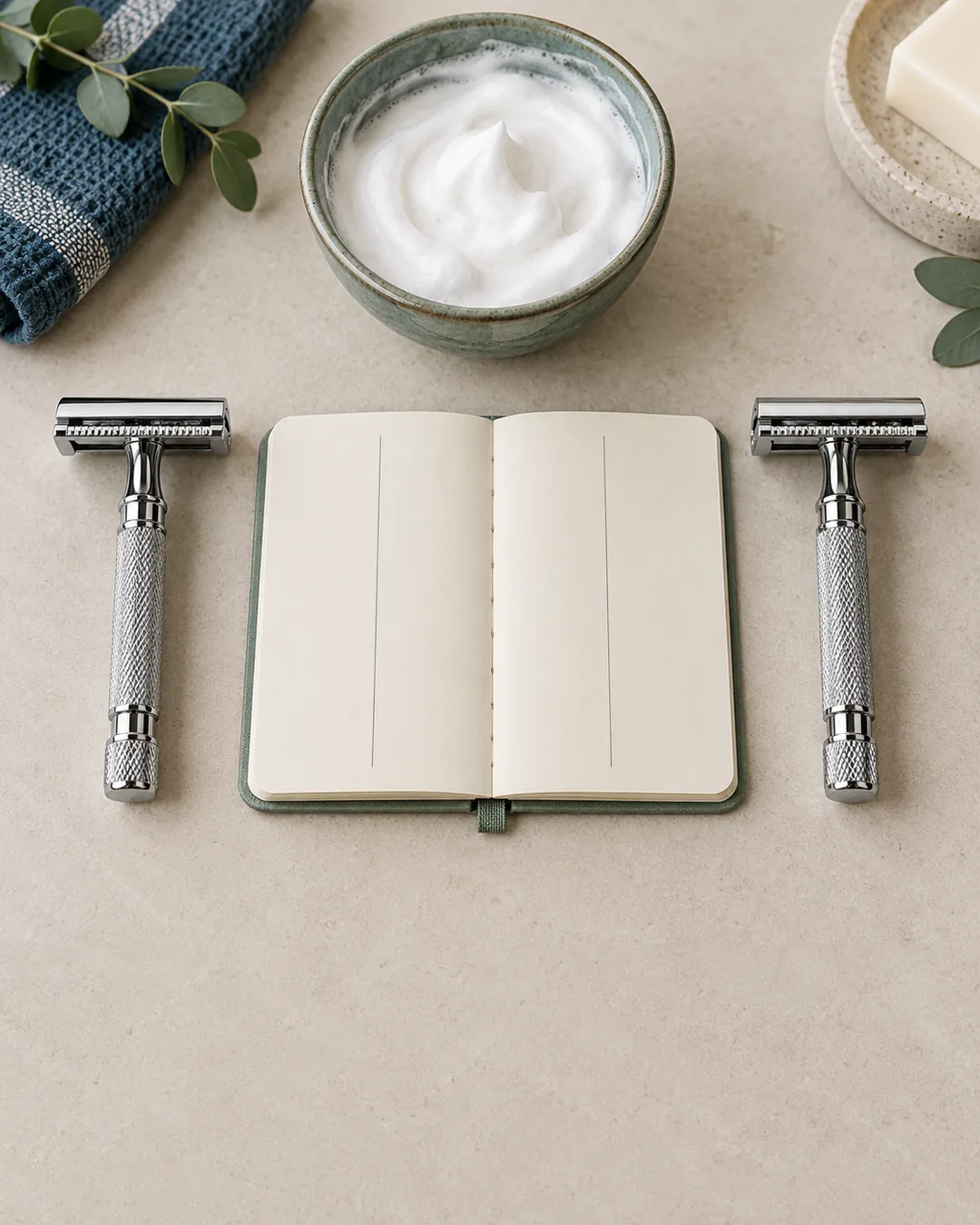
The idea is this. Take two razors identical in every respect except the one you want to study: the blade, say, or the soap. Soften the beard thoroughly, then shave one side of the face with the first razor and the other side with the second. On the following days, reverse the order, to cancel out whatever you cannot control. Then compare three things: how much effort a close shave takes, how much the razor pulls or scrapes, and how the skin looks afterwards.
Why sides alone are not enough
It sounds like a detail, but reversing the order is the heart of the method. The side you shave second has had longer to soften under the lather, and preparation, as the same clinic measured, changes the result considerably. Hollander and Casselman even advised shaving the easier areas first, precisely to give the difficult ones a few more minutes of water. If blade B always ends up on the side shaved second, it starts with an advantage.
Then there is the beard itself. In the clinic, hair density varied widely across the face: the upper lip and the centre of the chin carried many more hairs per square centimetre than the lower cheek. The angle at which hair leaves the skin varied too, and near the throat it could lie almost flat. So compare symmetrical areas, cheek against cheek, and don’t judge by the neck. Finally, the same man changes from day to day and even with the seasons: one comparison is not enough; you need several.
Casselman thought that a lack of controls like these explained many false notions about shaving. One example: the belief that blades go dull resting in the drawer, when his measurements showed they wear out mainly by shaving.
How to do it today
The method adapts easily to a home bathroom. A few practical suggestions, offered as ideas rather than rules:
- One variable at a time. Two different blades in two identical razors; or one razor with two soaps, one per side. Everything else the same: water, prep time, brush, number of passes.
- Full preparation. If the beard isn’t properly softened, the test mostly measures your hurry.
- Reverse the order. Start on the right one day, on the left the next.
- Several shaves. Note your impressions over a number of days, not just once.
- A few words, always the same. Effort, pulling, how the skin feels at the end and a few hours later.
- A helper, if you can. Ask someone to load the blades and mark the razors only A and B, so expectations don’t steer your judgement.
A method without rankings
The 1937 clinic found huge differences between men: some dulled blades eight times faster than others, and each was convinced he had the toughest beard around. That is why the split-face test is not about crowning “the best” blade. It is about finding which one suits your face, today. It is the same spirit in which, in our piece on the “ideal” blade, we suggest starting from a reference blade and changing slowly.
And there is something more. Comparing two sides of the face makes you pay attention: to the sound of the blade, the resistance of the stubble, the feel of the skin under your fingertips. It is a small exercise in listening, and that may be the most valuable part of the method. The result matters, but so does the way you reach it: calmly, observing, in no hurry to name a winner.
Sources and further reading
- Elbridge J. Casselman, “Science Turns to Shaving”, Scientific American, vol. 157, no. 5, November 1937, pp. 261–264, 314, 316: doi.org/10.1038/scientificamerican1137-261 (Library B042).
- Lester Hollander, Elbridge J. Casselman, “Factors Involved in Satisfactory Shaving”, Journal of the American Medical Association, vol. 109, 1937, p. 95 (Library B043).


 English
 Français
 Italiano