

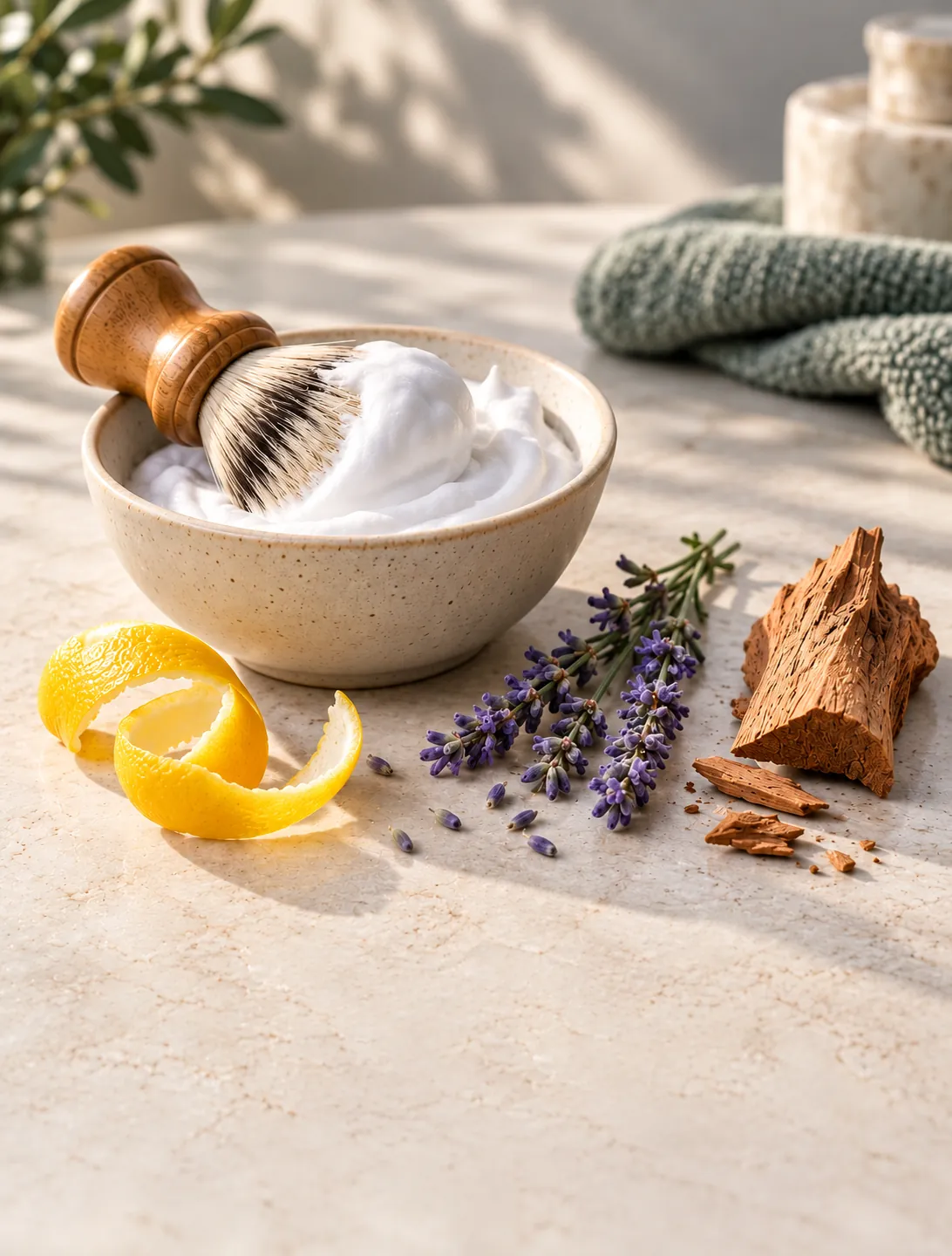
Open a tub of shaving soap and sniff it, and you smell one thing. Lather it with a brush and hot water, and you smell another, broader one. Run a hand over your freshly rinsed face ten minutes later, and you find a third, softer still. This is not your imagination: a scent changes over time, and a shave lets you watch it happen in a few minutes.
The usual way to describe this is the pyramid: top, heart and base notes. It is a useful model, as long as we know what lies beneath it.
What lies beneath the pyramid
A fragrance is a blend of molecules that evaporate at different speeds. Luca Turin, biophysicist and perfume critic, offers a rough rule: every extra carbon atom in a molecule roughly doubles how long it stays on the skin. Between the smallest and the largest molecules used in perfumery, he writes, the range runs from about five minutes to about two weeks.
The pyramid is, in effect, that scale seen from above.
- Top notes. The lightest, most volatile molecules: citrus such as bergamot and lemon, green and aromatic notes, and the esters that give fresh fruit its smell and that, Turin reminds us, last only minutes. First to arrive, first to leave.
- Heart notes. The character of the composition: lavender, geranium, flowers, herbs and spices. They carry the middle of the shave.
- Base notes. The heaviest molecules: woods, resins, musks, vanilla. Some act as fixatives, slowing the evaporation of the rest and lingering longest.
The scale does not always line up with the families, though. Turin observes that woody notes, despite often having the fresh character we associate with top notes, are large molecules that persist well into the drydown. So the pyramid is best read as a tendency, not as three separate floors.
Why a soap compresses everything
Sprayed on skin, a fragrance unfolds over hours. In a shaving soap it unfolds in ten or fifteen minutes, and under unusual conditions.
In the tub, the scent molecules are held within the mass of the soap, which is why it often seems muted when dry. With hot water and the movement of the brush, the soap dissolves, the lather fills with air and the surface from which the scent can evaporate multiplies; heat does the rest. That is the moment the bathroom fills with fragrance. (We will cover the chemistry of soap in a separate article.)
Then comes the rinse, which carries away almost all the lather. Of the base notes, in most cases, only a trace remains on the skin and in the brush. The rest of the story, if you want it, is told by the aftershave.
Heat speeds everything up
In their guide to perfumes, Turin and Tania Sanchez note that rubbing a fragrance hard into the skin warms it and makes it evaporate before its time: the top notes are lost. Skin temperature, too, changes how fast a scent evaporates.
The same principle applies to lather. With very hot water the scent bursts out at once, but the most volatile notes, citrus above all, leave sooner and the heart and base emerge earlier. With warm but not scalding water the sequence is slower and easier to follow. There is no right temperature, only the one that lets you smell what you are looking for.
Listening to a soap in four moments
Turin and Sanchez point out that nothing can be smelled without disappearing: what you smell is what is evaporating. That makes attention worthwhile. A simple way is to smell the soap at four moments:
- From the tub, dry. A preview, often tilted towards the lighter notes.
- While lathering. The top at its fullest: this is where citrus and fresh notes are strongest.
- Between passes. The heart and character come through: the lavender of a fougère, flowers, herbs.
- On rinsed skin and in the brush. What is left of the base: wood, musk, a sweet note.
A classic example is the fougère, the family behind so much masculine perfumery. Turin describes it as an accord of lavender and coumarin: lavender fresh and aromatic, coumarin sweet, powdery, like a vanilla biscuit. On one side it can be enriched with citrus and herbs, on the other with balsamic and vanilla notes. Shaving with a soap of this kind, you can often feel exactly that shift, from fresh to soft.
Noting these impressions down, without scores, is a good exercise: you discover that the same soap changes with the water, with the season, with the patience of your lathering.
The time of a scent, the time of a shave
The fragrance pyramid is a picture of time. In a shaving soap, that time coincides with the shave itself: fresh notes at the start, the heart’s character during the passes, the base that stays when everything is done. Slow down a little and you will notice it. For the lathering itself, in a bowl or on the face, see “The Art of Lathering Shaving Soap“.
Shaving soap scents: common questions
What are top, heart and base notes?
Why does a soap smell different in the tub and in the lather?
Does water temperature change the scent?
Sources and further reading
- Luca Turin and Tania Sanchez, Perfumes: The A–Z Guide, 2008 (paperback 2010), introduction, “Chemistry and Art: A Brief History of Perfume”, answers to frequently asked questions and the chapter on masculine fragrance (Library B025).
- Shaveslow Glossary, entries “Top, heart and base notes” and “Fixative”.


 English
 Français
 Italiano